 Warble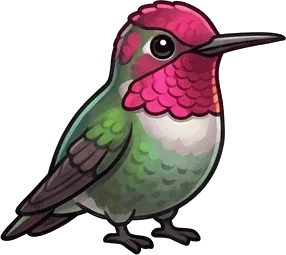
An Anna's Hummingbird sounds scratchy. The male sits on an exposed twig and sings a thin, squeaky, buzzing song that can run longer than ten seconds, closer to a tiny bird clearing its throat than to a melody, and it is one of the few hummingbirds in the United States that really sings. The common call is a sharp chip, and a fast chee-chee-chee-chee comes out in chases. The strangest sound is the courtship dive: the male climbs about 130 feet, drops toward a female and makes a loud, explosive squeak at the bottom with his tail feathers.
What the song sounds like
Most hummingbirds only chip and buzz. Anna's is more vocal than the rest, and the male has a true song: a thin, squeaky run of notes broken up by buzzes and chirps, stretched out to more than ten seconds. It is scratchy and metallic rather than sweet, and the first time you trace it to its source you may not believe something that small is making that much noise. He sings from a perch, often a bare twig or a wire where he can watch his flowers and feeder, and he repeats it over and over.
Because Anna's can begin nesting in December, the song is part of the winter soundscape in California gardens, when almost nothing else is singing. It is also a territorial signal, which is why a male will deliver it at a rival, at a feeder and sometimes at you.
The call: chips and chases
The everyday note is a sharp chip, given from a perch or while feeding. When a male chases another hummingbird off his territory the chips run together into a rapid chee-chee-chee-chee-chee, over the hum of wings beating 22 to 72 times a second. Anna's are strictly territorial and dive at almost anything that enters their space, so a yard with one male in it is rarely quiet.
When and where you hear it
This was once a bird of the Pacific coast of California and Baja California. Since the 1950s it has pushed north and east, reaching Oregon, Washington and British Columbia in the 1960s and 1970s, and it now nests north to British Columbia and east to Arizona. Suburban gardens, feeders and planted non-native flowers such as eucalyptus seem to have made the expansion possible. It lives in gardens, city parks, chaparral, coastal sage scrub and open woods, mostly in the lowlands.
Most Anna's are year-round residents, which is unusual for a North American hummingbird. The exception is a shuffle in the Southwest: birds that nest in Arizona in spring move west to California for the summer and return in late summer. Nesting runs from mid-December to June depending on place and weather, and on cold nights the bird drops its body temperature and goes into torpor. In California, Oregon, Washington and Arizona this is the hummingbird card Warble players catch most, usually from the scratchy song rather than the hum of wings.
It feeds on nectar, tree sap, sugar water and small insects, hovering at a flower with its bill and tongue pushed deep inside, snatching gnats in midair or picking insects and spiders out of webs.
The dive and its squeak
The courtship display starts with the male hovering in front of a perched female while giving his buzzy song. Then he climbs, to roughly 130 feet, and drops almost straight down toward her, pulling out right over her head. At the bottom comes a loud, explosive pop or squeak. Research has shown the sound is made by air rushing over the spread tail feathers, not by the voice. The bird averages about 27 meters per second on the way down and is still doing about 51 miles per hour at the bottom. Because Anna's start courting in winter, you can hear the squeak on a sunny January afternoon.
What it looks like
A stocky hummingbird about 4 inches long with a 4.7 inch wingspan, weighing one to two tenths of an ounce. The adult male has an iridescent rose-red throat and crown; he is the only North American hummingbird with a red crown, though in poor light the whole head can look black or gold. The female is green above and dingy gray below, often with a few red spots on the throat. Anna's tends to hold its tail still while hovering. The name honors Anne d'Essling, wife of the French ornithologist François Victor Masséna, Duke of Rivoli, and the bird is the official city bird of Vancouver, British Columbia and Sedona, Arizona.
Birds that sound similar
- ?Costa's Hummingbird
The Costa's male gives a shrill, high whistle during his dive and the same whistle from a perch, a clean tone against Anna's scratchy buzz. Costa's also prefers deserts, washes and sage scrub.
- ?Black-chinned Hummingbird
A Black-chinned has no song, just a low tup, and its display is a back-and-forth U-shaped swing with a whirring at each dip rather than a tall dive with a squeak.
- ?Rufous Hummingbird
A migrating Rufous gives an abrupt, high zeee and thin squeals, and its dive ends in whining and popping. It does not sing a long perched song.
Where the Anna's Hummingbird card lives
In Warble the same bird can be an easy card in one state and a prized one in another, because each album ranks its birds by how often people really report them there. The Anna's Hummingbird appears in 5 state albums:
 Heard one? Open Warble, tap the green button while it sings, and the Anna's Hummingbird card flips into your album. Get the app free.
Questions people ask
Do Anna's Hummingbirds sing?
Yes, and that sets them apart. The male sings a thin, scratchy, squeaky song mixed with buzzes and chirps that can last more than ten seconds, usually from an exposed perch. Most other hummingbirds in the United States only chip and buzz.
What makes the squeak at the bottom of a hummingbird's dive?
In Anna's Hummingbird it is the tail. The male dives from about 130 feet and spreads his tail feathers at the bottom, and air rushing over them produces a loud, explosive squeak or pop. It is a mechanical sound, not a vocal one.
Why is there a hummingbird singing in my yard in December?
Because Anna's Hummingbirds stay all year and can start nesting as early as mid-December. Males sing and dive through the winter to hold territory and attract females, especially where gardens and feeders keep food available.
How fast does an Anna's Hummingbird dive?
Fast for its size. Measurements put the average dive speed around 27 meters per second, with the bird still doing about 51 miles per hour at the bottom, roughly 385 body lengths per second.
Sources
- National Audubon Society, Guide to North American Birds: Anna's Hummingbird. www.audubon.org/field-guide/bird/annas-hummingbird
- Wikipedia: Anna's hummingbird (song, dive mechanics and speed, range expansion, name, city bird status). en.wikipedia.org/wiki/Anna%27s_hummingbird
- Animal Diversity Web: Calypte anna. animaldiversity.org/accounts/Calypte_anna/
- National Audubon Society, Guide to North American Birds: Costa's Hummingbird. www.audubon.org/field-guide/bird/costas-hummingbird