 Warble


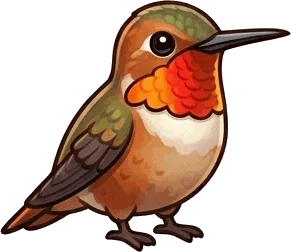
A Rufous Hummingbird does not sing, but it is rarely quiet. Adult males make a high, metallic whine with their wings in direct flight, a bit like a cicada. The call is a hard, ticking ch-tik, and when one bird chases another off a feeder or a flower patch, the air fills with squeaky buzzes and chippering. In courtship, the male dives and pulls out with a stuttering burst of sound. Listen in the West from late winter through summer, and at winter feeders along the Gulf Coast.
What it sounds like: wings instead of a song
Rufous Hummingbirds do not sing. What they have instead is a wing sound. Adult males make a metallic whine as they fly, similar to a cicada, and it is often the first thing that tells you one has arrived. The buzz comes only in direct flight, not while the bird hovers, so a male feeding at a flower is much quieter than one zipping across the yard.
The male's courtship display adds the loudest sound of all. He climbs high and dives steeply, and at the bottom of the dive pulls out with a loud whine, popping notes and a stuttering ch-ch-ch-ch-chi. That stutter is diagnostic for the species. Between dives he may buzz back and forth in front of a perched female. Young males go through the same motions without the sound effects, and dives happen on migration too.
The calls: ticks, chips and squeaky buzzes
The everyday call is a fairly hard, ticking or clicking note, ch-tik or ch-ti-tik, and warning chips go up whenever something threatens. The alarm call is a slightly squeaky buzz, written tssiur or tsirr, and run-ins with other hummingbirds bring on squeaky chippering. Listen also for an abrupt, high-pitched zeee and assorted thin, squealing notes.
When and where you hear it
The Rufous Hummingbird nests farther north than any other hummingbird, up to south-central Alaska, and south through British Columbia and the Pacific Northwest, in forest edges and clearings, brushy second growth, mountain meadows and streamsides. Measured in body lengths, its migration is the longest of any known bird.
The route is a loop. In early spring birds move northwest through the Pacific lowlands, reaching the Washington coast from late February to early March, just as red flowering currant and salmonberry bloom. From late June they head back southeast, mostly through the Rocky Mountains, where they work meadows of penstemon, columbine and paintbrush in late summer. Adult males leave first, moving up to higher elevations in June and July before heading south, and most females and young leave Washington in August. Most winter in Mexico. This is also the western hummingbird most likely to wander east, and many now winter in the Gulf Coast states.
The female builds a tiny cup of moss and plant down bound with spider silk and covered with lichen, often right on top of last year's nest. She lays two eggs, incubates them for 15 to 17 days and raises the young alone; a male may mate with several females. Numbers have fallen in recent decades, though the species is still common, with an estimated 22 million birds. For Warble players in the Northwest, spring feeders are the place to catch this card.
The buzzing chases
Rufous Hummingbirds are famously pugnacious. A male will claim a patch of flowers in a mountain meadow and chase off every intruder, larger birds included, and both breeding birds and migrants defend feeding territories. A chase sounds like a zipper yanked back and forth: the metallic wing whine, the squeaky buzz and a spray of chips.
What it looks like
A tiny, compact hummingbird weighing a tenth to a fifth of an ounce. The adult male is the only North American hummingbird with a rufous back: coppery orange above and on the sides, with a white chest and a throat that flashes orange-red in good light, though a few males have green backs. Females and young are green above with a spotted throat, often a small red central spot, and orange-buff on the sides and at the base of the tail.
Birds that sound similar
- ?Allen's Hummingbird
Looks and sounds nearly the same, and females and young are rarely separable in the field, so many sightings are logged as rufous/Allen's. The male Rufous's stuttering ch-ch-ch-ch-chi at the bottom of his dive is diagnostic, so a displaying adult male is your best chance.
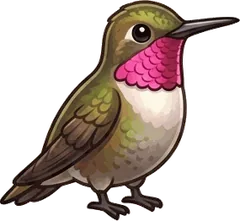 Broad-tailed Hummingbird
The adult male Broad-tailed's wings make a cricket-like, metallic trill rather than a whine, and its chips are slightly higher pitched than a Rufous's. Both work western mountain meadows in late summer.
Where the Rufous Hummingbird card lives
In Warble the same bird can be an easy card in one state and a prized one in another, because each album ranks its birds by how often people really report them there. The Rufous Hummingbird appears in 4 state albums:
 Heard one? Open Warble, tap the green button while it sings, and the Rufous Hummingbird card flips into your album. Get the app free.
Questions people ask
Are Rufous Hummingbirds aggressive?
Very. Males defend flower patches and chase away every intruder, including larger birds, and migrants defend feeding spots along their route. The chases come with a metallic wing whine, squeaky buzzes and chips.
Do Rufous Hummingbirds sing?
No. They give warning chips, a hard ch-tik call and squeaky buzzes during fights, and adult males have a metallic wing whine. The loudest sound is the stuttering whine at the bottom of the male's courtship dive.
When do Rufous Hummingbirds arrive and leave?
On the Washington coast they arrive from late February to early March. Males start south in June and July, and most females and young leave the Northwest in August, heading back through the Rockies.
Why is there a Rufous Hummingbird at my feeder in winter?
It is a wanderer. Rufous is the western hummingbird found most often in the East, and many now spend the winter in the Gulf Coast states, so a winter hummingbird at a southern feeder may well be this one.
Sources
- National Audubon Society, Guide to North American Birds: Rufous Hummingbird. www.audubon.org/field-guide/bird/rufous-hummingbird
- National Geographic: Rufous Hummingbird (calls, wing buzz, dive sound). www.nationalgeographic.com/animals/birds/facts/rufous-hummingbird
- Seattle Audubon BirdWeb: Rufous Hummingbird. www.birdweb.org/birdweb/bird/rufous_hummingbird
- Montana Field Guide: Rufous Hummingbird. fieldguide.mt.gov/speciesDetail.aspx?elcode=ABNUC51020
- National Geographic: Broad-tailed Hummingbird (wing trill, calls). www.nationalgeographic.com/animals/birds/facts/broad-tailed-hummingbird