 Warble


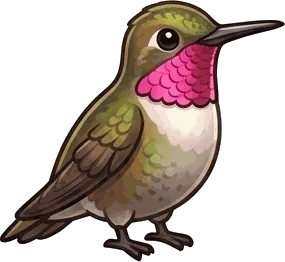
A Broad-tailed Hummingbird sounds like a cricket that learned to fly. The adult male's wings make a loud, metallic trill, a high buzzing whistle you hear as he zips past, often before you see him. That trill is the signature sound of summer in western mountain meadows. The call is a sharp, slightly metallic chip, often doubled as chi-tik. Listen from April through August in open pine, aspen and spruce forest near streams, up to 10,000 feet and higher.
What it sounds like: a cricket in the air
Broad-tailed Hummingbirds have no real song. The sound that defines them comes from the male's wings: a metallic, cricket-like trill that rings out as he flies. Field guides call it diagnostic, and in the mountain West it is often the only sign of a hummingbird that zings past unseen.
Courtship turns the trill up. The male climbs as high as 60 feet, then dives with a loud wing trill, climbs again and repeats. Males also perch high over their territory, watch for intruders and chase them off. A female mates with one of the many assertive males around her, there is no pair bond, and she builds the nest and raises the young alone.
The call: a sharp, metallic chip
The usual call is a sharp, slightly metallic chip or chik, often doubled into ch-chip or chi-tik and sometimes repeated steadily from a perch. Others write it as cheet, given in a series. When a Broad-tailed is warning off another bird it adds an abrupt, clipped buzz and squeaky chippering. Its voice runs a little higher than that of Rufous and Allen's Hummingbirds, a useful clue at a busy feeder.
When and where you hear it
Broad-tailed Hummingbirds breed from central Montana south through the Rocky Mountains and the Southwest to Mexico and Guatemala, mostly in the mountains, up to more than 10,000 feet. Look for them in fairly open forest near streams, such as pine-oak, pinyon-juniper, spruce, Douglas-fir and aspen, with flowery meadows nearby. They drink nectar from red, tubular flowers, catch tiny insects and visit sugar-water feeders, and they often fight over the best patches of flowers.
They migrate early. Many start north in early March, following the lowlands, and adults reach Rocky Mountain National Park in Colorado in April, where the breeding season lasts about two months. Adult males travel ahead of females and young in both directions. Once the young leave the nest, adults move upslope to treeline and alpine meadows where flowers are still blooming. The southbound trip follows the mountains and starts in early August, and young birds leave for Mexico in September. Most winter in Mexico, and more are turning up in the Southeast in late fall and winter.
The nest is a cup about 2 inches across, made of plant down, hair and feathers bound with spider silk and caterpillar silk, covered outside with lichen and bark until it nearly disappears, and set on a horizontal branch of aspen, cottonwood, willow or a conifer, usually along a stream. About 70 percent of females return to the same nest site the next year. The female lays two white eggs and incubates them for 16 to 19 days, and the young first fly at about three weeks. One survey found a 52 percent decline between 1966 and 2015, though the species is still common. In the Rockies, a July morning in a mountain meadow is the best time for Warble players to catch this card.
The wing trill: a whistle made of feathers
The trill is mechanical, not vocal. In adult males, air rushing through the ninth and tenth primary feathers of each wing produces a buzzing, metallic whistle. Both sexes also make a lower wing hum in flight, somewhere around 35 to 100 hertz, which they use to communicate, but the high trill is the male's.
It carries. Other males can hear it about 50 meters away, roughly 165 feet, and females about 75 meters, roughly 245 feet. It also does real work: in one experiment, males without their wing trill lost territories more easily to aggressive rivals. So the ringing sound of a male crossing a meadow is a no-trespassing sign he carries on his wings.
What it looks like
About 3.5 to 4 inches long, with a broad, rounded tail that reaches past the wingtips and gives the bird its name. Both sexes are bright green on the back and have a pale eye ring. The adult male has a rose-red throat, a pale chin and green sides. The female is a little larger, with a whitish, green-flecked throat and cinnamon-washed sides and underparts.
Birds that sound similar
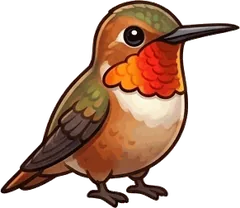 Rufous Hummingbird
Female and young Rufous Hummingbirds look much alike but are slimmer, with more tapered tails and no eye ring. Their chips are slightly lower pitched, and a cricket-like wing trill means a male Broad-tailed: it is diagnostic.
- ?Black-chinned Hummingbird
Its call is a low tup, not a sharp, metallic chip, and the male's courtship dives come with whirring sounds rather than a ringing trill. It favors lowland streamsides, towns and canyon oaks; the Broad-tailed mostly breeds in the mountains.
Where the Broad-tailed Hummingbird card lives
In Warble the same bird can be an easy card in one state and a prized one in another, because each album ranks its birds by how often people really report them there. The Broad-tailed Hummingbird appears in 5 state albums:
 Heard one? Open Warble, tap the green button while it sings, and the Broad-tailed Hummingbird card flips into your album. Get the app free.
Questions people ask
What is the trilling sound hummingbirds make in the mountains?
Usually a male Broad-tailed Hummingbird. Air rushing through two feathers in each wing makes a loud, metallic, cricket-like trill as he flies, often before you see him. It is the signature sound of summer in western mountain meadows.
Do female Broad-tailed Hummingbirds trill?
No. The loud trill comes from adult males. Both sexes make a lower wing hum in flight, and both give sharp, metallic chip calls.
Why do Broad-tailed Hummingbirds dive?
It is courtship. The male climbs as high as 60 feet and dives with a loud wing trill, then climbs and dives again. Males also rely on the trill to hold their territories.
When do Broad-tailed Hummingbirds leave?
Southbound migration starts in early August, with adult males leaving before females and young. In Rocky Mountain National Park the young birds head for Mexico in September.
Sources
- National Audubon Society, Guide to North American Birds: Broad-tailed Hummingbird. www.audubon.org/field-guide/bird/broad-tailed-hummingbird
- National Geographic: Broad-tailed Hummingbird (wing trill, calls, identification). www.nationalgeographic.com/animals/birds/facts/broad-tailed-hummingbird
- Wikipedia: Broad-tailed hummingbird (wing trill, range, breeding). en.wikipedia.org/wiki/Broad-tailed_hummingbird
- National Park Service, Rocky Mountain National Park: What's Humming in the Park. www.nps.gov/romo/whats_humming.htm
- National Audubon Society, Guide to North American Birds: Black-chinned Hummingbird. www.audubon.org/field-guide/bird/black-chinned-hummingbird