 Warble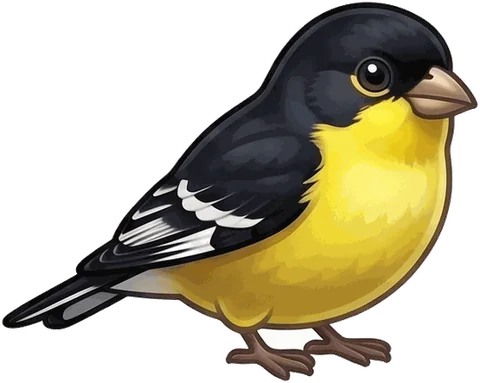
A Lesser Goldfinch sounds like a tiny bird talking too fast: a long, rapid medley of twitters, trills and warbled phrases that runs on for many seconds, with short imitations of other birds mixed in. The everyday call is a thin, high, drawn-out whistle that either rises, tee-yee?, or falls, tee-yoo, and sounds a little sad. In flight it gives a harsh chig chig chig. Compared with the American Goldfinch, the song is more broken into phrases and the calls are wheezier, and the bird itself is smaller.
What the song sounds like
The song is a prolonged twitter or warble that keeps changing: sweet notes, dry trills, a few squeaks, then a run of fast chatter, with hardly a pause. One analyzed song held 54 separate notes in just over 16 seconds, which gives you a sense of the pace. It has more shape than an American Goldfinch song, with distinct phrases rather than a steady stream, and it often runs much longer.
The surprise is the mimicry. Males slip short imitations of other birds into the medley, so a Lesser Goldfinch in a California garden may briefly sound like several of its neighbors in a row before the goldfinch twitter takes over again. Listen for that constant switching, and for the fact that each borrowed phrase is cut short rather than finished.
Males sing from an exposed perch, a treetop or a wire, and they sing in every month, not just in spring, because the song also announces a feeding territory. In the breeding season there is a courtship chase too, a fast flight led by the female with the male a couple of yards behind.
The call: a plaintive whistle
The call you hear most is a very high, drawn-out whistle, often sliding from one steady pitch to another. It can rise, written tee-yee? or teeeyeee, as if the bird were asking a question, or fall, cheeo or teeeyooo. It has a plaintive, slightly wheezy quality that is the quickest way to pick a Lesser Goldfinch out of a mixed finch flock.
Flying birds give a harsher chig chig chig, and the alarm is a short sequence that builds in intensity, roughly dee-ree, bay-bee, bee-ee. Males courting a female use a soft tee-yer. Small flocks of four to six birds keep up a steady conversation of these notes as they move between weed patches, which is often how you notice them before you see any yellow.
When and where you hear it
This is a bird of the Southwest and the Pacific slope: year-round across California, Arizona, New Mexico and much of Texas, and north along the coast to the Columbia River in Washington. Inland birds in Colorado, Utah, Nevada, Idaho, Oregon and Wyoming are mostly summer visitors. It has spread quickly through the Pacific Northwest in recent decades, and strays occasionally turn up farther east.
It likes semi-open country with scattered trees next to weedy ground: brushy hillsides, open oak woods, streamside cottonwoods, farm edges, parks and suburban gardens, from low valleys up to about 2,100 meters in the mountains. In dry country it stays close to water. It comes readily to feeders stocked with thistle (nyjer) seed and joins flocks of American Goldfinches, usually as the one doing the chasing.
The diet is mostly seeds, especially from the daisy family, thistle and sunflower above all, plus buds, flowers, some berries and, in summer, aphids. Nesting runs from April into September, with two or three broods a year. The female builds a compact cup 5 to 30 feet up, lays four or five pale blue-green eggs and incubates for about 12 days while the male brings her food. For Warble players in the Southwest, the whistle is one of the easier backyard catches once you know it.
What it looks like
Very small, 3.5 to 4.3 inches long and 8 to 11 grams, a candidate for the smallest true finch in the world. Males are bright yellow below with a black cap and white patches in the wings and tail. The back color depends on where you are: from Colorado to Texas most males are black-backed, while birds in California and the rest of the West are green-backed. Females and young birds are olive above and yellowish below with a dark gray bill and narrow pale wing bars. Their undertail coverts are yellow, which separates them from female American Goldfinches.
Birds that sound similar
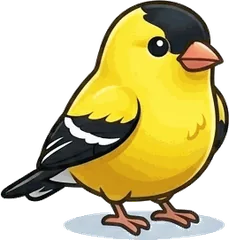 American Goldfinch
The American Goldfinch has a bouncy per-chick-o-ree or potato-chip flight call and a smoother twitter. The Lesser gives thinner, wheezier whistles, and its song breaks into phrases with imitations mixed in.
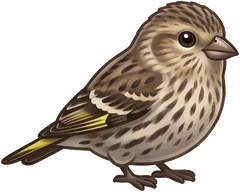 Pine Siskin
A Pine Siskin sings like a hoarse goldfinch and gives a distinctive rising bzzzzzt. If the twitter is buzzy and streaky brown birds are involved, think siskin.
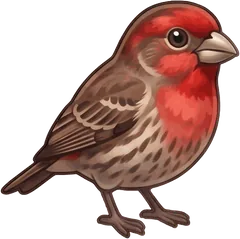 House Finch
The House Finch's long warble ends in a zeee and its call is a sparrow-like chirp. It is a bigger, slower song without the Lesser's high plaintive whistles.
Where the Lesser Goldfinch card lives
In Warble the same bird can be an easy card in one state and a prized one in another, because each album ranks its birds by how often people really report them there. The Lesser Goldfinch appears in 9 state albums:
 Heard one? Open Warble, tap the green button while it sings, and the Lesser Goldfinch card flips into your album. Get the app free.
Questions people ask
How do I tell a Lesser Goldfinch from an American Goldfinch by sound?
Listen for the call. The American Goldfinch gives a cheerful potato-chip in flight; the Lesser gives a thin, drawn-out whistle that rises or falls, tee-yee? or tee-yoo, plus a harsh chig chig. The Lesser song is also longer and more broken into phrases.
Do Lesser Goldfinches imitate other birds?
Yes. Males work short imitations of other species into their long twittering songs, which is one reason the song sounds so varied. The borrowed bits are brief and quickly give way to goldfinch twitter.
Do Lesser Goldfinches sing all year?
Males sing from perches year-round, not only in spring, because the song also marks a feeding territory. Singing and chasing pick up during the April to September breeding season.
Why are some Lesser Goldfinches black-backed and others green-backed?
It is regional. Males from Colorado to Texas are mostly black-backed, while males farther west, including California, have green backs. Both have a black cap, yellow underparts and white in the wings.
Sources
- National Audubon Society, Guide to North American Birds: Lesser Goldfinch. www.audubon.org/field-guide/bird/lesser-goldfinch
- Wikipedia: Lesser goldfinch (measurements, plumage forms, vocalizations, range). en.wikipedia.org/wiki/Lesser_goldfinch
- Animal Diversity Web: Spinus psaltria. animaldiversity.org/accounts/Spinus_psaltria/
- National Audubon Society, Guide to North American Birds: American Goldfinch. www.audubon.org/field-guide/bird/american-goldfinch