 Warble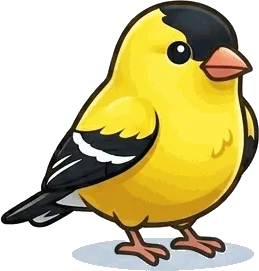
An American Goldfinch sounds like a cheerful, bouncing po-ta-to-chip passing overhead: a bright four-note call, also written per-chick-o-ree, given in flight and timed to each dip of the bird's roller-coaster flight path. Perched, the male sings a long, rambling jumble of sweet warbles, twitters and whistles, often with one drawn-out note in it, and a rising sueweeet call. You hear the flight call all year over weedy fields, roadsides and yards.
The birder's mnemonic
“po-ta-to-chip” The four syllables come out with each bound of the flight, so listen for the rhythm as the bird rises and dips.
What the song sounds like
The song is a long, unhurried run of musical warbles, twitters and thin whistles, without a fixed pattern, and often with one long note held in the middle of the jumble. A male may sing it from a perch or deliver it in a fluttering courtship flight over a field. It is sweet and light rather than loud, and it rarely stands out in a spring chorus; the flight call is what most people learn first.
Goldfinches nest later than any other finch, mostly in July and August, and the male sings through courtship, so in midsummer, when many other birds have gone quiet, the goldfinch is often still in full voice.
The flight call: po-ta-to-chip
The signature sound is the flight call, a bright per-chick-o-ree or ti-di-di-di that birders hear as po-ta-to-chip. It is given as the bird flies, and it lines up with the deeply undulating flight: a burst of wingbeats lifts the bird, then it folds its wings and drops, and the call rides along on that rhythm. Once you have matched sound to bounce you will notice goldfinches passing over almost anywhere. A drawn-out sueweeet is the other call you will hear.
Outside the breeding season goldfinches travel in flocks, so the flight call usually comes in overlapping bunches. In winter the flocks often mix with Pine Siskins, whose buzzy rising bzzzzzt is the giveaway inside the twittering.
When and where you hear it
Goldfinches breed from coast to coast across the northern and central United States and southern Canada, north to Saskatchewan and south to about North Carolina and northern California. They like open weedy ground with some trees and bushes nearby: roadsides, streamsides, woodland edges, orchards, overgrown fields and suburbs. In winter they use even more open fields farther from trees.
Migration is irregular and depends on food. When lows approach freezing, and especially when they drop toward zero Fahrenheit, birds move south; in a winter with a good seed crop many stay in the North. Movement peaks in mid-fall and early spring and happens by day. Missouri, for instance, lists the goldfinch as a common permanent resident, though the birds at the feeder in January are not necessarily the ones that nested in the hedge in August.
They are among the strictest vegetarians in the bird world, living on seeds of the daisy family, thistles, weeds and grasses, plus small tree seeds like elm, birch and alder, with buds and maple sap on the side. At feeders they want nyjer and sunflower. In Iowa, New Jersey and Washington the goldfinch is the state bird, and in all three the Warble card is an easy one.
Why it nests in August
Most goldfinch nesting happens in July and August, timed so that the young hatch just as thistles and other late-summer plants set seed. The female weaves a tight cup in a shrub or small tree, usually under 30 feet up, lined with thistle and milkweed down, and builds it so well it can hold water. She lays four to six pale bluish eggs and incubates them for twelve to fourteen days while the male brings her food; the young fledge at eleven to seventeen days.
The seed diet has a side benefit. When a Brown-headed Cowbird slips an egg into a goldfinch nest, the cowbird chick usually dies, because it cannot grow on the seed mash that goldfinch parents feed their young.
What it looks like
A small finch, four to five inches long, with a short conical bill that is pink most of the year and turns bright orange in spring. The summer male is brilliant lemon yellow with black wings, a black tail, a black cap on the forehead and a white rump. The summer female is a duller olive-yellow with dark wings. After the fall molt both sexes turn drab, yellowish-brown to gray, with two bold pale wing bars on black wings and white spots in the tail; males keep a yellow patch on the shoulder. The result is that many people think their goldfinches leave in fall, when in fact they have simply changed clothes.
Birds that sound similar
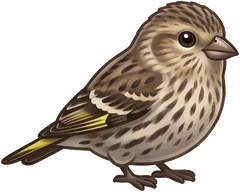 Pine Siskin
The Pine Siskin sings like a hoarse goldfinch and flocks with goldfinches in winter, but its call is a distinctive rising, buzzy bzzzzzt. Goldfinch calls are clean and sweet with no buzz.
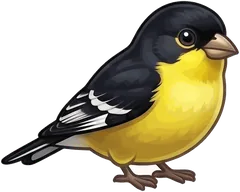 Lesser Goldfinch
In the West the Lesser Goldfinch has a similar rapid twittering song, but it works short imitations of other birds into it, and its calls are plaintive, questioning tee-yee? and cheeo? notes rather than po-ta-to-chip.
Where the American Goldfinch card lives
In Warble the same bird can be an easy card in one state and a prized one in another, because each album ranks its birds by how often people really report them there. The American Goldfinch appears in 46 state albums:
 Heard one? Open Warble, tap the green button while it sings, and the American Goldfinch card flips into your album. Get the app free.
Questions people ask
What bird says potato chip?
The American Goldfinch. Its flight call, written per-chick-o-ree or ti-di-di-di, is heard by most people as po-ta-to-chip, and it is given in rhythm with the bird's bounding flight.
Why do goldfinches nest so late in the summer?
To match the seed crop. Goldfinches feed their young almost entirely on seeds, so most nesting happens in July and August, when thistles and other late-summer plants are ripening. That makes them the latest nesting finch in North America.
Where do goldfinches go in winter?
Often nowhere far. Many stay in the North when seeds are plentiful, and others move south as temperatures drop toward freezing. The bigger change is in color: both sexes molt into drab brownish-gray plumage in fall, so the bright yellow birds seem to vanish.
Which states have the goldfinch as state bird?
Iowa (adopted in 1933, as the Eastern Goldfinch), New Jersey (1935, also as the Eastern Goldfinch) and Washington (1951, as the Willow Goldfinch). All three names refer to the same species.
Sources
- National Audubon Society, Guide to North American Birds: American Goldfinch. www.audubon.org/field-guide/bird/american-goldfinch
- Wikipedia: American goldfinch (calls, molt, migration, cowbirds, state bird status). en.wikipedia.org/wiki/American_goldfinch
- Missouri Department of Conservation, Field Guide: American Goldfinch. mdc.mo.gov/discover-nature/field-guide/american-goldfinch
- Wikipedia: List of U.S. state birds. en.wikipedia.org/wiki/List_of_U.S._state_birds