 Warble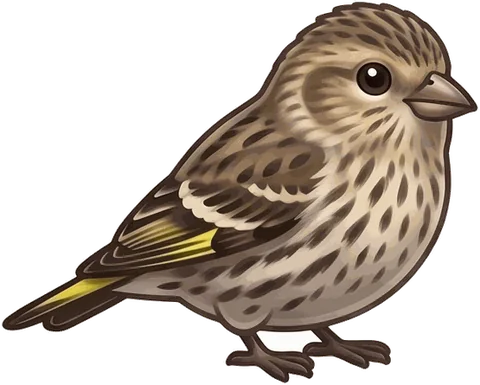
A Pine Siskin sounds like a goldfinch with a sore throat. The flock keeps up a constant husky twittering, and out of it comes the one note to learn: a long, buzzy, rising zreeeeee that climbs like a zipper being pulled. The song is a wheezy jumble of trills and quick warbles with those buzzy notes stitched in. The flight call is a quick tee-u, quite different from a goldfinch's per-chick-o-ree.
What the song sounds like
The song is a fast, rambling mix of trills, twitters and rapid warbles, delivered from a treetop or in flight, and it never quite clears its throat. Audubon sums it up as the song of a hoarse goldfinch, and an older description quoted by Eastside Audubon calls it decidedly wheezy. Woven through it are the buzzy, rising notes that no goldfinch makes. Siskins also work bits of other birds' calls into the song, a habit that researchers with the Finch Research Network are still studying.
You will more often hear the flock than a single singer. A dozen siskins in a birch or on a thistle patch produce a continuous, restless chatter that rises and falls as birds shift position, and the rising zreeee punctuates it every few seconds. If a feeder full of small streaky finches sounds like an argument that never ends, you probably have siskins.
The call: a buzzy zipper
The signature call is the grating zree-e-e-e-eet with a rising inflection, given from a perch or in flight. It lasts about a second and sounds mechanical, a tiny zipper or a wind-up toy starting. The flight call is different: a quick tee-u that the Finch Research Network notes is distinct from anything a goldfinch or a redpoll says. Learn both, because in an irruption winter siskins fly over in twittering flocks all day, and most of them never land where you can see the yellow in the wing.
When and where you hear it
Pine Siskins breed in coniferous and mixed forest across Canada, Alaska and the mountains of the West, and they wander. Some winters they pour south in huge numbers, reaching the Gulf states and Florida; in other winters the same feeders see none. These irruptions follow the food supply in the northern forests, and after a big invasion year a few pairs sometimes stay to nest well south of the usual range.
In summer siskins are birds of spruce and pine, often in the higher country; in winter they drop to lowlands and semi-open places, weedy fields, alder thickets and suburban yards, where they descend on thistles and wild sunflowers and cling upside down to the dried heads. They travel by day in flocks and mix freely with goldfinches and redpolls. Seed feeders draw them in, and an irruption winter is the season to catch the card in Warble anywhere south of the northern forest. They are unusually prone to salmonella, so clean feeders matter more for this species than for most.
For a bird so small they are tough: a metabolic rate about 40 percent higher than a typical songbird, extra winter fat, and a crop that can hold a tenth of the bird's weight in seed to burn overnight. Surveys estimate roughly 46 million siskins, with a slow decline since the 1960s that is hard to measure because the flocks move so much.
What it looks like
Four and a half to five inches, smaller and slimmer than a House Finch, with a short notched tail and a slender, sharply pointed bill that is the first thing to check: sparrows and House Finches have thicker, blunter bills. The plumage is brown above and pale below, streaked all over, with edgings of yellow in the wings and at the base of the tail that show as a bright stripe when the bird flies. The amount of yellow varies a lot from bird to bird and is strongest in males, and about one siskin in a hundred is a greener morph. Males and females look nearly alike, which is why the sound matters.
Birds that sound similar
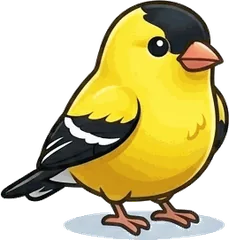 American Goldfinch
Goldfinch calls are clear and sweet, the bouncing per-chick-o-ree or potato-chips in flight, and the winter flock calls are musical and plaintive. The siskin is the hoarse version of the same sounds, and its rising buzzy zreeee has no goldfinch equivalent.
- ?Common Redpoll
Redpolls travel with siskins in irruption winters and share the restless twitter. Their song is a twittering trill and the call a soft rattle, drier and less buzzy than the siskin's; listen for the siskin's rising zreeee and quick tee-u to split the flock.
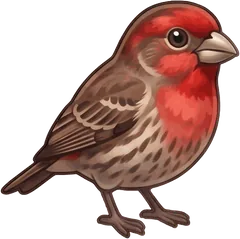 House Finch
A House Finch's warble is longer, looser and ends in a harsh rising zeee, which can pass for a siskin note, but its calls are cheerful sparrow-like chirps. The siskin is huskier throughout and gives the buzzy zipper call between phrases.
Where the Pine Siskin card lives
In Warble the same bird can be an easy card in one state and a prized one in another, because each album ranks its birds by how often people really report them there. The Pine Siskin appears in 20 state albums:
 Heard one? Open Warble, tap the green button while it sings, and the Pine Siskin card flips into your album. Get the app free.
Questions people ask
Why do Pine Siskins show up some winters and not others?
They are irruptive finches. When seed crops fail in the northern forests, siskins push south in large flocks in search of food; when the crop is good they stay north and southern feeders see none. The pattern is erratic and food-driven, and it makes their numbers hard to count.
What is the buzzy rising call at my feeder?
Very likely a Pine Siskin. Its most familiar sound is a grating zree-e-e-eet that climbs in pitch, like a zipper pulled quickly. Goldfinches and House Finches share the feeder and the twitter, but neither gives that rising buzz.
How do I tell a Pine Siskin from a goldfinch or a sparrow?
The bill and the wings. A siskin has a slender, sharply pointed bill, heavy streaking above and below, and yellow edges in the wings and tail that flash in flight. Streaky sparrows have thicker bills and no yellow, and goldfinches are unstreaked.
Are Pine Siskins safe at feeders?
Mostly, with care. Siskins appear to be unusually susceptible to salmonella among finches, so feeder hygiene matters when a flock settles in. Clean feeders regularly and rake up old seed and droppings underneath, especially during a big irruption winter when dozens crowd one spot.
Sources
- National Audubon Society, Guide to North American Birds: Pine Siskin. www.audubon.org/field-guide/bird/pine-siskin
- Wikipedia: Pine siskin (size, plumage, physiology, salmonella, population). en.wikipedia.org/wiki/Pine_siskin
- Finch Research Network: Pine Siskin (calls, flight call, mimicry). finchnetwork.org/species/siskins/pine-siskin
- Eastside Audubon Society: Pine Siskin (song, habits, feeders). www.eastsideaudubon.org/corvid-crier/2019/8/28/pine-siskin