 Warble
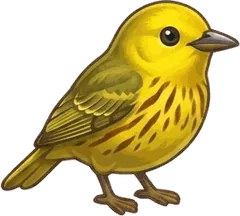
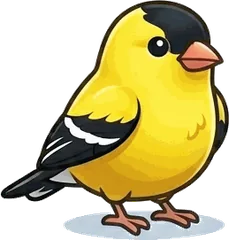
Listen for the shape of the sound. A Yellow Warbler sings one short, bright phrase of whistled notes that dips and then lifts at the end, the famous sweet-sweet-sweet, I'm so sweet, from willows and thickets near water. An American Goldfinch rambles instead: a long, patternless run of warbles, twitters and whistles, plus a bouncy per-chick-o-ree (potato chip) given in flight. If you can see the bird, look at the bill. A short, thick cone means goldfinch. A thin, straight bill, a plain yellow face and no black cap mean Yellow Warbler.
Side by side
| Yellow Warbler | American Goldfinch | |
|---|---|---|
| Song | A short, bright whistled phrase that drops, then rises: sweet-sweet-sweet, I'm so sweet | A long, rambling mix of warbles, whistles and twitters with no set pattern |
| Call | A single sharp, sweet chip | Per-chick-o-ree (potato chip) and sueweeet, often in flight |
| Bill | Narrow and straight | Short, thick and conical |
| Breeding male | Nearly all yellow, rusty-red breast streaks, plain face | Lemon yellow, black forehead, black wings with white bars |
| Tail spots | Yellow | White |
| Food | Insects from leaves; skips feeders | Seeds; a feeder regular |
| Where and when | Willows and thickets near water; spring and summer, many leaving in August | Weedy fields, roadsides, parks and yards; all year in places like Missouri |
By ear: a set phrase or a ramble
The Yellow Warbler's song is a phrase you can learn in one listen: a quick string of clear whistled notes that runs level, dips, and climbs back up at the finish. The Missouri Department of Conservation writes it seet-seet-seet-seet-su-ee and calls the birders' version, sweet-sweet-sweet, I'm so sweet, diagnostic. Audubon hears a bright, musical sweet-sweet-sweet, sweeter-than-sweet, a familiar sound in streamside willows. Males hold territory by singing, so the same tidy phrase keeps coming from the same bushes.
The goldfinch has no tidy phrase. Its song is a long, wandering mix of warbles, whistles and twitters, sweet but patternless, and a courting male may sing it in a fluttering display flight over a meadow. If it sounds like a bird chatting to itself rather than repeating a slogan, think goldfinch.
The calls split them even more cleanly. The goldfinch's best-known sound is per-chick-o-ree, which plenty of people hear as potato chips, given mostly in the air and timed to each rise and dip of its roller-coaster flight. Missouri adds a second flight call, sueweeet, and winter flocks keep up a plaintive chatter. The Yellow Warbler's call is a single sharp, sweet chip from among the leaves. A chip from a willow points to the warbler; four bouncing syllables from a bird passing overhead point to the goldfinch.
By sight: the bill, the black and the tail
Size will not help: both are about 5 inches long. The bill is the fastest mark, and both Missouri field guides single it out. A goldfinch has the short, thick, conical bill of a seed-eater. A Yellow Warbler's bill is narrow and straight, though fairly large for a warbler.
In summer the males are easy. A male goldfinch is bright yellow with a black forehead, black wings crossed by white bars, and a black tail. A male Yellow Warbler is yellow nearly everywhere, with no cap and no face markings, so the dark eye stands out; look for thin reddish streaks on his chest and yellow edges on the darker wing feathers. The tail settles it: the Yellow Warbler has yellow tail spots, where most warblers, and goldfinches, show white. Females of both are duller, the warbler an even yellow with only faint streaking, the goldfinch greenish yellow above with dark wings and tail.
Fall is harder, and Audubon itself suggests comparing very dull young female Yellow Warblers with goldfinches. By then goldfinches have molted into brownish to gray plumage, but they keep black wings with bold white or buff wing bars. Bold bars on black wings mean goldfinch; yellow-edged wings and yellow tail spots mean warbler.
Behavior helps too. A Yellow Warbler hops along small branches gleaning caterpillars and other insects, and Missouri notes that it does not visit feeders. A goldfinch clambers over thistles for seeds, travels in flocks outside the nesting season and comes readily to sunflower and nyjer.
Where you will meet each one
The Yellow Warbler wants wet, shrubby places. In the East that means woods and thickets along streams, lakes, swamps and marshes, especially willows and alders, plus orchards and roadside thickets; in the West it sticks to streamside thickets. It nests from the Arctic Circle to Mexico. In Missouri it is a common migrant statewide from April through September and nests mostly in the north of the state.
Its season is short. Yellow Warblers migrate mostly at night, and many head south during August for the tropics. The goldfinch runs on a nearly opposite calendar: it nests late, mostly in July and August, timing its young to the thistle seed crop, so it is busiest just as the warblers leave.
Goldfinches like semi-open, weedy ground with a few trees: roadsides, woodland edges, orchards, overgrown fields, parks and suburbs. Their migration is irregular, and in winters with plenty of seed more birds stay north. Missouri lists the goldfinch as a common permanent resident. So in winter, across most of the country, the choice between these two makes itself: the yellowish bird at the feeder is the goldfinch.
 Still not sure which one is outside? Warble listens while it sings and tells you, then adds the card to your album. Get the app free.
Questions people ask
How do you tell a Yellow Warbler from a goldfinch?
Look at the bill and the black. A goldfinch has a short, conical bill, and a summer male has a black forehead and black wings with white bars. A Yellow Warbler has a thin bill, a plain yellow face and yellow tail spots. By ear, the warbler repeats sweet-sweet-sweet, I'm so sweet; the goldfinch calls per-chick-o-ree in flight.
Do Yellow Warblers come to bird feeders?
No. Yellow Warblers eat insects, mostly caterpillars, and the Missouri Department of Conservation notes that they do not visit feeders. If a small yellow bird is working your sunflower or nyjer feeder, the goldfinch is the far better bet.
Is the Yellow Warbler now called the Northern Yellow Warbler?
Yes. In 2025 the old Yellow Warbler was split. The migratory bird that nests across the United States and Canada is now the Northern Yellow Warbler, Setophaga aestiva, while the Mangrove Yellow Warbler stays year-round on tropical coasts.
Sources
- National Audubon Society, Guide to North American Birds: Northern Yellow Warbler. www.audubon.org/field-guide/bird/northern-yellow-warbler
- National Audubon Society, Guide to North American Birds: American Goldfinch. www.audubon.org/field-guide/bird/american-goldfinch
- Missouri Department of Conservation, Field Guide: Northern Yellow Warbler. mdc.mo.gov/discover-nature/field-guide/yellow-warbler
- Missouri Department of Conservation, Field Guide: American Goldfinch. mdc.mo.gov/discover-nature/field-guide/american-goldfinch