 Warble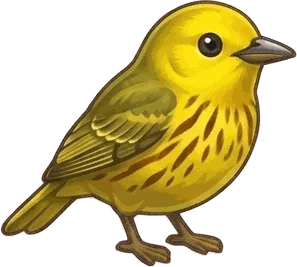
A Yellow Warbler sounds cheerful and in a hurry: a bright, musical run of clear whistled notes, usually six or seven, that dips and then rises at the end. Birders remember it as sweet sweet sweet, I'm so sweet or sweet-sweet-sweet, sweeter-than-sweet. The whole song lasts about a second and the male repeats it over and over from willows and alders along streams, ponds and marsh edges from late April into July. The call is a sharp, sweet chip. It is the most yellow bird you will see in a wet thicket, and one of the easiest warbler songs to learn.
The birder's mnemonic
“sweet sweet sweet, I'm so sweet” Say it quickly and let the last two words climb in pitch; the real song is faster and brighter than you can whistle it.
What the song sounds like
The song is a short, quick phrase of clear whistled notes with a bounce in it. The first few notes are even, the phrase drops a little, and the ending lifts back up, which is why the mnemonic ends on an upbeat I'm so sweet. Field guides also write it sweet-sweet-sweet, sweeter-than-sweet. The tone is bright and musical, with none of the buzz of many other warblers, and the whole thing is over in about a second before the bird sings it again.
Males sing a lot. One male was recorded singing more than 3,200 songs in a single day, and during May and June a territory-holding bird can seem to sing without pause from sunrise on. The female often answers the end of his song with a soft, high chip, so a duet of whistle and chip from the same bush usually means a pair. The song varies from bird to bird and place to place, but the shape stays recognizable: quick, sweet, and ending up.
The easiest confusion is with a American Redstart, whose thin, high notes can fall into a similar rhythm. Redstart songs are higher and less musical and end on an abrupt up-slur or down-slur rather than a clean whistled climb. Chestnut-sided Warblers sing a rich phrase with an emphatic ending that people hear as pleased to meetcha; the Yellow Warbler's finish is softer and rises.
The call: a sweet chip
The common call is a single sharp, sweet chip. Females give it after their mate's song, and both sexes use it when a person or a cat walks under the nest. Near a nest you may also hear a distinctive thin seet: the Yellow Warbler gives this specific alarm when a Brown-headed Cowbird is close, and a hissing note goes to other warblers that trespass on the territory.
When and where you hear it
The Yellow Warbler nests across almost all of North America, from the edge of the Arctic tundra south into Mexico, missing only the far Southwest deserts and the Gulf Coast lowlands. Look for it in wet, shrubby places: willow and alder thickets along streams and rivers, the edges of lakes, swamps and marshes, leafy bogs, and in the West almost any streamside tangle. It also uses orchards, hedgerows, parks and suburban gardens with dense shrubs and water nearby. In Missouri it is a common migrant statewide from April through September and breeds along the bigger rivers and in willow marshes.
Timing matters, because this is one of the earliest warblers to leave. Birds arrive in April or May and singing runs through June. Once the young fledge, as early as July, adults start slipping south, and most have gone by the end of August, traveling at night. By the time many people think of fall migration the Yellow Warblers are already in Mexico, Central America or as far as the Amazon, Bolivia and Peru. For a game that scores by ear, that early exit makes the Yellow Warbler a spring and early-summer catch in most state albums in Warble.
The bird feeds actively, hopping along small branches, picking caterpillars and other insects from leaves and twigs, sometimes hovering under a leaf or chasing a fly. Caterpillars can make up two thirds of the diet. The female builds a compact, sturdy cup in a fork, anywhere from 2 to 60 feet up, and lays four or five eggs that she incubates alone for about 11 days. Cowbirds find these nests often, and roughly 40 percent of them are targeted. The Yellow Warbler is one of the few small songbirds shown to recognize a cowbird egg, and its answer is to build a new nest floor right over the eggs, its own included, and start again.
What it looks like
A small, plump warbler about 5 inches long with a wingspan of 6 to 8 inches, weighing a third of an ounce. The breeding male is the yellowest warbler wherever it occurs: golden yellow below, yellow-green above, with a plain yellow face in which the dark eye stands out, thin rusty red streaks down the breast and yellow edges on the wing feathers. Females are duller, especially on the head, with faint or no streaking, and fall birds can look almost greenish. The one field mark shared by all of them is yellow spots in the tail, which most other warblers show in white. The bill is straight and slightly heavy for a warbler. Nine subspecies are recognized, sorted into three groups by the color of the male's head.
Birds that sound similar
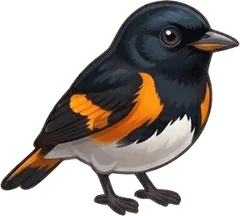 American Redstart
Redstart songs are thin, high see-see-see or seeta-seeta phrases that end in a wheezy up-slur or down-slur and vary constantly. The Yellow Warbler is lower, sweeter and finishes with a clean whistled rise.
- ?Chestnut-sided Warbler
Rich and musical too, but the Chestnut-sided ends with an emphatic downward snap, pleased to MEET-cha. The Yellow Warbler's ending lifts instead of stamping.
- ?Magnolia Warbler
A shorter, softer weeta-weeta-weeteo from young conifers. Fewer notes, less sparkle and no long run of even sweet notes at the start.
Where the Yellow Warbler card lives
In Warble the same bird can be an easy card in one state and a prized one in another, because each album ranks its birds by how often people really report them there. The Yellow Warbler appears in 38 state albums:
 Heard one? Open Warble, tap the green button while it sings, and the Yellow Warbler card flips into your album. Get the app free.
Questions people ask
Which bird sings sweet sweet sweet I'm so sweet?
The Yellow Warbler. That phrase matches its quick, bright whistled song, which dips and then rises at the end. Listen for it in willows and shrubs near water from late April through June across most of the United States and Canada.
Is the Yellow Warbler the same as the Mangrove Warbler?
Yes, they are one species, Setophaga petechia, with nine subspecies in three groups named for the male's head color. Mangrove Warbler and Golden Warbler are names for tropical forms long treated as part of that species; the all-yellow northern birds are what people in the United States call the Yellow Warbler, and some checklists use the longer name for all of them.
Why do Yellow Warblers build nests on top of nests?
To bury cowbird eggs. Unlike most small songbirds, the Yellow Warbler recognizes a Brown-headed Cowbird egg in its nest and, rather than tossing it, builds a new floor over the whole clutch and lays again. About 40 percent of nests are targeted by cowbirds, so multi-story nests are not rare.
When do Yellow Warblers leave for the winter?
Early. Adults can start south in July as soon as the young are independent, and most are gone by the end of August, well before other warblers move. They winter from southern California and Mexico to the Amazon basin.
Sources
- National Audubon Society, Guide to North American Birds: Yellow Warbler. www.audubon.org/field-guide/bird/yellow-warbler
- Wikipedia: American yellow warbler (song rate, calls, range, migration, cowbird response, subspecies). en.wikipedia.org/wiki/American_yellow_warbler
- Missouri Department of Conservation field guide: Yellow Warbler. mdc.mo.gov/discover-nature/field-guide/yellow-warbler
- Animal Diversity Web: Dendroica petechia. animaldiversity.org/accounts/Dendroica_petechia/