 Warble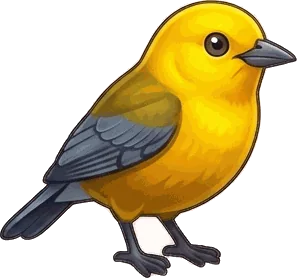
A Prothonotary Warbler sounds like someone shouting the same clear word over and over across the water: a loud, ringing sweet-sweet-sweet-sweet-sweet, five to a dozen identical notes on one pitch, with no flourish at the end. It carries surprisingly far for a bird this small and comes from low in a wooded swamp, usually over standing water. The call is a loud, metallic chip or tink, and a bird in flight gives a loud seeep.
The birder's mnemonic
“sweet-sweet-sweet-sweet-sweet” The trick is the sameness: every note is the same note, loud and ringing, unlike the Yellow Warbler's tune that changes at the end.
What the song sounds like
The song is one syllable, repeated. Audubon and Wikipedia write it sweet-sweet-sweet-sweet-sweet; the Missouri Department of Conservation hears swank-swank-swank. Either way the notes are loud, ringing and evenly spaced, anywhere from four to about fourteen in a row, and the series never turns into a warble or a trill. In a quiet swamp at dawn it sounds like a bell struck at a steady pace.
Males sing only on the breeding grounds, and unpaired males sing most. There is also a canary-like flight song, given during display flights when a male is courting, that is longer and more musical than the perched song. Rival males chase, snap their bills and sometimes grapple in the air with bills and feet locked together, noisy behavior for a warbler.
The call: a loud metallic chip
The everyday call is a loud, dry, metallic chip, written tsink or tink by some, and close enough to the call of the Hooded Warbler that the two are hard to separate by that note alone. Birds on the move give a loud, high seeep.
When and where you hear it
This is the warbler of wooded swamps: flooded bottomland forest of willow, ash, buttonbush, sweetgum and red maple, and the still edges of lakes, rivers and ponds. It breeds across the southeastern United States, north to the Great Lakes states and, barely, into extreme southeastern Ontario, where it is endangered. The densest known population is at Francis Beidler Forest in South Carolina, home to more than 2,000 pairs. In Missouri it is a common summer resident everywhere but the northwest corner. It winters in mangroves and lowland tropical woods from Mexico to northern South America.
It is an early migrant in both directions, with peaks in April and August. Missouri birds arrive in April and start nesting almost at once, and most are gone by the end of August. Migration is at night, and a few wander west each year, most often to California in fall.
The nest is what makes this bird unusual: it is the only eastern warbler that nests in a cavity. The site is a hole in a tree or stump, often an old Downy Woodpecker hole, typically 5 to 10 feet up and over standing water, and the species takes readily to nest boxes. The male lines several cavities with moss and shows them off; the female picks one and packs it nearly to the entrance with moss, leaves, twigs and bark. She lays four to six eggs, incubates them for 12 to 14 days, and the young leave after 10 or 11 days, usually twice a summer. House Wrens compete for the same holes and cowbirds lay eggs in the nests. In Warble the ringing song is one of the easier swamp cards to catch, since the singer rarely stops.
What it looks like
A stocky warbler, about five and a quarter inches long with a short tail and a long, pointed, dark bill that is bigger than most warblers carry. The male's head and breast are a deep golden yellow shading to orange, the back is olive, and the wings and tail are blue-gray, with no wing bars. The undertail is white, and in flight the short, wide tail shows white at the base and dark at the tip. The eye is large and dark against all that yellow. Females and young birds wear the same pattern in duller yellow. It feeds low, gleaning insects from foliage over water and working along fallen logs and dead trunks. Older books called it the golden swamp warbler.
Birds that sound similar
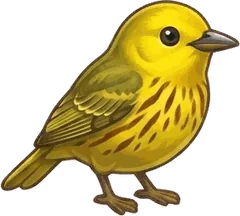 Yellow Warbler
The Yellow Warbler's sweet-sweet-sweet, sweeter-than-sweet starts the same way but speeds up and ends with a flourish. The prothonotary keeps every note identical and rings louder, from a swamp rather than a streamside willow thicket.
- ?Hooded Warbler
The Hooded Warbler's clear, ringing tawee-tawee-tawee-tee-o has two-part notes and a different ending. Its call is a dry chip almost identical to the prothonotary's, so use the song.
- ?Swainson's Warbler
Shares the same swamps and river floodplains, but its song is three or four clear notes followed by a rapid descending run, whee-whee-whee-whip-poor-will. The prothonotary never descends.
Where the Prothonotary Warbler card lives
In Warble the same bird can be an easy card in one state and a prized one in another, because each album ranks its birds by how often people really report them there. The Prothonotary Warbler appears in 4 state albums:
 Heard one? Open Warble, tap the green button while it sings, and the Prothonotary Warbler card flips into your album. Get the app free.
Questions people ask
Why is it called a prothonotary warbler?
After the prothonotaries, high-ranking church notaries who wore golden-yellow robes, a color the male's head and breast match closely. The species name citrea means citrine yellow. An older common name was golden swamp warbler.
Do Prothonotary Warblers use nest boxes?
Yes. It is the only eastern warbler that nests in cavities, and it readily takes to birdhouses placed over or beside standing water, typically 5 to 10 feet up. Nest box programs have helped local populations recover in places where natural holes are scarce. House Wrens will compete for the same boxes.
When do Prothonotary Warblers arrive and leave?
Early in both directions. Spring migration peaks in April, Missouri birds arrive that month and nest right away, and the fall exodus peaks in August, with only stragglers left in September. They winter mainly in coastal mangroves from Mexico to northern South America.
What is the Alger Hiss connection to the prothonotary warbler?
In the 1948 House Un-American Activities Committee hearings, Whittaker Chambers said Alger Hiss had once boasted to him about seeing a prothonotary warbler on the Potomac. When Hiss, questioned separately, mentioned the same sighting, several committee members took it as proof the two men knew each other.
Sources
- National Audubon Society, Guide to North American Birds: Prothonotary Warbler. www.audubon.org/field-guide/bird/prothonotary-warbler
- Wikipedia: Prothonotary warbler (song, plumage, range, name and history). en.wikipedia.org/wiki/Prothonotary_warbler
- Missouri Department of Conservation, Field Guide: Prothonotary Warbler. mdc.mo.gov/discover-nature/field-guide/prothonotary-warbler
- Animal Diversity Web (University of Michigan): Protonotaria citrea. animaldiversity.org/accounts/Protonotaria_citrea/