 Warble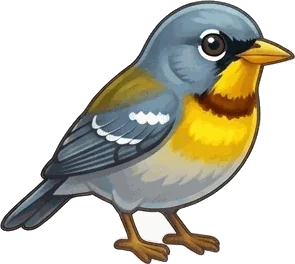
A Northern Parula sounds like a tiny zipper being pulled up and let go: a thin, buzzy trill that climbs in pitch and ends with one abrupt, lower note, bzzzzz-zip. A second version breaks the buzz into pieces, bz-bz-bz-zip, with the same closing drop. The song is short and comes from high in the canopy, usually from a bird you cannot find. The everyday call is a soft, sweet chip.
What the song sounds like
Two things give the parula away: the buzz and the drop. The song is a trill of buzzy notes that rises steadily, then falls over at the end with one short, lower, emphasized note, so the shape is a ramp with a step down. Audubon writes it bzzzzz-zip or bz-bz-bz-zip; Wikipedia has zeeeeee-yip. The tone is thin and insect-like rather than whistled.
There are two song types. The first is the plain rising buzz that snaps down at the finish. The second breaks the buzz into a stutter of separate notes, ti-ti-ti-ti-ti-tit, before the same closing drop. Males sing persistently from early spring through midsummer and, unusually, keep singing while they carry food to the young. Faster, more clipped versions come out when two males argue over a border.
Finding the singer is the hard part. Parulas feed and sing in the upper canopy, and unlike most warblers they often sit on one perch for a while instead of flitting.
The call: a soft chip
Away from the song, both sexes use a soft, sweet chip to stay in touch with a mate or with fledglings. It is quiet and easy to lose among the other warbler chips in a migrating flock. Rapid strings of notes mean a territorial dispute; an agitated male will also swipe his bill along the perch and hold his body flat with wings spread when a rival gets close.
When and where you hear it
Northern Parulas breed across eastern North America from southern Canada to Florida and winter in southern Florida, the West Indies and Central America. They are early. Birds in the Deep South are back and singing by early March and may nest that month; at the northern edge of the range nesting waits until May. In Missouri the parula is a common summer resident from April into early October. Migration happens at night, often in mixed flocks with other warblers, and during passage a parula can turn up in almost any stand of trees, including a city park.
The breeding habitat is specific: humid forest where something hangs from the branches. In the South that means Spanish moss in bottomland woods and swamps; in the North it means beard lichen, Usnea, in moist spruce bogs and hemlock swamps. The female hollows out a clump of the moss or lichen and lines it lightly, making a hanging pouch anywhere from 4 to 50 feet up that is essentially invisible until a parent flies into it. Pairs often return to the same site year after year. Southern pairs frequently raise two broods, northern pairs one. Where air pollution has thinned the mosses and lichens, parulas have vanished from areas where they once bred.
For Warble players the parula is a warbler card that is far easier to catch by ear than to see, since the singer rarely leaves the treetops.
What it looks like
A very small warbler, about four and a half inches long with a short tail: blue-gray above with a greenish-yellow patch in the middle of the back, two white wing bars, a yellow throat and upper breast and a white belly. White crescents sit above and below the eye rather than a full ring, and the bill is two-toned, dark above and yellow below. The breeding male wears a dark band above a rusty one across the yellow chest; the female is duller and usually lacks the bands. Feeding, it sometimes hangs upside down like a chickadee to reach a dead-leaf cluster, or works along a trunk like a nuthatch. The name comes from Latin parrula, a little titmouse, because Linnaeus first filed the bird with the tits in 1758.
Birds that sound similar
- ?Cerulean Warbler
The Cerulean's song is a run of short buzzy notes that ends on a higher buzz, so it climbs at the finish. The parula climbs and then drops with a snap. Both sing from tall trees in river-valley forest.
- ?Black-throated Blue Warbler
A husky, lazy zwee-zwee-zwee that rises, but with only a few slow notes and no clipped drop at the end. It also sings from the shrub layer, not the canopy.
Where the Northern Parula card lives
In Warble the same bird can be an easy card in one state and a prized one in another, because each album ranks its birds by how often people really report them there. The Northern Parula appears in 29 state albums:
 Heard one? Open Warble, tap the green button while it sings, and the Northern Parula card flips into your album. Get the app free.
Questions people ask
Why can I hear a Northern Parula but never see it?
Because it sings and feeds high in the canopy, it is barely four and a half inches long, and it moves less than other warblers, often sitting on one perch for a while. Watch the outer tips of tall branches for a small blue-gray bird with a yellow throat; the male sings persistently through midsummer.
Where do Northern Parulas build their nests?
Inside hanging clumps of Spanish moss in the South or beard lichen (Usnea) in the North. The female hollows out the clump and lines it thinly, 4 to 50 feet up. The nest is almost impossible to find except by watching a parent go in, and pairs reuse the same site year after year.
When do Northern Parulas arrive in spring?
Early for a warbler. Southern breeders are back by early March and can be nesting that month, Missouri birds arrive in April, and the northern edge of the range does not see nests until May. Fall departure runs through September and early October.
What does the name parula mean?
It comes from the Latin parrula, a little tit, because Linnaeus described the bird in 1758 as Parus americanus and placed it with the titmice. Genetic studies published in 2010 moved it to the warbler genus Setophaga, which means moth-eater.
Sources
- National Audubon Society, Guide to North American Birds: Northern Parula. www.audubon.org/field-guide/bird/northern-parula
- Wikipedia: Northern parula (song, measurements, range, nesting and taxonomy). en.wikipedia.org/wiki/Northern_parula
- Missouri Department of Conservation, Field Guide: Northern Parula. mdc.mo.gov/discover-nature/field-guide/northern-parula
- Animal Diversity Web (University of Michigan): Parula americana. animaldiversity.org/accounts/Parula_americana/