 Warble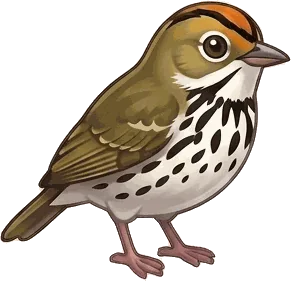
An Ovenbird sounds like a shout from inside the woods: a loud, ringing series of two-syllable phrases, teacher, teacher, teacher, TEACHER, repeated about eight times without a pause and growing louder with every repeat until it seems far too big for a bird you cannot see. The stress falls on the second syllable of each phrase. It rings through mature deciduous forest from late April into July, from a perch a few feet to 30 feet up or from the leaf litter itself. The call is a loud, sharp chip.
The birder's mnemonic
“teacher, teacher, TEACHER” Start almost quietly and let each word get louder than the last; the crescendo, not the words, is what identifies the bird.
What the song sounds like
The song is a staccato chant of short two-note phrases, relatively low-pitched for a warbler and strident in tone, repeated roughly eight times with no gap between them. The second note of each pair is sharply accented, so the pattern comes out as tea-CHER, tea-CHER, tea-CHER, and the volume climbs steadily from the first phrase to the last. That crescendo is the field mark. Plenty of birds repeat a phrase; almost none of them get louder as they go, and the effect in a quiet forest is of a voice walking toward you.
The bird sings from a low branch or a fallen log, sometimes from the ground, most often below 30 feet, and it is far more often heard than seen. Males sing at full volume when they are broadcasting to the whole neighborhood, but drop to a much quieter version when a rival male is close and the two are settling a boundary. The song varies a little from region to region, but the accent and the build never go away. Only the male sings; females are nearly silent.
The call: a loud chip
The everyday note is a sharp chip, loud for a warbler and variable in pitch. An excited bird, or one with young nearby, fires them off in a rapid series. The flight call, heard from migrants passing overhead at night, is a high, rising note.
When and where you hear it
Ovenbirds breed across eastern North America from Newfoundland west to Montana and Colorado and south to roughly northern North Carolina, and they are picky about the woods. They want large, unbroken tracts of mature deciduous or mixed forest with a closed canopy, big trees, deep leaf litter and little undergrowth. Small woodlots and fragmented forest hold far fewer pairs. Migration is at night. Birds return between late March and early May, with the main arrival through April and May, and the first ones head south in late August, with waves passing until late October. In Missouri the Ovenbird is a common migrant statewide, arriving in mid-April and gone by mid-October, and an uncommon nester in the south. Eastern birds winter mostly in the Caribbean, western birds in Mexico and Central America, and a few stay in the southeastern United States.
The bird lives on the ground, walking rather than hopping, tail cocked up, flipping dead leaves aside for beetles, ants, caterpillars, snails and spiders. The name comes from the nest: a domed structure of dead leaves, grass, bark and twigs built by the female on the forest floor, with a side entrance, shaped like a Dutch oven. She lays four or five eggs and incubates them for 11 to 14 days, and the young leave after 8 to 11 days. Nesting on the ground has a price. Snakes, red squirrels and chipmunks take eggs and young, and chipmunks have been known to dig straight into the dome. Cowbirds find the nests too. Even so, Ovenbird numbers appear stable and the species is listed as Least Concern.
The night flight song
At dusk, and sometimes after dark, a male will fly up above the canopy and pour out a very different song: a bubbling, exuberant jumble of sputtering notes mixed with bits of mimicry, often ending with a few recognizable teacher, teacher phrases as he dives back to the forest floor. It is the same kind of display a skylark gives over a field, transplanted into the woods. The bird also has a literary career: Robert Frost's poem "The Oven Bird" appeared in his 1916 collection Mountain Interval.
What it looks like
A plump, thrush-like warbler about 6 inches long with a wingspan of 8 to 10 inches, weighing around two thirds of an ounce. The back is plain olive-brown, the underparts are white with heavy black streaks that run in rows down the breast and sides, and a bold white eye ring circles a large dark eye. On top of the head a dull orange stripe runs front to back, edged on both sides by blackish stripes, and the orange feathers can be raised into a small crest. The legs are pink and sturdy. Males and females look alike. It walks like a tiny chicken, and if you flush one from the trail it will usually land a few yards away and stare back.
Birds that sound similar
- ?Kentucky Warbler
The Kentucky Warbler's rich tur-dle, tur-dle, tur-dle rolls along at one volume from humid, shaded undergrowth. The Ovenbird chants sharper two-note phrases that build steadily louder.
 Carolina Wren
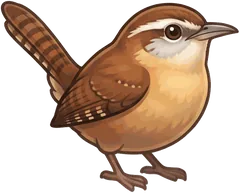
A Carolina Wren's tea-kettle, tea-kettle is a three-syllable whistle at full volume from the first note, sung all year in yards and thickets. The Ovenbird is a summer forest bird with a two-beat phrase that swells.
 Common Yellowthroat
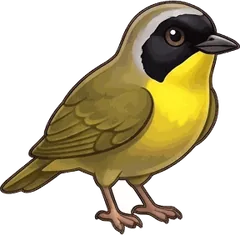
The Common Yellowthroat's witchety-witchety-witchety has three beats, stays level in volume and comes from cattails and wet brush, not from under a closed forest canopy.
Where the Ovenbird card lives
In Warble the same bird can be an easy card in one state and a prized one in another, because each album ranks its birds by how often people really report them there. The Ovenbird appears in 18 state albums:
 Heard one? Open Warble, tap the green button while it sings, and the Ovenbird card flips into your album. Get the app free.
Questions people ask
Which bird says teacher teacher teacher?
The Ovenbird, a ground-dwelling warbler of mature eastern forests. Its song is a loud, ringing series of two-syllable phrases that grows louder with each repeat, sung from late April through summer and heard far more often than the bird is seen.
Why is it called an Ovenbird?
Because of its nest. The female builds a domed structure of dead leaves, grass and bark on the forest floor with an entrance in the side, which looks like a small Dutch oven. She lays four or five eggs inside it.
Do Ovenbirds sing at night?
Sometimes. At dusk and occasionally after dark a male flies up above the trees and gives a bubbling flight song, a jumble of notes with bits of mimicry that usually ends in a few teacher, teacher phrases as he drops back down. The regular daytime song is the one you hear most.
Is the Ovenbird a thrush?
No. It looks like a small thrush, with a streaked breast, a white eye ring and a habit of walking on the ground, but it is a wood-warbler. The orange crown stripe bordered in black gives it away.
Sources
- National Audubon Society, Guide to North American Birds: Ovenbird. www.audubon.org/field-guide/bird/ovenbird
- Wikipedia: Ovenbird (song structure, flight display, migration, nest, predators, Frost poem). en.wikipedia.org/wiki/Ovenbird
- Missouri Department of Conservation field guide: Ovenbird. mdc.mo.gov/discover-nature/field-guide/ovenbird
- Animal Diversity Web: Seiurus aurocapilla. animaldiversity.org/accounts/Seiurus_aurocapilla/