 Warble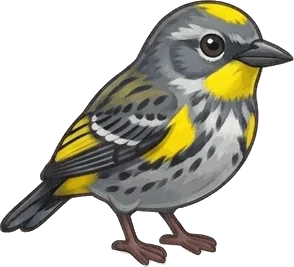
A Yellow-rumped Warbler sounds like a warbler that is not trying very hard: a loose, slow trill of similar sweet notes, tyew-tyew-tyew-tyew, tew-tew-tew, usually four to nine of them, often speeding up a little and then dropping lower and softer at the end. It is pleasant but colorless next to the songs of other warblers, and it comes from conifers and mixed woods in the northern and mountain West. What most people hear instead is the call: a sharp, flat check or chek, given constantly by the loose flocks that work parks, thickets and cedar groves across the southern United States all winter.
What the song sounds like
The song is a trill, but a relaxed one: a series of four to nine quick, similar notes, whistled and a bit buzzy, that runs for a second or two. Many songs pick up speed part way through and then slide downward and get quieter at the end, as if the bird lost interest. Field guides call it a buzzy warble or a trill-like tyew-tyew-tyew-tyew, tew-tew-tew, and none of them call it memorable. That is useful in itself. If a trill in spruce or pine woods sounds loose, soft and unfinished, think Yellow-rumped before you think of the tighter, drier trills of a Chipping Sparrow or a Dark-eyed Junco.
You will hear the full song mostly on the breeding grounds, from the northern forests of Alaska and Canada, New England and the Great Lakes, and the mountains of the West up to 12,000 feet. Migrants sing a little in April as they head north. In winter, when the bird is most familiar to most Americans, it barely sings at all.
The call: a sharp check
The everyday note is a sharp, flat check, sometimes written chek or chip, and it is the sound to learn. Yellow-rumps travel in loose flocks outside the breeding season and keep in touch with it constantly, so a winter thicket full of checks and flashing yellow rumps is one of the most common warbler experiences in the country. There is also a thinner sip. The check is a good first warbler sound to test yourself on, and a fair test for Warble too, since a flock calling in a windy park is exactly the kind of noisy scene where identifying by ear gets hard.
When and where you hear it
This is the most abundant warbler in North America, with a population around 170 million, and the one that behaves least like a warbler. It breeds in conifer and mixed forest, favoring open stands, edges and bogs of pine, fir, spruce, aspen and tamarack, from Alaska across Canada to Newfoundland and through the mountains of the West.
The trick that sets it apart is digestion. Yellow-rumped Warblers can break down the waxy coating on berries of bayberry, wax myrtle, juniper, poison ivy and red cedar, something no other warbler manages, and that lets them winter far north of any relative, along the Atlantic coast to Newfoundland in some years and across the whole southern United States. They also eat greenbrier, grapes, Virginia creeper and dogwood fruit, goldenrod and sunflower seeds and, when it is offered, birdseed. When the weather warms they go back to gleaning insects from leaves, hovering under branches, hawking flies in midair and even clinging to trunks.
They migrate at night, earlier in spring and later in fall than other warblers: fall movement runs September to November and spring movement April to May. In Missouri they are present from mid-September to mid-May, with peaks in April and October and big winter numbers in the cedar groves of the southern half of the state. How far south a given winter's birds go depends on food and weather, so a place that has none one January can be full of them the next. On the breeding grounds the female builds a cup of twigs, bark strips and rootlets lined with hair and feathers on a horizontal conifer branch, 4 to 50 feet up, and incubates four or five eggs for 12 to 13 days. Two broods a season are normal.
What it looks like
A sparrow-sized warbler, 5 to 6 inches long and a bit under half an ounce. Every plumage shares the field mark in the name: a bright yellow rump patch that flashes when the bird flies, plus a yellow patch on each side of the chest just in front of the wing, and white spots in the tail. Spring males are gray above with black streaks, a black chest and a yellow crown patch. Females and fall birds are browner and duller but keep the same pattern. The two forms are told by the throat: Myrtle birds, breeding in the East and North, have a white throat, a white eyebrow and a dark cheek; Audubon's birds, breeding in the West, have a yellow throat and a plainer face. The two have been treated as one species since 1973, a proposal to split them again failed in 2017, and some world checklists still list them separately.
Birds that sound similar
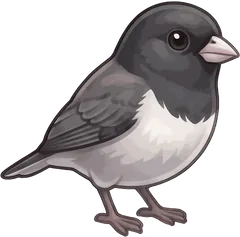 Dark-eyed Junco
The junco's song is a ringing, metallic trill that stays on one pitch from start to finish. The Yellow-rumped trill is looser and sweeter and usually sags lower and softer at the end.
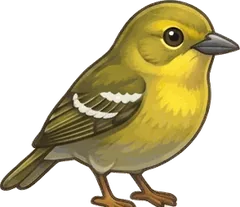 Pine Warbler
The Pine Warbler's trill is fuller, more musical and more even, a slow soft version of a Chipping Sparrow, and it comes from pines. The Yellow-rumped song sounds thinner and more unfinished.
- ?Palm Warbler
A weak, dry trill like a slow Chipping Sparrow, with no sweetness and no change of pitch. The Yellow-rumped has some whistle in it and tends to trail downward.
Where the Yellow-rumped Warbler card lives
In Warble the same bird can be an easy card in one state and a prized one in another, because each album ranks its birds by how often people really report them there. The Yellow-rumped Warbler appears in 50 state albums:
 Heard one? Open Warble, tap the green button while it sings, and the Yellow-rumped Warbler card flips into your album. Get the app free.
Questions people ask
What does the Yellow-rumped Warbler's call sound like?
A sharp, flat check or chek, repeated constantly by birds in a flock. In winter that call, plus the flash of a yellow rump as the bird flies, is how most people find Yellow-rumped Warblers in parks, thickets and cedar groves across the southern United States.
Why do Yellow-rumped Warblers stay north in winter when other warblers leave?
Because they can digest wax. Bayberry, wax myrtle, juniper and poison ivy berries have waxy coatings that other warblers cannot process, and the Yellow-rumped can, so it lives on fruit when insects disappear. That lets it winter along the Atlantic coast to Newfoundland in some years and throughout the South.
Are Myrtle Warbler and Audubon's Warbler the same bird?
They are the eastern and western forms of the Yellow-rumped Warbler and have been lumped as one species since 1973. Myrtle birds have a white throat; Audubon's have a yellow throat. A 2017 proposal to split them again was not accepted, though some international lists treat them as separate species.
Do Yellow-rumped Warblers come to feeders?
Yes. In winter they take birdseed and other feeder food, and they clean up berries on red cedar, poison ivy, Virginia creeper and dogwood in yards. A feeder near fruiting shrubs is the easiest way to see one up close.
Sources
- National Audubon Society, Guide to North American Birds: Yellow-rumped Warbler. www.audubon.org/field-guide/bird/yellow-rumped-warbler
- Wikipedia: Yellow-rumped warbler (song, taxonomy of Myrtle and Audubon's forms, migration, wax digestion). en.wikipedia.org/wiki/Yellow-rumped_warbler
- Missouri Department of Conservation field guide: Yellow-rumped Warbler. mdc.mo.gov/discover-nature/field-guide/yellow-rumped-warbler
- Animal Diversity Web: Dendroica coronata. animaldiversity.org/accounts/Dendroica_coronata/