 Warble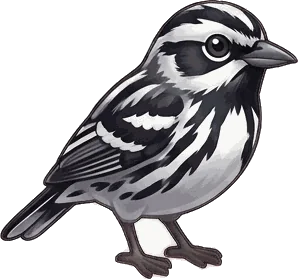
A Black-and-white Warbler sounds like a small wheel that needs oil: a thin, very high, squeaky weesy-weesy-weesy-weesy, six to ten two-syllable phrases on an even, chanting beat with the stress on the first syllable and no flourish at the end, lasting up to three seconds. It is monotonous on purpose, and once you know it you will pick it out of a spring woodland chorus every time. The call is a hard tick or a lispy see-see. Look for the singer creeping along a trunk or branch like a nuthatch, striped like a zebra.
The birder's mnemonic
“weesy, weesy, weesy, weesy” Think of a squeaky wheelbarrow or a rusty wheel turning at a steady pace: same two notes, same speed, no ending.
What the song sounds like
The song is a series of high, thin, squeaky two-note phrases repeated without variation, usually six to ten of them, for two or three seconds. Each phrase leans on its first syllable, WEE-see, WEE-see, WEE-see, and the pitch and pace hold steady from start to finish. There is no accented ending, no trill, no change of key. Audubon's guide compares it to a squeaky wheelbarrow, and that is exactly the right image: a mechanical rhythm rather than a melody.
The monotony helps. In late April and early May, when the trees are full of warblers with fancy endings and shifting pitches, the one song that just keeps squeaking evenly is this one. It is very high, so if you have trouble with high frequencies you may lose the top of it and hear only a faint rhythmic hiss; move closer and watch the trunks. Males sing on arrival, and the Black-and-white is among the first warblers back each spring, so its wheel is often turning before the leaves are out.
The call: tick and see-see
The call is a dull, hard tick or chip, sometimes described as a slightly metallic tsimp. There is also a soft, lispy see-see, usually doubled, given as a contact note and in flight, and a faint fsss. In fall, when the song is finished, these small notes and the sight of a striped bird working a trunk are what you get.
When and where you hear it
Black-and-white Warblers breed across most of Canada from northeastern British Columbia to Newfoundland and through the eastern United States. They nest in mature and second-growth deciduous and mixed forest, with a taste for dry, rocky hillsides, ravines and the dry parts of wooded swamps. On migration they turn up wherever there are trees, including parks and yards, always on the bark rather than out at the leaf tips. In Missouri the bird is a common migrant statewide with peak numbers in late April and early May, an uncommon nester in the south, and absent from mid-October until the end of March.
Spring migration starts early and stretches out, and the fall movement is drawn out as well, mostly at night. Winter is spent from southern Florida through the Caribbean and Central America to northern South America, where the birds occupy everything from lowland forest to cloud forest, mangroves, orchards and city lawns, usually alone but often tagging along with mixed flocks.
The oddest thing about the species is how it feeds. It is the only North American wood-warbler that regularly forages on bark, creeping along trunks and branches from the canopy to the ground, rocking its body from side to side with each hop, moving headfirst down a trunk or upside down along the bottom of a limb, and probing cracks with a thin, slightly curved bill for caterpillars, bark beetles, wood borers, ants and spiders. It has an extra-long hind claw and short legs for the job. The nest, by contrast, is on the ground, a cup of leaves, grass and bark lined with moss and hair, tucked at the base of a tree, rock, log or shrub under dead leaves. The female lays four to six eggs, usually five, incubates for 10 to 12 days, and the young leave 8 to 12 days after hatching. The oldest known bird lived at least 11 years.
What it looks like
A small warbler, 4.3 to 5.1 inches long with a wingspan of 7 to 9 inches, weighing about a third to half an ounce. It is striped black and white from head to tail in every plumage: a white stripe down the center of the crown between two black ones, streaked back and flanks, two white wing bars and white underparts. The breeding male has a black throat and black cheeks; females and young birds have a white or grayish throat, a gray cheek and a creamy wash on the face and sides. The bill is thin and a touch downcurved. The genus holds this one species and no subspecies are recognized, so a striped warbler creeping on bark anywhere in North America is this bird.
Birds that sound similar
 American Redstart
Redstart songs are also thin and high, but they change from one to the next and usually end with an emphatic wheezy note slurred up or down. The Black-and-white repeats one even two-note phrase with no ending.
- ?Blackpoll Warbler
The Blackpoll's song is a run of single high lisping notes all on one pitch that swells louder and then fades. The Black-and-white uses two-syllable phrases and keeps a steady volume.
 Brown Creeper
The Brown Creeper shares the trunks and the very high register, but its song is a short tinkling run that slides downward and its call is one thin see. No repeated squeaky two-beat rhythm.
Where the Black-and-white Warbler card lives
In Warble the same bird can be an easy card in one state and a prized one in another, because each album ranks its birds by how often people really report them there. The Black-and-white Warbler appears in 28 state albums:
 Heard one? Open Warble, tap the green button while it sings, and the Black-and-white Warbler card flips into your album. Get the app free.
Questions people ask
Which bird sounds like a squeaky wheel?
In eastern and northern woods in spring, the Black-and-white Warbler. Its song is a thin, high weesy-weesy-weesy repeated evenly for up to three seconds, like a wheelbarrow with a dry axle, and the singer is usually creeping along a trunk or branch.
Why does the Black-and-white Warbler act like a nuthatch?
It has specialized in bark. An elongated hind claw, short legs and a thin, slightly curved bill let it creep up, down and under trunks and limbs, picking insects and spiders from crevices. It is the only North American warbler that regularly forages that way.
When do Black-and-white Warblers arrive in spring?
Early. They are among the first warblers back on the breeding grounds each spring, reaching Missouri at the start of April with peak migration in late April and early May. Spring passage is long and drawn out, mostly at night.
Where do Black-and-white Warblers nest?
On the ground, which surprises people who only see them on tree trunks. The female builds a cup of leaves, grass and bark lined with moss at the base of a tree, rock, log or shrub, hidden under dead leaves, and lays four to six eggs.
Sources
- National Audubon Society, Guide to North American Birds: Black-and-white Warbler. www.audubon.org/field-guide/bird/black-and-white-warbler
- Wikipedia: Black-and-white warbler (song, calls, nuthatch-like foraging, early arrival, monotypic genus). en.wikipedia.org/wiki/Black-and-white_warbler
- Missouri Department of Conservation field guide: Black-and-white Warbler. mdc.mo.gov/discover-nature/field-guide/black-and-white-warbler
- Animal Diversity Web: Mniotilta varia (song structure, bark foraging adaptations, nesting, lifespan). animaldiversity.org/accounts/Mniotilta_varia/