 Warble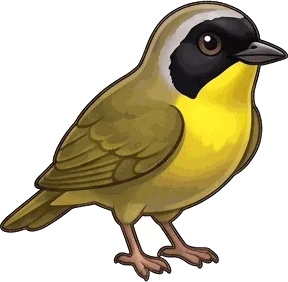
A Common Yellowthroat sounds like a small bird shouting a three-syllable word on repeat: a loud, fast, rolling witchety-witchety-witchety-witch, delivered from a cattail, a briar or the top of a marsh weed. Some birds sound more like which-is-it, which-is-it. The call is a husky, sharp chip or tcheg, close to a marsh wren's scold. You hear it from mid-April through summer in marshes, wet meadows, streamside tangles and overgrown fields across the whole continental United States.
The birder's mnemonic
“witchety-witchety-witchety” Put the stress on the first syllable of each word and keep it quick; the bird usually stops after a few repeats.
What the song sounds like
The song is a bright, whistled phrase of three notes repeated without a pause, loud and fast for a bird this small. Most people hear witchety-witchety-witchety-wit; field guides also write which-is-it, which-is-it or twichety twichety twichety twich. The rhythm is the giveaway. Each unit has a hard first beat and two lighter ones, and the units roll straight into each other, so the whole song has the swing of a small engine turning over. It varies from bird to bird and across the 13 subspecies, but the bouncing three-part pattern holds.
The singer is usually easy to find, which is unusual for a warbler. Males climb to the top of a tall marsh stalk, a reed or a low bush and sing in the open, then drop back into the tangle. During courtship a male will also launch into a flight high above the vegetation, singing in full view, then tumble down. The male uses the song to claim and hold a patch of wet ground and to draw a mate to it.
The call: a husky chip
Away from the song the yellowthroat gives a sharp, low chip that field guides write as tcheg, chack or jip. It has a husky, scolding quality that sounds a lot like a marsh wren, and it comes from low in the cattails, often right at your feet, when you walk a marsh edge. A run of these notes usually means you are near a nest or a fledgling. In late summer and fall, after singing stops, the chip is the sound to learn: it is what tells you the wet thicket still has yellowthroats in it.
When and where you hear it
Few warblers cover as much ground. The Common Yellowthroat breeds from Alaska and across Canada down through every one of the lower 48 states into central Mexico, and it is one of the most abundant warblers on the continent, with a population estimated at 77 million. The recipe is simple: low, dense, damp vegetation. Cattail marshes, wet meadows, reed beds, swamp edges, willow and briar tangles along streams, overgrown fields and ditches all work. Dry ground with the same structure holds a few birds, but the numbers are always in the wet places.
Northern birds migrate at night, and both migrations are drawn out. Spring movement runs from February through May, with males arriving about five days ahead of females, and fall movement runs from August through October. In Missouri the bird is a common summer resident statewide from mid-April through mid-October, with a rare bird lingering in a wetland through a mild winter. Southern populations stay all year, and the rest winter from the southern United States through Central America and the West Indies.
The nest is a bulky open cup of grasses built by the female less than 3 feet up, in marsh plants, briars or weeds. She lays three to five eggs and incubates for 12 days, and pairs often raise two broods in a season. Both parents feed the young on the insects and spiders they glean from low leaves and stems: grasshoppers, dragonflies, mayflies, beetles, caterpillars and aphids. Nests this low and this common are found often by the Brown-headed Cowbird, and the yellowthroat is one of its regular hosts.
What it looks like
A small, round-bodied warbler, 4.3 to 5.1 inches long with a 6 to 7.5 inch wingspan, weighing about a third of an ounce. The male wears a black bandit mask across the forehead, eyes and cheeks, edged above with a pale gray or white band, over a bright yellow throat and breast. The back, wings and tail are plain olive, the belly is whitish with buff sides, and there are no wing bars or tail spots. The female has no mask: she is olive-brown above with a plain face, a thin pale eye ring and a yellow throat that contrasts with a darker cheek. Young birds are duller still. It spends its life low in the tangle, more like a wren than a treetop warbler. Southwestern subspecies are the brightest yellow underneath.
Birds that sound similar
- ?Kentucky Warbler
The Kentucky Warbler's tur-dle, tur-dle, tur-dle is rich and two-syllabled, rolling like a Carolina Wren, and it comes from deep, shaded woods. The yellowthroat's phrase has three beats and comes from open marsh or brush.
 Carolina Wren
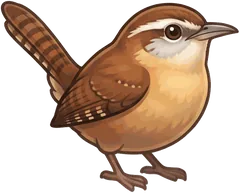
A Carolina Wren's tea-kettle, tea-kettle, tea-kettle is louder, fuller and sung all year from yards and undergrowth. The yellowthroat is thinner, faster and tied to wet ground in the warm months.
 Ovenbird
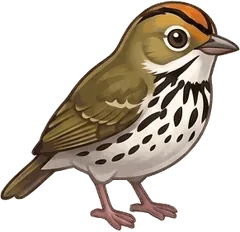
The Ovenbird's teacher, teacher, TEACHER is two-syllabled and gets louder with each repeat, from inside mature forest. The yellowthroat stays at one volume and sings from cattails and briars.
Where the Common Yellowthroat card lives
In Warble the same bird can be an easy card in one state and a prized one in another, because each album ranks its birds by how often people really report them there. The Common Yellowthroat appears in 45 state albums:
 Heard one? Open Warble, tap the green button while it sings, and the Common Yellowthroat card flips into your album. Get the app free.
Questions people ask
What bird says witchety witchety witchety?
The Common Yellowthroat. The loud, quick three-note phrase repeated three to five times comes from a small yellow-throated warbler in marshes, wet thickets and overgrown fields, and the male usually sings it from the top of a cattail or low bush in plain view.
Where do Common Yellowthroats nest?
Low and hidden. The female builds a bulky open cup of grasses less than 3 feet up in marsh plants, briars or weeds, lays three to five eggs and incubates them for 12 days. Pairs often raise two broods, and Brown-headed Cowbirds frequently slip an egg into the nest.
Do Common Yellowthroats sing in flight?
Yes. Besides singing from a perch, a courting male will rise in a flight above the marsh, singing in full view, then drop back into the vegetation. Most of the singing you hear, though, comes from a stalk or a low bush.
When do Common Yellowthroats arrive and leave?
In most of the country they arrive from April into May, males about five days ahead of females, and leave between August and October. Southern populations are present all year, and a few linger farther north through mild winters.
Sources
- National Audubon Society, Guide to North American Birds: Common Yellowthroat. www.audubon.org/field-guide/bird/common-yellowthroat
- Wikipedia: Common yellowthroat (song, calls, size, subspecies, migration timing). en.wikipedia.org/wiki/Common_yellowthroat
- Missouri Department of Conservation field guide: Common Yellowthroat. mdc.mo.gov/discover-nature/field-guide/common-yellowthroat
- Animal Diversity Web: Geothlypis trichas. animaldiversity.org/accounts/Geothlypis_trichas/