 Warble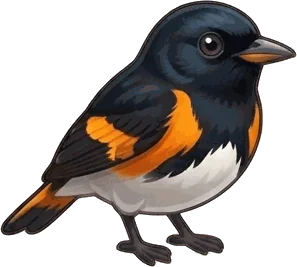
An American Redstart sounds thin, high and quick: a short series of five or six squeaky notes or two-note phrases, see-see-see-see or seeta-seeta-seeta, that ends on an emphatic wheezy note slurred up or down, or sometimes with no ending at all. The catch is that one male sings several different versions and switches between them, so the song is easier to recognize by its high, hurried texture than by any one pattern. The call is a soft, musical chip. Listen in open deciduous woods, edges and streamside thickets from late April through July.
What the song sounds like
Redstart songs are rapid, high-pitched and variable, which is a polite way of saying they are a nuisance to learn. A typical one is five or six thin notes, single or doubled, see see see see or seeta seeta seeta, finished with a wheezy note that jumps up or drops down. Another version repeats the same one or two phrases; another strings two to eight different phrases together in a rush. The whole thing lasts about a second and is repeated often, so you get plenty of chances.
The versions have jobs. A male uses repeated songs with a strong accented ending when he is courting or close to his mate, and switches to a mixed series of different songs when he is arguing with the neighbors over a boundary. He also learns the songs of the males next door and works them into his own, so the birds in one patch of woods end up sharing a local dialect that differs from the next patch over. Individual males can be told apart by their songs, and a persistent listener can do it too.
The nearest confusion is the Yellow Warbler, which shares the wet edges and has a similar quick rhythm. The Yellow Warbler is lower, sweeter and more whistled, and it ends with a clean upward turn rather than a squeezed wheeze. A Black-and-white Warbler repeats one thin two-syllable phrase over and over on an even beat, like a squeaky wheel, without the redstart's variety or its punchy ending.
The call: a musical chip
The call is a soft, musical chip. Females give harsh chips at intruders near the nest and during courtship, and a flurry of chips low in a thicket in July usually means fledglings are being fed.
When and where you hear it
Redstarts breed across southern Canada from coast to coast and through the eastern United States, thinning out in the Southeast. They like open-canopy deciduous and mixed woodland, second growth, forest edges, roadside trees and the banks of streams, and in the Northwest they use willow and alder thickets. Territories are small, under a hectare, and males sing from the middle and lower levels of the trees rather than the canopy. In Missouri the redstart is a common migrant and summer resident from late March through early September.
Migration is at night. Birds arrive from late April into May, pair up within about a week of the females' arrival, nest from mid-May through July and begin drifting south in August. The winter is spent from Mexico and the West Indies through Central America to northern South America, in almost any wooded habitat, including shade-grown coffee farms, where older males claim the best mangrove patches and push females and young males into drier scrub.
The bird is a flycatcher in warbler clothing. It hops and darts through the branches, drooping its wings, fanning its tail and flashing the orange or yellow patches to startle insects into the open, then leaps or flies out to snatch them. It takes more of its food on the wing than any other warbler, and its flat bill with bristles at the base looks like a flycatcher's for that reason. The female alone builds a tight cup of grass, bark, roots and hair in the fork of a shrub or low tree and incubates about four eggs for 10 to 13 days. The young leave after nine days and the parents split the brood between them.
What it looks like
A small, slim, long-tailed warbler, 4.3 to 5.1 inches long with a wingspan of about 6.5 to 8 inches, weighing around a quarter of an ounce. The adult male is glossy black with big orange patches on the wings, the sides of the tail and the flanks and a white belly. The female is gray-headed and olive above and white below with the same patches in lemon yellow. A first-year male looks like a female with a few black flecks and tries to breed in that plumage; fewer than half of them manage to breed before they molt into black the following year. Every plumage constantly fans the tail and half-opens the wings, which is how you pick a redstart out of a flock before you see any color.
Birds that sound similar
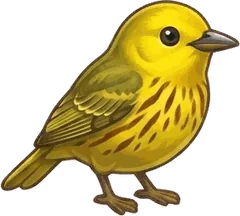 Yellow Warbler
The Yellow Warbler's sweet sweet sweet, I'm so sweet is lower, rounder and more whistled, with a clean rising finish. Redstart songs are thinner and squeakier and end with a wheezy slur or stop abruptly.
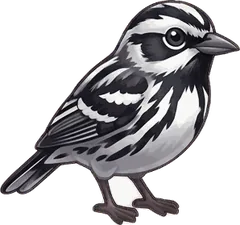 Black-and-white Warbler
The Black-and-white Warbler repeats a single high weesy-weesy-weesy on an even, chanting beat for up to three seconds, with no emphatic ending. Redstarts vary their phrases and punch the last note.
- ?Magnolia Warbler
The Magnolia's weeta-weeta-weeteo is short and soft with a rising finish, from young conifers. Redstart notes are higher and squeakier, and the ending is a wheeze rather than a whistle.
Where the American Redstart card lives
In Warble the same bird can be an easy card in one state and a prized one in another, because each album ranks its birds by how often people really report them there. The American Redstart appears in 31 state albums:
 Heard one? Open Warble, tap the green button while it sings, and the American Redstart card flips into your album. Get the app free.
Questions people ask
Why does the American Redstart have so many different songs?
Because different songs do different jobs. Males use a repeated song with an accented ending near a mate and a mixed series of songs when disputing a boundary, and they copy neighbors' songs, so each patch of woods develops its own dialect. That is why no single mnemonic works for the species.
Why do redstarts fan their tails?
To flush insects. The bird flashes the orange or yellow patches in its tail and wings to startle prey out of the leaves, then chases it down, often catching it in midair like a flycatcher. It does this constantly, even in winter.
Is a gray and yellow redstart a female?
Usually, but not always. First-year males wear female-like gray and yellow plumage through their first summer, with a few black flecks, and try to breed in it. Fewer than half of them succeed before they turn black and orange the next year.
When do American Redstarts arrive in spring?
Late April into May across most of the breeding range, with the earliest birds reaching states like Missouri in late March. Courtship starts within about a week of the females' arrival and nesting runs from mid-May through July.
Sources
- National Audubon Society, Guide to North American Birds: American Redstart. www.audubon.org/field-guide/bird/american-redstart
- Wikipedia: American redstart (size, plumage, first-year males, tail flashing, wintering). en.wikipedia.org/wiki/American_redstart
- Missouri Department of Conservation field guide: American Redstart. mdc.mo.gov/discover-nature/field-guide/american-redstart
- Animal Diversity Web: Setophaga ruticilla (song types, dialects, nesting, winter habitat segregation). animaldiversity.org/accounts/Setophaga_ruticilla/