 Warble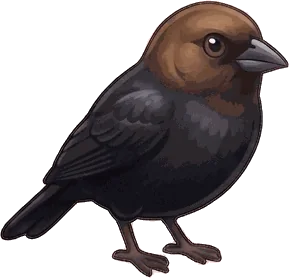
A Brown-headed Cowbird sounds like water poured from a bottle, then a squeak: two or three low, bubbling notes that slide up into a thin, high whistle, all in about a second. The male sings it with a deep bow, feathers puffed, often beside a couple of rivals doing the same. Away from the display, the common sounds are a harsh, stuttering rattle and a high two-note whistle, plus a short check. You hear it in pastures, lawns and under feeders across the United States from March into summer.
What the song sounds like
The song is short and oddly liquid. It starts with a couple of low, gurgling notes, glug-glug, that seem to come from under water, and finishes with a sharp squeak or whistle far above them, so high that older ears sometimes lose the end. Audubon calls it a squeaky gurgle, which is about right. It takes a second, then the bird does it again.
Watch a male sing and you understand the shape of it. He fluffs his body feathers, half spreads his wings and tail, and bows so deeply he nearly topples off the branch, squeezing out the gurgle on the way down and the squeak on the way up. Males often gather in small groups on a wire and take turns displaying while a female feeds on the ground below, apparently unimpressed.
The call: a rattle and a thin whistle
Two calls carry farther than the song. One is a harsh, stuttering rattle, a dry chatter that stops and starts. The other is a high, thin whistle of two or three notes, often given in flight, that sounds nothing like a blackbird and sends people looking for something more exotic. Both sexes also give a short check in flocks.
When and where you hear it
Cowbirds live coast to coast in farms, fields, prairies, wood edges, lawns, parks and mowed roadsides, anywhere open enough to walk and feed on the ground; they avoid unbroken forest. Southern birds stay all year. Northern birds leave the nesting areas as early as July or August and come back in March or April, which is when the gurgle starts up in yards across the middle of the country. In Missouri only a few birds winter in the north of the state. Winter flocks pile into farmland and cattle feedlots.
The name is literal. Before European settlement cowbirds followed the bison herds across the prairies, eating the grasshoppers and beetles the animals kicked up, and today they do the same with cattle and horses, sometimes riding on their backs. Clearing the eastern forests and bringing in livestock let the species spread across the continent, and it is now a regular under suburban feeders. Seeds make up about half the diet in summer and more than 90 percent in winter.
Why it never builds a nest
The Brown-headed Cowbird builds no nest and raises no young. A female watches other birds build, then slips in and lays an egg in their nest, sometimes removing one of the host's eggs first. She can lay nearly an egg a day for weeks, up to about 40 in a season. Cowbird eggs have been found in the nests of more than 220 species, and more than 140 of those have raised cowbird chicks, from tiny warblers to the Chipping Sparrow, which often abandons a parasitized nest. The cowbird chick usually hatches first, grows fast and takes most of the food, and its nestmates often starve or are pushed out.
There is a darker twist. In experiments where cowbird eggs were removed, the cowbird came back and wrecked the host's nest 56 percent of the time, and hosts that rebuilt were usually parasitized again. As forests are cut into fragments, more forest birds are exposed to cowbirds, which is why the species is unpopular with people who love warblers.
What it looks like
The male is a stocky, short-tailed blackbird, seven to eight and a half inches long, glossy black with a chocolate-brown head and a dark eye; in poor light the head just looks dull. The bill is short and thick, more like a finch's than a grackle's. The female is plain gray-brown all over with a slightly paler throat and very few marks, which makes her one of the most misidentified birds at feeders; the giveaway is the sparrow-like bill on a blackbird body, and the male standing next to her. Juveniles are streaky.
Birds that sound similar
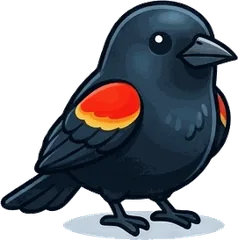 Red-winged Blackbird
The Red-wing's conk-la-ree is louder and ends in a wide buzzing trill; the cowbird's song ends in a thin squeak. A cowbird's rattle is also drier and faster than the Red-wing's check notes.
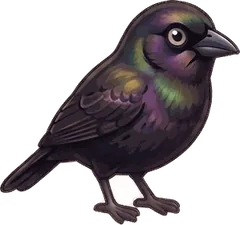 Common Grackle
The grackle's squeak is harsh and grating from start to finish, like a rusty hinge, with none of the cowbird's liquid gurgle at the beginning. Grackles are also much bigger and louder.
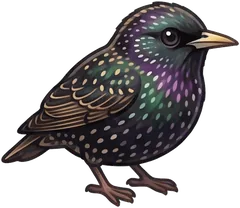 European Starling
Starlings squeak and whistle in long strings and copy other birds, and can slip a cowbird-like whistle into the mix. The cowbird's song is a fixed one-second phrase with a bow attached.
Where the Brown-headed Cowbird card lives
In Warble the same bird can be an easy card in one state and a prized one in another, because each album ranks its birds by how often people really report them there. The Brown-headed Cowbird appears in 49 state albums:
 Heard one? Open Warble, tap the green button while it sings, and the Brown-headed Cowbird card flips into your album. Get the app free.
Questions people ask
Why do cowbirds lay eggs in other birds' nests?
It is the species' whole reproductive strategy, not a mistake. The female builds no nest and instead spreads up to about 40 eggs a season across the nests of other birds, which hatch and raise the chicks. The habit fits a life spent following roaming bison herds.
What is the big brown baby bird that a warbler is feeding?
Probably a young Brown-headed Cowbird. The chick hatches first, grows fast and is often far larger than its foster parents by the time it leaves the nest, still begging from them.
Should I remove cowbird eggs from a nest?
Be careful. In experiments where cowbird eggs were taken out, the cowbird came back and wrecked the host's nest more than half the time. The surest help is habitat: cowbirds avoid large blocks of unbroken forest, so big, connected woods protect the birds they parasitize.
Sources
- National Audubon Society, Guide to North American Birds: Brown-headed Cowbird. www.audubon.org/field-guide/bird/brown-headed-cowbird
- Wikipedia: Brown-headed cowbird (brood parasitism, host counts, history with bison). en.wikipedia.org/wiki/Brown-headed_cowbird
- Missouri Department of Conservation, Field Guide: Brown-headed Cowbird. mdc.mo.gov/discover-nature/field-guide/brown-headed-cowbird
- Wikipedia: Chipping sparrow (nests abandoned after cowbird parasitism). en.wikipedia.org/wiki/Chipping_sparrow