 Warble
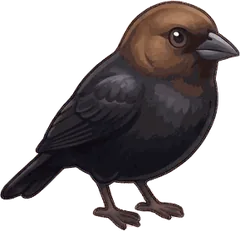
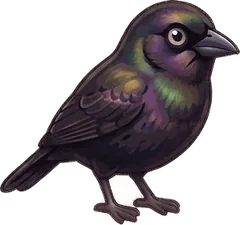
Listen for water or for a rusty gate. A Brown-headed Cowbird sings a few liquid, purring gurgles that end in a high whistle. A Common Grackle gives a harsh, grating squeak, kree-del-eeek, and a loud chlack. By eye, size settles most cases: the grackle is a long, lanky bird of about 12 inches with a yellow eye and a long tail. The cowbird is a compact 7.5 inches, with a dark eye, a short finch-like bill and, on the male, a brown head.
Side by side
| Brown-headed Cowbird | Common Grackle | |
|---|---|---|
| Song | Liquid, purring gurgles ending in a high whistle | A harsh, gurgling squeak, kree-del-eeek; creaky and grating |
| Calls | A high two-note whistle, a harsh stuttering rattle, a soft kek | A harsh chlack; a sharp call like a rusty hinge |
| Size | About 7.5 inches, stocky and compact | 11 to 13 inches, long-legged and long-tailed |
| Bill | Short and thick, almost finch-like | Long and slightly curved |
| Eye | Dark | Yellow in adults |
| Male | Glossy black body, chocolate-brown head | Glossy black with an iridescent blue, purple or green head and a bronzy body |
| Female | Plain gray-brown, pale throat | Duller and browner than the male, with a short tail and pale eye |
| Where and when | Lawns, pastures, roadsides and feedlots; many leave the North in winter | Lawns, parks, farms and shores in the East and Midwest; all year in much of the East |
By ear: a gurgle or a creak
Both birds are said to gurgle, which is where the confusion starts; the difference is texture and ending. A male cowbird's song, as National Geographic describes it, is a series of liquid, purring gurgles that finishes in a high whistle: something like water glugging from a bottle, then a squeak far above it. National Geographic adds that the song spans the highest frequency range of any North American bird.
A grackle's song is harsh all the way through. The Missouri Department of Conservation writes it kree-del-eeek and calls it a harsh, gurgling squeak, and Audubon describes males giving creaking, grating songs from neighboring treetops. One prominent birder, quoted by Missouri, judged that the grackle makes a mistake in trying to sing. If the sound makes you think of a gate that needs oil rather than water going down a drain, it is the grackle.
The calls are just as useful. Cowbirds give a high, two-note whistle and a harsh, stuttering rattle. The grackle's everyday call is a loud, harsh chlack, and Audubon compares its sharp, high call to a rusty hinge. A high whistle from a blackbird on the lawn points to a cowbird; a hard chlack points to a grackle.
By sight: size, eye and bill
Side by side there is no contest. Missouri measures the cowbird at about 7.5 inches and the grackle at 12.5, so the grackle is two-thirds longer. The cowbird is a stocky, compact blackbird with a short, thick bill that looks almost like a finch's, and it often feeds on the ground with its tail cocked up. The grackle is elongated, with long legs, a long tail and a long, slightly curved bill, and it walks a lawn with deliberate steps.
Then look at the head. A male cowbird has a glossy black body and a chocolate-brown head with a dark eye. A male grackle is glossy black with an iridescent head, blue-green to purplish depending on the light, over a bronzy body, and he stares out with a bright yellow eye. In flight a male grackle often holds his long tail in a shallow V, creased down the middle.
Females are where people slip up. A female cowbird is plain gray-brown with few marks, darker wings and tail and a pale throat, and Missouri suggests confirming her by size, bill, shape and the males nearby. A female grackle is duller and browner than the male, with a short, straight tail, but she keeps the long bill and the pale eye. Young grackles have dark eyes, so check the bill on those.
Where you will meet each one
Both are blackbirds of open ground. The cowbird wants open places to forage: lawns, parks, mowed roadsides, pastures, livestock fields and feedlots, with woodland edges nearby where it can find other birds' nests. It never builds its own. A female lays her eggs in other birds' nests and leaves the hosts to raise the young; National Geographic calls it the most widespread brood parasite in North America. Cowbirds ride on cattle to catch the insects they flush, a habit that goes back to the days when they followed bison.
The cowbird is a short-distance migrant. In Missouri it is a common summer resident, but only a few winter in the north of the state, and in winter cowbirds gather in open farmland and at feeders.
The grackle lives throughout the East and Midwest and has been spreading west. It uses farmland, towns, groves and streamsides, and it nests in small colonies, often 10 to 30 pairs, in dense trees, especially conifers. It is a partial migrant that stays all year across much of the eastern United States. Northern birds come back early in spring, and in Missouri the noisy flocks and creaky courtship start in late March. From late summer through winter, watch for big evening flights of grackles heading to communal roosts.
 Still not sure which one is outside? Warble listens while it sings and tells you, then adds the card to your album. Get the app free.
Questions people ask
How do you tell a cowbird from a grackle?
Size, eye and voice. A grackle is about 12 inches long with a long tail, a long bill and a yellow eye, and it gives a harsh kree-del-eeek and a loud chlack. A cowbird is about 7.5 inches with a short, finch-like bill and a dark eye, and it sings a liquid gurgle that ends in a high whistle.
What blackbird has a brown head?
The male Brown-headed Cowbird: a glossy black body with a chocolate-brown head. The Missouri Department of Conservation notes that no other blackbird or grackle in the state looks like that. A male grackle's head shines blue, green or purple instead.
Do grackles lay eggs in other birds' nests like cowbirds?
No. Grackles build their own bulky nests, often in small colonies in dense trees. The cowbird is the one that never builds a nest: females lay their eggs in other birds' nests and leave the hosts to raise the chicks.
Sources
- National Geographic: Brown-headed Cowbird. www.nationalgeographic.com/animals/birds/facts/brown-headed-cowbird
- Missouri Department of Conservation, Field Guide: Brown-headed Cowbird. mdc.mo.gov/discover-nature/field-guide/brown-headed-cowbird
- National Audubon Society, Guide to North American Birds: Common Grackle. www.audubon.org/field-guide/bird/common-grackle
- Missouri Department of Conservation, Field Guide: Common Grackle. mdc.mo.gov/discover-nature/field-guide/common-grackle