 Warble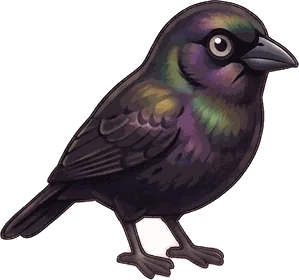
A Common Grackle sounds like a gate that needs oil: a short, harsh squeak that rises and breaks, kree-del-eeek, delivered with the whole body and repeated every few seconds from a treetop or a lawn. There is no melody, only effort. The everyday call is a loud, flat chack, and a flock settling into a roost at dusk makes a dense, creaking racket that Wikipedia compares to buzzing power lines. Grackles also throw in rough imitations of other birds.
What the song sounds like
Calling this a song is generous, and an early ornithologist quoted by the Missouri Department of Conservation said the grackle makes a mistake in trying to sing. What comes out is a grating, scraping squeak, usually written kree-del-eeek or chewink, that climbs in pitch and ends in a strangled screech. It is about a second long, and it sounds like it hurts. In the breeding season the phrase speeds up and finishes with a louder crewhewwhew.
The performance is half the identification. The male fluffs every feather, half spreads his wings and tail, and squeezes the note out, or tips his head back and points his bill straight at the sky, a posture he also uses to stare down other males. Grackles are loose mimics too, and a flock can contain odd snippets of other birds and even human sounds, never as clean as a mockingbird's.
The call: a hard chack
The call is a hard, harsh chack or chlack, louder and deeper than a Red-winged Blackbird's check, given on the ground, in flight and constantly in flocks. Mixed with squeaks and rattles from dozens of birds it becomes the wall of noise you hear from a roost, or from the long evening flights that stream overhead from late summer into winter.
When and where you hear it
Grackles live east of the Rocky Mountains, from Canada to the Gulf, and across most of the eastern United States they are present all year. Northern birds are partial migrants: they leave late in fall and come back very early, flying in daytime flocks. In Missouri the migrants and returning breeders show up in March, and in winter the species thins out in the northern half of the state.
This is a bird of open and half-open country: farmland, town parks, suburban lawns, streamsides, groves, cattle feedlots and marshes. Pairs nest in small colonies, typically 10 to 30 pairs and sometimes more than 100, in dense trees near open ground, with a strong preference for conifers. Outside the nesting season grackles feed in flocks and gather each evening into huge communal roosts, which is why the same lawn can host three grackles in May and three hundred in October. In Warble the squeak is an easy early catch in almost any eastern yard, alongside the European Starling.
They are opportunists. Grackles walk the ground and wade shallow water for grain, insects, earthworms, crayfish, minnows, frogs, eggs and the occasional small bird or mouse, and they will rob an American Robin of its worm. A hard keel inside the bill lets them crack acorns. They also practice anting, rubbing ants through their feathers. Despite the crowds, the species is in decline: a 2011 Audubon analysis of Christmas Bird Count data put the population near 73 million, down 61 percent from a historic high above 190 million, and the IUCN lists it as Near Threatened.
What it looks like
A big, lanky blackbird, 11 to 13 inches long, with a long heavy bill, a pale yellow eye and a long tail that the male often folds into a keel or holds in a shallow V in flight. In good light the black turns iridescent: a blue or purple head over a bronzy body in the widespread Bronzed Grackle, more purple and green with less contrast in the Purple Grackle of the Southeast. Females are smaller and duller with a shorter tail; juveniles are plain brown with dark eyes.
Birds that sound similar
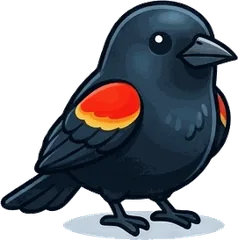 Red-winged Blackbird
The Red-wing's conk-la-ree has a liquid start and a musical, spreading buzz; the grackle's squeak is dry, harsh and rising with no musical part at all. The Red-wing sings from cattails, the grackle from treetops and lawns.
 European Starling
A starling's song is a long, rambling string of squeaks, rasps, whistles and imitations. A grackle gives one short creak, pauses, and gives it again. A starling's copy of a grackle is usually buried in other noises.
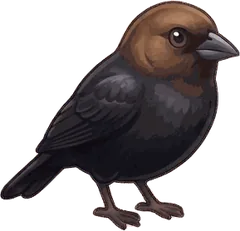 Brown-headed Cowbird
The cowbird's song is a soft, bubbling gurgle that slides up into a thin whistle, quieter and more liquid than the grackle's grinding squeak. Cowbirds also give a stuttering rattle; grackles give a hard chack.
Where the Common Grackle card lives
In Warble the same bird can be an easy card in one state and a prized one in another, because each album ranks its birds by how often people really report them there. The Common Grackle appears in 41 state albums:
 Heard one? Open Warble, tap the green button while it sings, and the Common Grackle card flips into your album. Get the app free.
Questions people ask
Why do grackles make that squeaking noise?
It is the male's song, used to claim a spot and impress females. Grackles have no musical song, so they put on a show instead: feathers fluffed, wings and tail half spread, and a harsh rising creak repeated every few seconds through spring.
Why are there suddenly hundreds of grackles in my yard?
From late summer through winter grackles feed in flocks and roost together by the thousands, often with starlings and other blackbirds. A flock passing through will strip a lawn or a feeder and move on within a day or two.
Are grackles rare now?
Not rare, but shrinking. A 2011 Audubon study of Christmas Bird Count data estimated a 61 percent decline, from a historic high of more than 190 million birds to about 73 million, enough for the IUCN to list the species as Near Threatened.
Sources
- National Audubon Society, Guide to North American Birds: Common Grackle. www.audubon.org/field-guide/bird/common-grackle
- Wikipedia: Common grackle (calls, mimicry, diet, population decline). en.wikipedia.org/wiki/Common_grackle
- Missouri Department of Conservation, Field Guide: Common Grackle. mdc.mo.gov/discover-nature/field-guide/common-grackle