 Warble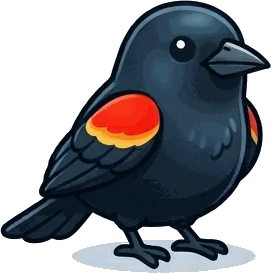
A Red-winged Blackbird sounds like spring arriving in a marsh: a short gurgle that breaks into a loud, buzzy trill, conk-la-reeee, with all the weight on the last syllable. The male sings it from the top of a cattail with his red shoulder patches flared, over and over, from late winter until the young are out. Both sexes give a throaty check call, females answer with a scolding chatter, and in the West the song stretches into a longer oo-PREEEEE-om.
The birder's mnemonic
“conk-la-ree” Audubon writes it o-ka-leeee and Missouri's field guide konk-o-REEE; whichever you pick, the last part is a loud, spreading buzz.
What the song sounds like
The song is a two-part thing. First a couple of low, liquid notes, then a harsh, ringing trill that opens out like a rusty gate: conk-la-reeee. It lasts about a second and the male repeats it every few seconds for as long as he has an audience. The tone is more buzz than whistle, scratchy and musical at once, and it carries across open water. Western birds sing a longer version that Wikipedia renders as ooPREEEEEom.
You rarely hear it without the show. The male climbs a cattail or fence post, fluffs his feathers, half spreads his tail, lifts the leading edge of each wing so the red patches blaze, and sings. He also has a slow, fluttering song flight. Those patches matter: when researchers dyed them black, nearly two thirds of the males lost their territories. Females sing too, a scolding chatter aimed at intruders and at each other.
The call: a throaty check
The workaday call is a throaty check or chack, sometimes written steek, given by both sexes and heard year-round from flocks in fields and feedlots. Near a nest the male adds high, slurred whistles and a stream of alarm notes, and he will fly at crows, hawks and people who come too close. A blackbird diving at your head in June is defending a nest a few feet away.
When and where you hear it
Red-wings nest from Alaska and Newfoundland south to Central America, in freshwater marshes, brushy swamps, wet roadside ditches, hayfields and the upper edge of salt marshes. Birds on the Pacific and Gulf coasts and across the South stay all year. Northern birds head south between August and October and come back between mid-February and mid-May, males first, so the first conk-la-ree of the year often arrives while there is still ice on the pond. In Missouri they are present all year and nesting starts around the middle of April.
Outside the breeding season they gather. Flocks feed in farm fields, pastures and feedlots, and in migration and winter they roost by the thousands, sometimes by the millions, in cattails and dense plantations; one Tennessee roost in the winter of 1975 to 1976 held an estimated 11 million birds. Wikipedia calls the species possibly the most abundant land bird in North America, with a peak breeding population that may top 250 million pairs. It is in every state album in Warble, from Florida to Alaska.
A male defends a patch of marsh and mates with several females, up to ten, each of whom weaves a bulky cup nest into standing cattails or rushes over water and raises two or three broods. Adults walk the ground to feed, eating roughly three parts seeds to one part insects, with more beetles, caterpillars and dragonflies in summer.
What it looks like
The male is glossy black, a bit smaller than a robin, with a red shoulder patch edged in yellow; when he is feeding quietly the red can be almost hidden and only the yellow edge shows. The female looks like a large, dark, heavily streaked sparrow: brown above, whitish below with bold brown streaks, a pale eyebrow and a pointed blackbird bill. Older females pick up a salmon or pink wash on the throat and shoulders.
Birds that sound similar
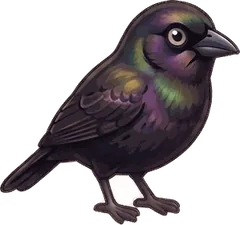 Common Grackle
The grackle's song is a single harsh squeak like a rusty hinge, kree-del-eeek, without the liquid opening or the spreading buzz. Its chack is deeper and louder than the Red-wing's check.
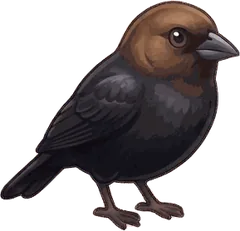 Brown-headed Cowbird
A cowbird's song is a soft, liquid gurgle that ends in a thin, high whistle, quieter and squeakier than the blackbird's buzzing trill. Listen also for the cowbird's stuttering rattle and two-note flight whistle.
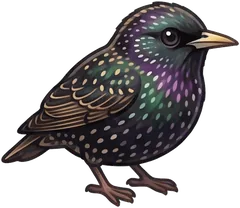 European Starling
Starlings squeak, rasp and whistle in long rambling strings and imitate other birds. A real conk-la-ree is one short, fixed phrase repeated from a marsh; a starling's copy sits inside a longer jumble from a rooftop.
Where the Red-winged Blackbird card lives
In Warble the same bird can be an easy card in one state and a prized one in another, because each album ranks its birds by how often people really report them there. The Red-winged Blackbird appears in 49 state albums:
 Heard one? Open Warble, tap the green button while it sings, and the Red-winged Blackbird card flips into your album. Get the app free.
Questions people ask
Why do Red-winged Blackbirds attack people?
A male is defending a nest. During the nesting season he dives at crows, hawks and anything else that comes close, and a person on a path beside the marsh counts. Keep walking; he stops as soon as you leave his patch.
When do Red-winged Blackbirds start singing?
In late winter. Northern males return from mid-February onward, weeks ahead of the females, and start singing as soon as they arrive. In the South and along the coasts the birds stay year-round, and in Missouri nesting is under way by mid-April.
Is the female Red-winged Blackbird a sparrow?
No, though it fools almost everyone. The female is streaky brown with a pale eyebrow, but she is larger than a sparrow, has a sharp pointed bill, and gives the same throaty check as the male. Look for her in the cattails near a singing male.
How many Red-winged Blackbirds are there?
A lot. Wikipedia describes it as perhaps the most abundant land bird in North America, with a breeding population that may exceed 250 million pairs in peak years, and single winter roosts have been estimated in the millions.
Sources
- National Audubon Society, Guide to North American Birds: Red-winged Blackbird. www.audubon.org/field-guide/bird/red-winged-blackbird
- Wikipedia: Red-winged blackbird (song, display, abundance, roosts). en.wikipedia.org/wiki/Red-winged_blackbird
- Missouri Department of Conservation, Field Guide: Red-winged Blackbird. mdc.mo.gov/discover-nature/field-guide/red-winged-blackbird