 Warble
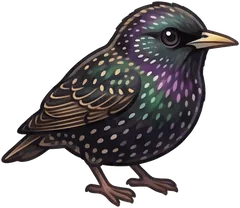
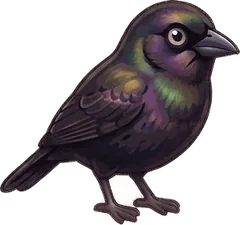
Listen for variety. A European Starling rambles: bouts of a minute or more that mix pure whistles, clicks, squeaks and rasps with imitations of other birds, plus a clear, falling whee-ee. A Common Grackle has one short, harsh, creaking squeak, kree-del-eeek, and a hard chlack, and not much else. By sight, the starling is robin-sized and round-bellied, with a short tail and a sharp, pointed bill; the grackle is bigger and lankier, with a long tail and a pale yellow eye.
Side by side
| European Starling | Common Grackle | |
|---|---|---|
| Song | Long, rambling bouts of whistles, clicks, squeaks and rasps, with imitations of other birds | A short, harsh, creaking squeak, kree-del-eeek |
| Calls | A clear, descending whistle, whee-ee | A hard chlack; a sharp call like a rusty hinge; clucks |
| Size | 8 to 9 inches, about robin-sized | 11 to 13.4 inches |
| Tail | Short, square or notched | Long and rounded; males fly with it held in a shallow V |
| Bill | Thin, straight and sharp; yellow in spring and summer | Long, strong and slightly curved |
| Plumage | Glossy black with purple and green; covered in white spots after the fall molt | Glossy black with a blue, purple or bronze sheen; pale yellow eye |
| On the ground | Walks or runs with a slight waddle, probing the soil | Walks with deliberate steps |
| Where and when | Towns, suburbs and farms across most of the continent, all year in the south | Open country, towns and lawns in the East and Midwest, all year in much of the East |
By ear: a medley or a creak
A singing starling sounds like someone flipping through radio stations. Audubon describes the song as discordant, squeaky and rasping, a wheezing, sputtering run broken up with perfect imitations of other birds. Wikipedia lays out the structure: a bout lasts a minute or more, opens with pure whistles, then wanders through variable sequences that often include copies of other birds and of man-made sounds. A skilled male may carry up to 35 song types.
The one clean note is the call, a clear whistle that slides downward, whee-ee. Flocks add steady chatter at roosts and birdbaths.
The grackle has far less to say. Missouri's field guide writes the song as a harsh, gurgling squeak, kree del eeeek, and quotes a prominent birder who judged that the grackle had made a mistake in trying to sing. Audubon calls the songs creaking and grating, and describes the courting male fluffing his body feathers, half spreading his wings and tail, and squeezing out a short, scraping song before pointing his bill straight up. The calls are a harsh chlack, a high, sharp note Audubon compares to a rusty hinge, and low clucks.
So the test is change against repetition. If the sound keeps changing, from a whistle to a click to a borrowed song, you are hearing a starling. If it is one short, rough squeak, with a hard chlack now and then, it is a grackle.
By sight: tail, shape and spots
Shape is the quick tell. A starling is about the size of a robin, 8 to 9 inches long, with a round belly, a short, square or slightly notched tail and a thin, straight, sharp bill. In flight its wings are strongly pointed, and it flies strong and direct, gliding briefly between bursts of wingbeats. A grackle is 11 to 13.4 inches long, and much of the difference is tail: long and rounded, with a crease down the middle. Males often fly with it held in a shallow V, and in the breeding season its edges curl upward. The bill is long, strong and slightly curved.
Color helps too, because the starling changes outfits. In spring and summer it is black with a purple and green gloss and a bright yellow bill. After the fall molt it is heavily marked with white spots, which gradually wear off over the winter, and the bill turns dark. Young starlings in summer are dusty gray with dark bills. A grackle is glossy black, with an iridescent blue or purple head over a bronzy body in the widespread Bronzed form. Adults have a pale yellow eye; juveniles have dark eyes, and females are duller and browner, with a shorter tail.
Watch them walk. A starling walks or runs with a slightly waddling gait, stopping to probe the lawn with its bill. A grackle walks the grass with deliberate steps, hunting for insects.
Where you will meet each one
The starling is an import. About 60 were released in New York's Central Park in 1890, and a club in Portland, Oregon released more around the same time. Today an estimated 150 million range from southern Canada and Alaska to Central America. They are most numerous in cities, suburbs and farm country. Southern birds stay all year; many northern birds move south in fall.
The grackle is native and more particular about the map: it lives through the East and Midwest and has been spreading west in recent decades. It likes open and semi-open country, farmland, towns, groves, streamsides, lawns and feedlots, and nests in colonies in dense trees, especially conifers. It is present all year across much of the East; northern birds return early in spring and leave late in fall.
So away from the grackle's range in the East and Midwest, the starling is the likelier of the two. In the East you will often see both on the same grass. From late summer through winter both gather in big flocks, and grackles stream overhead in the evening toward their communal roosts.
 Still not sure which one is outside? Warble listens while it sings and tells you, then adds the card to your album. Get the app free.
Questions people ask
What is the difference between a starling and a grackle?
Size, tail and voice. A starling is robin-sized and short-tailed and sings a long medley of whistles, clicks and imitations. A grackle is bigger, with a long tail and a yellow eye, and gives one harsh, creaking squeak.
Which black bird has yellow eyes?
Of these two, the adult Common Grackle, which has a pale yellow eye. Young grackles have dark eyes, and females are duller and browner, with shorter tails.
Why do starlings have white spots?
After the fall molt the fresh plumage is heavily marked with white spots. They gradually wear off over the winter, so by spring the bird is glossy black again, with a yellow bill.
Sources
- National Audubon Society, Guide to North American Birds: European Starling. www.audubon.org/field-guide/bird/european-starling
- National Audubon Society, Guide to North American Birds: Common Grackle. www.audubon.org/field-guide/bird/common-grackle
- Missouri Department of Conservation, Field Guide: Common Grackle. mdc.mo.gov/discover-nature/field-guide/common-grackle
- Wikipedia: Common starling (song structure, mimicry, flight, gait, introduction). en.wikipedia.org/wiki/Common_starling