 Warble
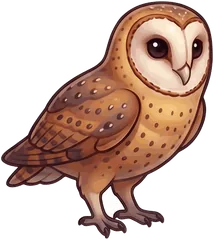
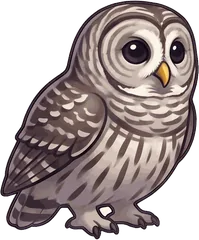
Listen for a hoot. A Barred Owl hoots, loudly, in a barking phrase that fits who cooks for you, who cooks for you-all, ending in a drawn-out hoo-aw. A Barn Owl does not hoot at all: its call is a harsh scream that lasts a few seconds. Both have dark eyes and no ear tufts, so if you get a look, check the face and color. A Barn Owl is pale, with a white, heart-shaped face. A Barred Owl is brown and white, round-headed and barred across the chest.
Side by side
| Barn Owl | Barred Owl | |
|---|---|---|
| Main call | A harsh screech or scream lasting a few seconds; never a hoot | A loud, barking who cooks for you, who cooks for you-all, ending in hoo-aw |
| Other sounds | Hisses, guttural grunts, bill snapping; young give rapid clicks | Other barking calls and screams; pairs call back and forth |
| Face | White and heart-shaped, dark eyes, no ear tufts | Round head, dark eyes, no ear tufts |
| Body | Cinnamon and gray above, white to buff below, small black spots, long legs | Brown and white, bars across the chest, streaks down the belly |
| Size | 13 to 16 inches; 15 ounces to 1 pound 9 ounces | 17 to 20 inches; 1 to about 2.3 pounds |
| Hunts | Mainly at night, seldom by day, low over open ground | Mostly at night, but also by day, perhaps most at dawn and dusk |
| Habitat | Farmland, marsh, prairie; nests in barns, steeples and hollow trees | Dense, wet woods, river bottoms and swamps; nests in big tree hollows |
By ear: a hoot or a scream
The Barred Owl is the hooter. Its classic call is a loud, barking run of hoots in two halves, hoo hoo h'hoo, hoo hoo h'hoo-ahh, which matches the mnemonic who cooks for you, who cooks for you-all. The last note is the signature: a drawn-out hooo-aw that falls away at the end. The voice can be oddly hard to locate, and pairs often call back and forth, sometimes in a duet.
The Barn Owl never gives anything like that. The Missouri Department of Conservation puts it plainly: they do not hoot. The main call is a harsh screech or scream that lasts a few seconds and then stops, nothing like the owl of cartoons. Close to a roost or nest you may also hear hissing, guttural grunts, bill snapping, and from the young, rapid clicks that Audubon compares to a grackle.
The one place the two can overlap is the screaming. Barred Owls have other barking calls and screams besides the hoot, and a pair in full voice can sound wild. The difference is the company the scream keeps. Barred Owl screams come mixed with hoots and barks, usually from deep woods, and often from two birds answering each other. A Barn Owl gives a harsh scream with no hoots anywhere in the conversation, and it lives over open fields, farmyards and marsh.
If a lone screech is all you have, also consider the Eastern Screech-Owl, whose defensive screech can pass for a Barn Owl's; its usual song is a descending trill.
By sight: heart face or barred chest
These are the two large owls of the East with dark eyes, and neither has ear tufts, so eye color and tufts will not help. Look at the face and the overall tone instead.
A Barn Owl is pale. The face is a whitish, heart-shaped disk, the source of its nickname, monkey-faced owl. The upperparts are cinnamon and gray, the underparts white to buff with small black spots, and the legs are long. Caught in headlights over a field, it can look almost white. It is the smaller of the two, 13 to 16 inches long, and it flies with slow, buoyant wingbeats.
A Barred Owl is bigger, 17 to 20 inches long and up to about 2.3 pounds, with a large, round head. It is brown and white all over: horizontal bars across the chest, then vertical streaks down the belly, the pattern that gives it its name. There is no white heart. Females of both species are larger than males, so size alone is a weak clue on a single bird; the face and the barring are not.
Where and when you will meet each one
The Barn Owl is a bird of open or semi-open lowland country: farmland, pasture, brushy fields, marsh, prairie and even desert, wherever rodents are plentiful. It nests in hollow trees and caves but is famous for buildings: barn lofts, grain elevators, church steeples, abandoned houses and the nest boxes landowners put up for rodent control. It is highly nocturnal, often waiting several hours after dark before leaving its roost, then flying slowly and low over grassland, and it can catch prey in total darkness by sound alone. Nesting can happen in any month. In Missouri it is a rare resident, present all year.
The Barred Owl wants big trees near water: dense woods with scattered clearings, wooded river bottoms, swamps and the timber along lakes and streams. It nests 20 to 40 feet up in a tree hollow or an old hawk or crow nest. It is active mostly at night but also calls and hunts in daylight, so a hoot at midday is no surprise. In Missouri, courtship runs February through March, a good time to listen. It stays all year, and it has spread into the Pacific Northwest, where it competes with the smaller Spotted Owl.
So the setting is a strong clue. A barking who cooks for you from a swampy creek bottom is a Barred Owl. A scream over a hayfield beside an old barn points to a Barn Owl.
 Still not sure which one is outside? Warble listens while it sings and tells you, then adds the card to your album. Get the app free.
Questions people ask
Do Barn Owls hoot?
No. A Barn Owl's main call is a harsh scream lasting a few seconds, and it also hisses, grunts, snaps its bill and clicks. If you hear a hoot, especially a barking who cooks for you, it is a different owl, such as a Barred Owl.
What owl says who cooks for you?
The Barred Owl. Its loud, barking hoots come in two groups that fit who cooks for you, who cooks for you-all, with the final note sliding down into a drawn-out hoo-aw.
Sources
- National Audubon Society, Guide to North American Birds: American Barn Owl. www.audubon.org/field-guide/bird/american-barn-owl
- National Audubon Society, Guide to North American Birds: Barred Owl. www.audubon.org/field-guide/bird/barred-owl
- Missouri Department of Conservation field guide: Barn Owl (voice, similar species, behavior). mdc.mo.gov/discover-nature/field-guide/barn-owl
- Missouri Department of Conservation field guide: Barred Owl (voice, dark eyes, nesting, behavior). mdc.mo.gov/discover-nature/field-guide/barred-owl