 Warble
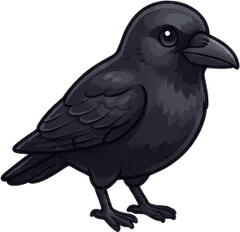
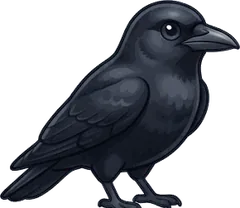
Listen, because looking will not settle it. An American Crow says caw-caw: loud, short, open notes, the head bobbing with each one. A Fish Crow sounds like the same bird with a stuffed-up nose: a nasal, two-note ah-ah (birders also write it nyuh-unh) and a single nasal kwok; neither is a true caw. Audubon says the Fish Crow can be recognized with certainty only by sound. One catch: young American Crows give nasal calls too, including a kwok, in the breeding season.
Side by side
| American Crow | Fish Crow | |
|---|---|---|
| Main call | A loud, short, rapid caw-caw-caw or caa-caa | Nasal and short: a two-note ah-ah or nyuh-unh, and a single kwok |
| Other calls | A short rattling song in courtship; imitations of other animals, such as Barred Owls | A nasal ark-ark-ark, a drawn-out cahrrr, a begging waw-waw |
| How it calls | Thrusts its head up and down | Hunches and fluffs out its throat feathers |
| Size | 16 to 21 inches | 14 to 16 inches, slightly smaller |
| Build | Strong bill; broad, rounded wings | Slimmer bill and feet, shorter-looking legs, slightly more pointed wingtips |
| Plumage | Iridescent black all over | Silkier, with a blue or blue-green sheen above |
| Where and when | Almost every habitat coast to coast except tundra; all year in most of the US | Atlantic and Gulf coasts and big river valleys inland; mostly resident |
By ear: caw or ah-ah
The American Crow's voice is the crow sound everyone knows. Audubon writes it caw-caw or caa-caa; Wikipedia describes a loud, short, rapid run of caaw notes, given while the bird thrusts its head up and down. Crows have other sounds too, including a short rattling song from courting males and imitations of other animals, Barred Owls among them, but the caw is what carries across a parking lot.
The Fish Crow never quite gets to the caw. Audubon lists two main calls, both different from the American Crow's: a nasal kwok and a nasal, two-note ah-ah. Wikipedia passes on a birders' memory aid that sets the American Crow's caw caw against the Fish Crow's nasal nyuh unh, which is about what a person sounds like when they mean no. Wikipedia also gives a nasal ark-ark-ark, a single drawn-out cahrrr and a begging waw-waw. Everything it says sounds pinched, as if it had a head cold.
Watch the bird as it calls if you can. Wikipedia notes that a Fish Crow hunches and fluffs out its throat feathers when it calls, which an American Crow does not do; the American Crow pumps its head instead.
The trap is summer. Audubon warns that young American Crows make many nasal calls, and in the breeding season they give a kwok much like a Fish Crow's. So a lone nasal note from a crow family in June proves little. A two-note ah-ah, or a nasal flock working a beach with no caw anywhere in it, is better evidence.
By sight: barely possible
Both crows are entirely black, and the sources do not soften it: Audubon says the Fish Crow is recognized with certainty only by sound, and Wikipedia calls identification by sight very difficult and often inaccurate. The marks exist, but they are small and mostly useful with both birds side by side.
The Fish Crow is a little smaller, 14 to 16 inches long against 16 to 21 for the American Crow. Its plumage looks silkier, with a blue or blue-green sheen on the upperparts and a greenish-black tone below. The bill and feet are slimmer, the upper bill may end in a small, sharp hook, and the bird looks shorter-legged when it walks. Audubon adds slightly more pointed wingtips. The American Crow, by comparison, has a strong bill, broad wings rounded at the ends and a relatively short, square-tipped tail. None of that will name a lone bird on a wire. The calling posture, hunched with a puffed throat, is the most useful visual clue, and it comes with the sound anyway.
Where you will meet each one
The American Crow is everywhere. It lives from the Atlantic to the Pacific across Canada and the United States and into northern Mexico, in nearly every habitat from wilderness and farmland to city parks, missing only from the tundra and avoiding hot desert. It is a year-round resident in most of the country, while most Canadian birds move south in winter. Outside the nesting season crows gather at night in communal roosts of thousands of birds or more.
The Fish Crow is tied to water. It lives along the Atlantic coast from Maine to Key West and west along the northern Gulf of Mexico, and it has spread inland along river systems since the early 1900s, in recent decades especially up the Atlantic coastal plain and far up the Mississippi Valley. Since 2012 it has bred in Canada along Lake Ontario. Look for it on beaches, salt marshes, tidal flats and estuaries, along big rivers and swamps inland, and around nearby towns, landfills and fields. It is mostly a permanent resident, though it pulls out of some inland areas in winter.
It earns its name on the shore, walking the beach and wading shallow water for crabs, shrimp, crayfish and stranded fish, sometimes hovering to pluck prey with its feet. It also raids heron colonies for eggs. So away from the coasts and the big river valleys the Fish Crow follows inland, a crow is almost surely an American Crow. Where the ranges meet, both can turn up in the same town, and only the voice will sort them out.
 Still not sure which one is outside? Warble listens while it sings and tells you, then adds the card to your album. Get the app free.
Questions people ask
How do you tell a fish crow from an American crow?
By voice. An American Crow gives a clear, open caw; a Fish Crow gives a nasal, two-note ah-ah and a short, nasal kwok. Audubon says only sound identifies a Fish Crow with certainty.
Why does a crow sound nasal?
It may be a Fish Crow, whose every call is nasal. But young American Crows also make many nasal calls, including a Fish Crow-like kwok in the breeding season, so wait for the two-note ah-ah before calling it.
Where do fish crows live?
Along the Atlantic coast from Maine to Key West and the northern Gulf Coast, and inland along big rivers, especially up the Atlantic coastal plain and the Mississippi Valley.
Sources
- National Audubon Society, Guide to North American Birds: Fish Crow. www.audubon.org/field-guide/bird/fish-crow
- National Audubon Society, Guide to North American Birds: American Crow. www.audubon.org/field-guide/bird/american-crow
- Wikipedia: Fish crow (calls, field marks, range expansion). en.wikipedia.org/wiki/Fish_crow
- Wikipedia: American crow (call, calling posture, telling it from the fish crow, range, roosts). en.wikipedia.org/wiki/American_crow