 Warble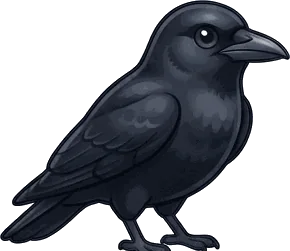
A Fish Crow sounds like an American Crow with a head cold. Its calls are shorter and distinctly nasal: a two-note uh-uh or ah-ah, like someone saying no, and a single clipped kwok or cawk, sometimes run into a series, ark-ark-ark. There is no clear, open caw in its vocabulary. Because the two crows look nearly identical, that nasal quality is the one field mark that works, and birders lean on it from Maine to Texas.
The birder's mnemonic
“uh-uh” The old birders' joke: ask the crow whether it is an American Crow. If it says uh-uh, it is a Fish Crow.
The calls, and why they matter
Fish Crows have no song, only calls, and every one of them is a nasal version of something an American Crow might say. The signature is the double note, written uh-uh, ah-ah or nyuh unh, with the second syllable a little lower, like a grunted refusal. Alongside it come a short kwok or cawk, a drawn-out cahrrr, and a rapid ark-ark-ark when a flock is stirred up. Females call at a higher pitch than males.
Compare that with the American Crow's familiar caw-caw, which is open, loud and comparatively clear. The Fish Crow's notes are more pinched and hollow, as if the bird were calling through its nose. Once you have heard the two side by side, which happens often where the ranges overlap, the difference is hard to unhear.
Other sounds
Territorial and mobbing birds give a harsher awwr, and aggressive encounters bring out a rattle. Nestlings and incubating females beg with a whining waw-waw. Fish Crows call throughout the day all year, more so in the breeding season, and a roost gathering in the evening can be loud.
When and where you hear it
Fish Crows are birds of the Atlantic and Gulf coasts, from Maine south to the Florida Keys and west along the Gulf. They follow big rivers inland: the range has pushed steadily up the Atlantic coastal plain and far up the Mississippi Valley, and birds are now found as far inland as Iowa, Kansas and Nebraska. Since 2012 they have crossed into Canada along Lake Ontario. Habitat is anywhere near water: beaches, salt marshes, estuaries, tidal rivers, lakes, swamps, and the towns, farms and parking lots around them.
Many populations are partly migratory. Birds winter on the coast and move inland to breed from March to June, leaving the breeding areas again in September, though the timing varies from place to place. Outside the breeding season they roost communally in trees or marshes, sometimes alongside American Crows, herons, egrets and gulls.
Diet is anything: crabs, shrimp, crayfish, stranded fish, insects, berries, seeds, nuts, carrion and garbage. Eggs are a specialty. Fish Crows raid the nests of colonial waterbirds and dig up turtle eggs, and a crow will carry a mollusk into the air and drop it on rocks to break it. They forage by walking the shoreline and wading the shallows. Nesting is in loose colonies: a bulky platform of sticks and bark strips in a tree fork, with four or five blue-green eggs. The species appears in the Warble albums of the coastal and river states, where it is the crow whose call has to be separated from the American Crow's.
What it looks like
Smaller than an American Crow, fourteen to sixteen inches long against the American Crow's sixteen to twenty-one, but the difference is useless unless the two are standing together. The plumage is entirely black with a silky, smooth look and a blue-green sheen, the bill and feet are a little slimmer, and the bird looks shorter-legged when it walks. The wingtips are slightly more pointed. Field guides are blunt about it: identifying a lone Fish Crow by sight is unreliable, and even experienced birders wait for it to call.
Birds that sound similar
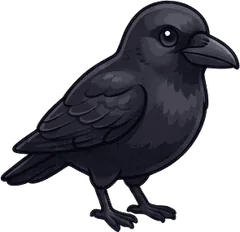 American Crow
The American Crow's caw is open, loud and clear. Fish Crow notes are nasal, hollow and shorter, and the two-note uh-uh is the giveaway. Where both live, listen before you write anything down.
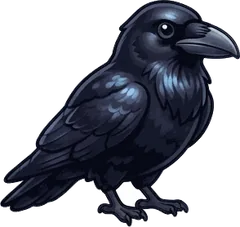 Common Raven
A Common Raven croaks, a deep, rolling prruk-prruk or hollow wonk-wonk, far lower than any crow. It is also much bigger, with a wedge-shaped tail and a shaggy throat, and it soars where crows flap.
Where the Fish Crow card lives
In Warble the same bird can be an easy card in one state and a prized one in another, because each album ranks its birds by how often people really report them there. The Fish Crow appears in 21 state albums:
 Heard one? Open Warble, tap the green button while it sings, and the Fish Crow card flips into your album. Get the app free.
Questions people ask
How do I tell a fish crow from an American crow?
By voice. A Fish Crow says a nasal, two-syllable uh-uh or a short kwok; an American Crow says a clear caw. The Fish Crow is smaller, silkier and slimmer-billed, but those marks only help with the birds side by side. If it has not called, most birders leave it unidentified.
Why does this crow sound like it is saying no?
Because its main call is a two-note uh-uh with the second note dropping, exactly the sound of a grunted refusal. It is the everyday contact call of the Fish Crow, and it is nasal all year round, which is what gives the bird away.
Are fish crows only found at the coast?
Not anymore. The species began as a bird of Atlantic and Gulf shorelines, but it has spread inland along big rivers, up the Atlantic coastal plain and the Mississippi Valley, into Iowa, Kansas and Nebraska, and since 2012 into Canada on Lake Ontario. Water is still the common thread.
Do fish crows eat other birds' eggs?
Yes, regularly. Eggs and nestlings of colonial waterbirds are a major food, along with turtle eggs dug from beaches. The crows hunt by sight, and nests in the open lose more eggs than hidden ones.
Sources
- National Audubon Society, Guide to North American Birds: Fish Crow. www.audubon.org/field-guide/bird/fish-crow
- Wikipedia: Fish crow (calls, size, field marks and range expansion). en.wikipedia.org/wiki/Fish_crow
- Animal Diversity Web (University of Michigan): Corvus ossifragus. animaldiversity.org/accounts/Corvus_ossifragus/
- National Audubon Society, Guide to North American Birds: American Crow (for the comparison). www.audubon.org/field-guide/bird/american-crow