 Warble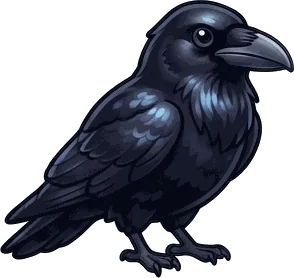
A Common Raven sounds like a crow pitched down and roughened up: a deep, hoarse, rolling croak, written prruk-prruk-prruk or a hollow wonk-wonk, far lower than an American Crow's caw. Ravens have somewhere between 15 and 30 distinct calls, including a dry grating kraa, a knocking toc-toc-toc, low gurgling rattles and a few notes that are almost musical. Most of it comes from a big black bird soaring overhead, which crows rarely do.
The croak and everything else
The basic sound is the croak: deep, resonant, a little rolled, usually given two or three times, prruk-prruk-prruk. Audubon renders the common flight call as a hollow wonk-wonk. Both carry a long way over a canyon or a ridge, and both are unmistakably lower than anything a crow can produce. Where crows sound like they are shouting, ravens sound like they are talking from the bottom of a barrel.
Then the repertoire opens up. Researchers sort raven calls into 15 to 30 categories: a dry, grating kraa; a high knocking toc-toc-toc; a low guttural rattle; and soft, oddly musical notes exchanged between mates. Young birds practice, running through their whole range of sounds, pitches and volumes in what amounts to vocal play. Ravens also make noise without their voice: the wings whistle in flight and the bill snaps.
Telling it from a crow by ear
The American Crow says caw-caw, loud, flat and clear. A raven croaks, and the croak is deeper, rougher and more drawn out. If the call is low enough to feel in your chest, and the bird making it is gliding on flat wings rather than rowing steadily along, you have a raven. The Fish Crow of the East is confusing in the other direction, a small crow with a nasal, pinched uh-uh; nothing about it is deep.
When and where you hear it
Ravens live around the top of the world, across North America, Europe, Asia and North Africa, in country most birds find hard: tundra, sea cliffs, deserts, mountain and boreal forest, open plains with woodland nearby. In the United States they are common through the West and the North. They were once widespread in the East as well, but persecution wiped them out of most of the eastern states before 1900. They are coming back, especially in the Northeast and southward through the Appalachians.
They do not migrate. Pairs stay on a territory year-round and mate for life, nesting on a cliff ledge or high in a tall tree, often a conifer, and sometimes on a utility pole or an old building. The bulky stick nest may be reused for years. Four to six eggs are laid and the young fly at five to seven weeks. Listen for ravens over ridgelines, along coastal cliffs and around landfills. In Warble they are on the card list in the western and northern states and, increasingly, the Appalachian ones.
In the air
Ravens soar and glide far more than crows, riding the lift along ridges, and they play up there: rolls, loops, dives, and pairs locking talons and falling together. A courting male soars, swoops and tumbles above the female. Despite their bulk they are as agile in the air as their smaller cousins.
What it looks like
The largest perching bird and the heaviest songbird in the world, 21 to 28 inches long with a wingspan of four feet or more and a weight of up to about five pounds; an American Crow is 16 to 21 inches. Everything is black. The marks to learn are the tail, long and wedge-shaped in flight where a crow's is short and square; the bill, huge and slightly curved; and the throat, where shaggy feathers called hackles bristle when the bird calls or displays. Wild ravens usually live 10 to 15 years, with a record past 23, and they are famously clever: pulling up a string to reach hanging meat, remembering where other ravens hid food in order to steal it, and, as juveniles, sliding down snowbanks, apparently for fun.
Birds that sound similar
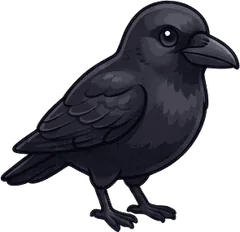 American Crow
A crow caws, clear, flat and loud. A raven croaks, deeper, hoarser and rolled. Size is hard to judge on a lone bird; the voice, the wedge tail and the soaring flight are what settle it.
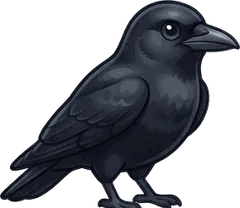 Fish Crow
Along the East Coast the Fish Crow is the other crow-like voice, but it goes the other way: small, short and nasal, a two-note uh-uh. A raven's croak is deep and resonant and never nasal.
Where the Common Raven card lives
In Warble the same bird can be an easy card in one state and a prized one in another, because each album ranks its birds by how often people really report them there. The Common Raven appears in 25 state albums:
 Heard one? Open Warble, tap the green button while it sings, and the Common Raven card flips into your album. Get the app free.
Questions people ask
How can I tell a raven from a crow?
Listen first. A raven gives a deep, hoarse croak; a crow gives a clear caw. Then watch it fly: a raven soars and glides on flat wings and shows a long, wedge-shaped tail, while a crow flaps steadily and has a short, square tail. Up close the raven's massive bill and shaggy throat feathers clinch it.
Are there ravens in the eastern United States?
Yes, and more every year. Ravens were driven out of most of the East before 1900 but have been spreading back, especially through the Northeast and down the Appalachian mountains. They remain most common in the West, the North and the mountains.
Why do ravens do flips and rolls in the air?
Partly courtship, partly play. A displaying male soars, swoops and tumbles; pairs sometimes lock talons and fall together, and ravens have been seen flying loops for no obvious purpose. They are among the most playful of birds and easily as agile in the air as smaller crows.
How many different sounds can a raven make?
Researchers sort raven calls into roughly 15 to 30 categories, from the deep croak and the hollow wonk-wonk to knocking, rattling, grating and almost musical notes, plus wing whistles and bill snaps.
Sources
- National Audubon Society, Guide to North American Birds: Common Raven. www.audubon.org/field-guide/bird/common-raven
- Wikipedia: Common raven (vocalizations, size, flight, range and intelligence). en.wikipedia.org/wiki/Common_raven
- Animal Diversity Web (University of Michigan): Corvus corax. animaldiversity.org/accounts/Corvus_corax/
- National Audubon Society, Guide to North American Birds: American Crow (for the comparison). www.audubon.org/field-guide/bird/american-crow