 Warble
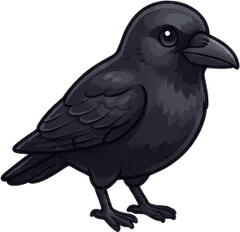
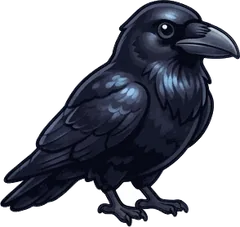
Listen first. An American Crow says caw: loud, short, flat notes in a quick series. A Common Raven croaks: a deep, guttural, rolling prruk or a hollow wonk-wonk, lower and more resonant than any caw. If the bird is in view, look at the tail as it passes over: a crow's is fairly short and squared off, a raven's long and wedge-shaped. Then watch how it flies. Ravens soar for long stretches, while crows rarely go more than a few seconds without flapping.
Side by side
| American Crow | Common Raven | |
|---|---|---|
| Main call | A loud, short, flat caw-caw-caw, the head bobbing with each note | A deep, guttural, rolling croak, prruk-prruk, or a hollow wonk-wonk |
| Other sounds | Rattles and other notes; sometimes copies other animals, Barred Owls included | 15 to 30 call types, including a knocking toc-toc-toc, a grating kraa and wing whistles |
| Size | 16 to 21 inches | Much larger, about hawk-sized: 22 to 27 inches |
| Tail | Relatively short, square-tipped | Long and wedge-shaped |
| Bill and throat | Strong bill | Very thick, slightly curved bill; shaggy throat feathers |
| Flight | Steady flapping, rarely gliding more than a few seconds | Long soaring with little flapping; rolls and tumbles in courtship |
| Where and when | Farms, fields, shores, towns and city parks across most of the US, all year | Mountains, forests, cliffs, deserts and tundra; mostly West and North, returning to the East |
By ear: caw or croak
The crow's voice is the one everyone learned as a child: caw-caw or caa-caa, loud, short and flat, given in a quick run while the bird pumps its head with every note. Crows have more than that, including rattles (a courting male bows to the female and gives a short rattling song) and imitations of other animals, Barred Owls among them. But the caw is what carries.
A raven does not caw. Its everyday call is a croak: deep, guttural and resonant, written prruk-prruk-prruk on Wikipedia and as a hollow wonk-wonk by Audubon. Wikipedia notes that people who know the crow family find this call unlike that of any relative, and Audubon points out that a deep croak from high above is often the first sign of a raven pair soaring overhead. Where a crow sounds like it is shouting, a raven sounds like it is talking from the bottom of a well.
The catch is that ravens have a big vocabulary. Their calls have been sorted into 15 to 30 categories, among them a high knocking toc-toc-toc, a dry, grating kraa, a low rattle and a few notes that are almost musical. They can mimic other sounds, human speech included, and their feathers creak and whistle in flight. So one odd note proves little. Wait for the croak: a single deep, rolling croak settles it in a way that size, judged against an empty sky, often cannot.
By sight: the tail and the flight
Both birds are black all over, so the useful marks are shape. A crow has a strong bill, broad wings rounded at the ends and a relatively short tail with a square tip. A raven is much bigger, roughly the size of a hawk; Audubon gives 16 to 21 inches for the crow and 22 to 27 for the raven. The raven's bill is very thick and slightly curved, the feathers on its throat are long and shaggy, its head looks larger, and its wings are longer and narrower.
The tail is the best single mark when the bird is overhead: square on a crow, long and wedge-shaped on a raven, almost a diamond at the end. Flight style comes next. Ravens soar for long periods with little flapping, pairs may soar high together, and in courtship the male swoops and tumbles in midair. Crows rarely go more than a few seconds without a wingbeat. Do not lean on the throat alone, though: both birds fluff their throat feathers when they call.
Where you will meet each one
The American Crow is the bird of the places people live. It uses almost any semi-open country, from woodlands, farms, fields, river groves and shores to towns, and it increasingly nests in city parks. It lives from coast to coast across most of North America, though it is absent from the tundra and avoids hot desert. Most crows in the United States stay all year, while most Canadian birds come south for winter. Outside the nesting season they gather at night in communal roosts, sometimes thousands of birds in a single grove.
The Common Raven prefers wilder ground: boreal and mountain forest, coastal cliffs, tundra and desert, from above the Arctic Circle to the hot Southwest. Compared with crows it favors undisturbed mountain, forest or rural country over towns, though in parts of California ravens have increased by feeding near people. They disappeared from much of the eastern and midwestern United States before 1900 and have been spreading back in recent decades, especially in the Northeast and southward into places they once lived.
So the map helps. In eastern towns and farm country, expect a crow; listen for ravens on mountains and cliffs and in the Northeast. Across much of the West and North the two overlap, and that is where the ear earns its keep. In the desert Southwest, Audubon adds one more bird to check: the Chihuahuan Raven.
 Still not sure which one is outside? Warble listens while it sings and tells you, then adds the card to your album. Get the app free.
Questions people ask
What is the difference between a crow and a raven sound?
A crow caws: loud, short, flat caw-caw-caw notes. A raven croaks: a deep, guttural, rolling prruk-prruk or a hollow wonk-wonk, more resonant than any crow. Ravens also make knocking, grating and almost musical calls, but the low croak is the one that settles it.
Are ravens bigger than crows?
Yes, much bigger. Audubon gives 22 to 27 inches for the Common Raven, about the size of a hawk, against 16 to 21 inches for the American Crow. On a lone bird size is hard to judge, so check the wedge-shaped tail and the soaring flight.
Can ravens talk?
Ravens can mimic sounds, including human speech. Crows imitate too: American Crows have been heard copying other animals, such as the hooting of Barred Owls.
Sources
- National Audubon Society, Guide to North American Birds: American Crow. www.audubon.org/field-guide/bird/american-crow
- National Audubon Society, Guide to North American Birds: Common Raven. www.audubon.org/field-guide/bird/common-raven
- Wikipedia: American crow (voice, mimicry, flight, range, roosts). en.wikipedia.org/wiki/American_crow
- Wikipedia: Common raven (telling it from crows, vocalizations, habitat). en.wikipedia.org/wiki/Common_raven