 Warble
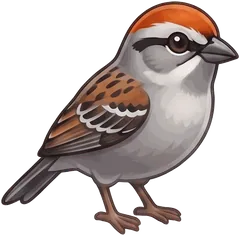
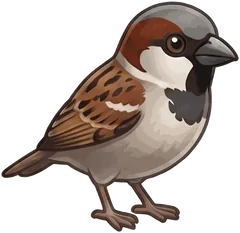
Listen for a trill or a chirp. A Chipping Sparrow's song is one rapid trill: a single note repeated so fast it runs together, all on one pitch, which Audubon likens to the whir of a sewing machine. A House Sparrow does not trill. It repeats a slurred chireep or chirip, one note at a time. By eye, the Chipping Sparrow is the smaller bird, with a bright chestnut cap and a black line through the eye. A male House Sparrow has a gray crown and a black bib.
Side by side
| Chipping Sparrow | House Sparrow | |
|---|---|---|
| Song | A rapid trill of one repeated note on one pitch, like a sewing machine | A repeated, slurred chireep or chirip, one note at a time |
| Call | A high chip or tseep | A harsh chireep; shrill chirping and rattles from flocks |
| Head | Bright chestnut cap, white eyebrow, black eye line, gray cheeks and nape | Male: gray crown, chestnut nape, pale cheeks, black bib. Female: plain, with a pale buff eyebrow |
| Size | 5 to 5.5 inches, 0.4 to 0.6 ounces | About 6 inches |
| Nest | An open cup in a conifer, shrub or small tree | A cavity: holes in buildings, gutters, signs, birdhouses |
| Where and when | Pine woods, lawns, parks and cemeteries; mostly a summer bird in the North | Around buildings in cities, towns and farms, all year |
By ear: a trill or a chirp
The Chipping Sparrow's song is about as simple as birdsong gets. The male picks one short note and fires it off again and again, so fast that the notes blur into a single even trill, with no change in pitch from start to finish. Audubon compares it to the whir of a sewing machine. The Missouri Department of Conservation hears a loud run of one note repeated in quick succession.
The House Sparrow never manages a trill. Its song is its ordinary chirp, a slurred, unmusical chireep or chirip, repeated note by note, and its call is a harsher version of the same sound. Audubon sums up the voice as shrill, monotonous, noisy chirping. In spring a courting male hops around a female with his tail raised, wings drooped and chest puffed out, bowing and chirping all the while.
So the test is spacing. If the notes come so close together that you cannot count them, you are hearing a Chipping Sparrow. If you could count every chirp, each one slurred like chi-reep, it is a House Sparrow. The calls differ too: a high chip or tseep against a harsh chireep.
By sight: who wears the chestnut
The two heads are almost mirror images. A breeding Chipping Sparrow has a bright chestnut crown on top, set off by a white eyebrow and a narrow black line through the eye, with clear gray cheeks and nape, a black bill and an unstreaked light gray breast. A male House Sparrow has it the other way around: a gray crown, chestnut on the nape, whitish cheeks and a black throat and upper breast, the bib. Chestnut on top with a black eye line means Chipping Sparrow; gray on top over a black bib means House Sparrow.
Size backs that up. Audubon gives 5 to 5.5 inches for the Chipping Sparrow, and Missouri measures the House Sparrow at about 6 1/4, so on a shared lawn the House Sparrow is the bigger bird.
The confusing pairs are the plain ones: a female House Sparrow next to a Chipping Sparrow in fall. The female House Sparrow is plain and unstreaked below, with a pale buff eyebrow, a striped brown back, a yellowish bill and no cap at all. A Chipping Sparrow out of breeding plumage has a streaked crown with the chestnut partly hidden and a buffy eye line, and immatures show breast streaks, but the rump is always gray, a mark Missouri uses to sort it from other fall sparrows.
Where you will meet each one
The House Sparrow is the bird of buildings. In North America it lives around cities, towns and farms and is essentially never found in untouched natural habitat. Look in parking lots, at feeders and around outdoor restaurant tables. It nests in cavities, preferring holes in buildings, rain gutters, crannies in signs and birdhouses, and it evicts native cavity nesters such as bluebirds, martins, Tree Swallows and woodpeckers. It stays all year.
The Chipping Sparrow likes open ground with trees, short grass and evergreens. It began in open pine woods and conifer edges and has moved happily into suburbs, city parks, lawns, cemeteries and orchards. It feeds on the ground, often in loose flocks outside the nesting season, and nests in an open cup low in a shrub or small tree, often a conifer. In much of the North it is a summer bird: in Missouri it is a common summer resident statewide but scarce in winter, and migration runs over a long stretch in both spring and fall.
The two have a history. Audubon notes that the Chipping Sparrow was even more common in towns in the 1800s, and Missouri calls it a beloved dooryard bird, in the same company as robins and bluebirds. Then the House Sparrow, an Old World sparrow and not a true American one, was released in New York in 1851 to fight insect pests. It ate few insects and took over the town sparrow's job instead.
 Still not sure which one is outside? Warble listens while it sings and tells you, then adds the card to your album. Get the app free.
Questions people ask
What is the difference between a chipping sparrow and a house sparrow?
Voice and head. A Chipping Sparrow sings a fast, even trill on one pitch and has a chestnut cap with a black eye line. A House Sparrow repeats a slurred chireep; the male has a gray crown and a black bib.
Is a House Sparrow a real sparrow?
Not an American one. The House Sparrow belongs to the Old World sparrow family, Passeridae, and is more closely related to birds of Europe, Asia and Africa than to native sparrows like the Chipping Sparrow. It was brought to North America from Europe in the 1800s.
Do Chipping Sparrows come to feeders?
Yes. The Missouri Department of Conservation notes that Chipping Sparrows forage on the ground for seeds and insects and visit bird feeders. House Sparrows come to feeders too, but they are larger, and the males show a black bib instead of a chestnut cap.
Sources
- National Audubon Society, Guide to North American Birds: Chipping Sparrow. www.audubon.org/field-guide/bird/chipping-sparrow
- National Audubon Society, Guide to North American Birds: House Sparrow. www.audubon.org/field-guide/bird/house-sparrow
- Missouri Department of Conservation, Field Guide: Chipping Sparrow. mdc.mo.gov/discover-nature/field-guide/chipping-sparrow
- Missouri Department of Conservation, Field Guide: House Sparrow. mdc.mo.gov/discover-nature/field-guide/house-sparrow