 Warble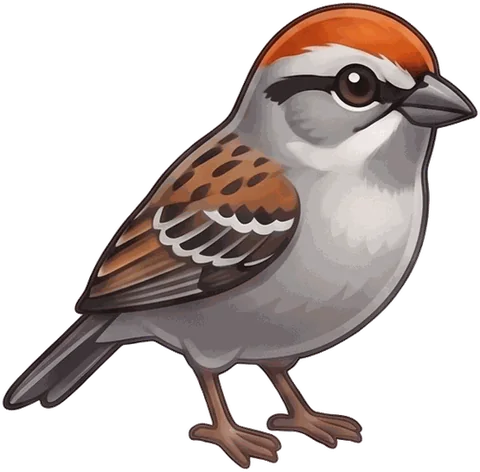
A Chipping Sparrow sounds like a tiny sewing machine running for a second or two: a rapid trill of identical dry notes, all on one pitch, with no rise, no fall and no tune. Some people hear it as thin and musical, others as a loud mechanical chipping; it depends on the bird and the distance. Males repeat it from spring into summer in yards, parks and open pine woods. The everyday call is a high, thin chip or tseep, and during migration the same bird gives a piercing flight call in the dark overhead.
What the song sounds like
The whole song is one trill. Each note is a short, dry chip, and the bird runs them together at an even speed on an even pitch, then stops. There is no introduction and no flourish at the end. The Audubon guide reaches for machinery to describe it, the whir of a sewing machine, and that is fair. Up close it is a rattle. Across a lawn it thins out into something you could almost call musical.
Because there is no melody, what you are really listening for is texture and tempo: dry, fast and flat, every note the same length and the same loudness. That plainness is the point, and also the problem. It is the least distinctive trill in the neighborhood, which is why it gets mixed up with the two birds listed further down.
The call: a thin chip
The call is a high, thin chip or tseep, sharp enough to register but easy to lose among other small birds. You hear it from birds feeding on the ground, from loose flocks moving through a hedge in fall, and from adults near a nest.
There is also a flight call, a single piercing note that birds give while migrating at night. On a still night in spring or fall you can hear Chipping Sparrows passing over a dark yard without ever seeing one.
When and where you hear it
This is a summer bird across most of the United States, Canada and Alaska, and a year-round bird only near the southern edge of the country. Northern populations winter in the southern states and Mexico, traveling in flocks over a long, spread-out season in both spring and fall. Males arrive first, from March in southern Texas to the middle of May in northern Ontario and southern Alberta, and females follow a week or two behind.
Where to listen: anywhere with short grass and an evergreen or two. The Chipping Sparrow began as a bird of open pine woods and conifer edges, and it has taken to lawns, cemeteries, city parks, orchards and suburban yards without complaint. Before the House Sparrow was introduced, this was the small brown bird of American towns, and it is still tame around people wherever House Sparrows are scarce.
The nest is a loose cup of grass and rootlets lined with animal hair, usually low in a young conifer, and a pair raises two broods a season. It is a frequent target of the Brown-headed Cowbird, and a parasitized nest is often simply abandoned. If you play Warble, expect this trill to be one of the first spring cards in any yard that already holds a Northern Cardinal and an American Robin.
What it looks like
In spring and summer the adult is a neat little sparrow, about five inches long, with a bright chestnut cap, a white eyebrow, a thin black line through the eye and a dark bill. The face and underparts are plain gray, with no streaks and no breast spot; the back is streaked rusty brown, the rump is gray, and the wings carry two pale bars. In winter the cap turns dull brown and streaky and the face pattern fades. Juveniles are streaked underneath. The Field Sparrow has a pink bill and a white eye ring instead of the black eye line.
Birds that sound similar
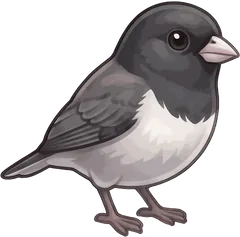 Dark-eyed Junco
The junco's song is a ringing, metallic trill on one pitch, looser and more musical than the Chipping Sparrow's dry rattle. Context helps: juncos are the gray ground feeders of winter yards, and when one flies it flashes white outer tail feathers.
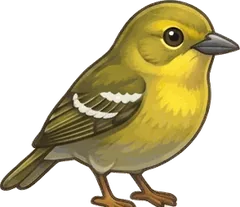 Pine Warbler
Audubon describes the Pine Warbler's song as a soft, sweet, somewhat melancholy version of the Chipping Sparrow's trill, and that is how it sounds: slower and richer, usually from inside a pine. A musical trill from tall pines early in spring is more likely the warbler.
Where the Chipping Sparrow card lives
In Warble the same bird can be an easy card in one state and a prized one in another, because each album ranks its birds by how often people really report them there. The Chipping Sparrow appears in 45 state albums:
 Heard one? Open Warble, tap the green button while it sings, and the Chipping Sparrow card flips into your album. Get the app free.
Questions people ask
What bird sounds like a sewing machine?
Most often a Chipping Sparrow. Its song is a fast, dry trill of identical notes on a single pitch, and the Audubon guide compares it to the whir of a sewing machine. If the trill comes from a lawn, a cemetery or a suburban spruce in late spring, that is your bird.
How do I tell a Chipping Sparrow from a Dark-eyed Junco by sound?
Listen for tone. The junco's trill rings, with a metallic, slightly loose quality; the Chipping Sparrow's is drier and flatter, closer to a mechanical rattle. Season helps too: juncos are mostly winter birds in yards, while the Chipping Sparrow is the one still trilling from your evergreens in June.
Do Chipping Sparrows stay for the winter?
Only in the southern United States. Northern and central populations move to the southern states and Mexico in fall, where snow will not bury the seeds they live on. In Missouri, for example, it is a common summer bird but only a casual winter visitor in the south of the state.
Do Chipping Sparrows come to feeders?
Yes, occasionally. They prefer to forage on the ground for grass and weed seeds and will pick up spilled seed under a feeder. They are notably tame around people, a habit from the days when the Chipping Sparrow was the common small bird of American towns.
Sources
- National Audubon Society, Guide to North American Birds: Chipping Sparrow. www.audubon.org/field-guide/bird/chipping-sparrow
- Wikipedia: Chipping sparrow. en.wikipedia.org/wiki/Chipping_sparrow
- Missouri Department of Conservation, Field Guide: Chipping Sparrow. mdc.mo.gov/discover-nature/field-guide/chipping-sparrow
- National Audubon Society, Guide to North American Birds: Pine Warbler (song compared with the Chipping Sparrow). www.audubon.org/field-guide/bird/pine-warbler