 Warble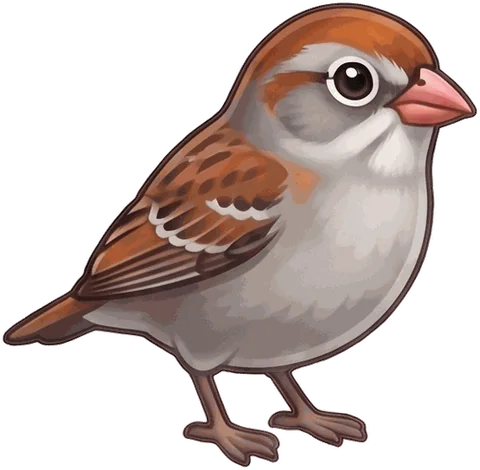
A Field Sparrow sounds like a ping-pong ball dropped on a table: a series of soft, clear, slightly sad whistles, all on about the same pitch, that start slow and speed up until they run together into a trill and stop. The whole song takes about four seconds. It is sweeter and more plaintive than the dry rattle of a Chipping Sparrow, and it comes from brushy, overgrown fields rather than lawns. The call is a weak chip. Males sing from a small tree, a fence post or a weed stalk, often all through a hot afternoon when other birds have gone quiet.
The birder's mnemonic
“a bouncing ball coming to rest” Picture the ball: slow bounces at first, then faster and faster until they blur. The pitch barely moves; only the speed changes.
What the song sounds like
The song is built on one idea, acceleration. It opens with a few clear, down-slurred whistles spaced well apart, each with a soft, wistful quality, then the notes come quicker and quicker until they fuse into a trill at the end. The pitch stays almost level from start to finish, which is why the bouncing-ball picture works so well: what changes is the rhythm, not the tune. A typical song lasts about four seconds and is repeated after a short rest.
Males set up territories in late March in the southern states and sing constantly until they attract a mate, after which they sing much less. They pick modest perches, a branch of a small tree, a fence post, the top of a sapling in a field going back to brush. In summer they keep going through the middle of the day, so the bouncing-ball song is often the only voice in an overgrown pasture at two in the afternoon. Thoreau compared it to small change being counted out on a counter, and once you hear the silvery notes speeding up you will not confuse it with much else.
The call: a weak chip
The call is a soft, rather weak chip, easy to overlook among louder sparrows, and sometimes a short trill. In fall and winter Field Sparrows travel in small loose flocks, often mixed with other sparrows in weedy fields and hedgerows, and the thin chips are what give them away as they drop out of the brush to feed on fallen seeds. They also pull down a seed stalk with their weight to get at the seed heads, a trick worth watching for.
When and where you hear it
Field Sparrows live across the eastern half of the United States, from the Plains to the Atlantic and from southern Canada to the Gulf. They are partial migrants: birds in the South stay all year, while northern breeders move to the southern states and northeastern Mexico for the winter. In Tennessee they are present in every month, with winter numbers swelled by birds from farther north; in Missouri they are common all summer but pull back to the southernmost counties in winter.
The name is a little misleading. They do not want open grass or cultivated fields; they want fields that have been left alone: brushy pastures, old fields growing up in cedar and blackberry, woodland edges, hedgerows, glades, second growth after a clearcut. A field with scattered shrubs and a few small trees is perfect. That is also the habitat that vanishes fastest, either mowed back into pasture, built on, or allowed to grow into forest, and Field Sparrows have been declining across their range even though they remain common.
Nesting starts in mid-April in the South. The female weaves a cup of grasses on the ground in a clump of grass for the first nest and builds each later nest a little higher in a shrub as the vegetation grows up around her. Clutches hold two to five eggs, incubation takes 10 to 12 days and the young leave after only a week or so, which lets a pair raise two or three broods a summer despite heavy losses to snakes. Brown-headed Cowbirds lay in the nests as well. The song runs from late March into August, which makes this a reliable summer catch in Warble anywhere with an overgrown field.
What it looks like
A small, slim, long-tailed sparrow, 5 to 6 inches long and well under half an ounce. The face is plain gray with no strong lines through it, which gives the bird a blank, innocent look, set off by a thin white eye ring, a rusty cap and a rusty streak behind the eye. The bill is bright pink, and so are the legs. The breast is plain buff or grayish with no streaks and no central spot, the back is streaked rusty brown, and there are two thin whitish wing bars. Young birds in late summer are duller with faint streaks below. The pink bill and the empty face are the marks that separate it from the Chipping Sparrow, which has a black line through the eye and a white eyebrow. Banded birds have lived at least ten years.
Birds that sound similar
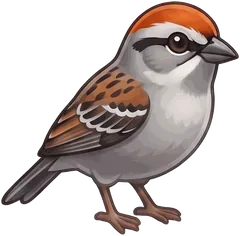 Chipping Sparrow
A Chipping Sparrow's trill is dry, mechanical and even from start to finish, like a sewing machine. The Field Sparrow's notes are sweet, clearly separate at the start and speed up as they go.
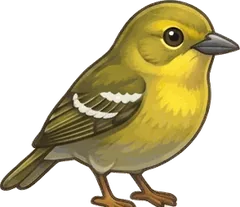 Pine Warbler
The Pine Warbler sings a soft, sweet, musical trill that stays at one speed and comes from the tops of pines. No slow, separate opening notes and no acceleration.
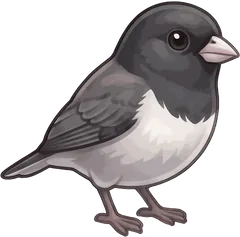 Dark-eyed Junco
The Dark-eyed Junco's song is a ringing, metallic trill on one pitch at a steady tempo, mostly heard in spring before the birds head north. The Field Sparrow starts slow and speeds up.
Where the Field Sparrow card lives
In Warble the same bird can be an easy card in one state and a prized one in another, because each album ranks its birds by how often people really report them there. The Field Sparrow appears in 28 state albums:
 Heard one? Open Warble, tap the green button while it sings, and the Field Sparrow card flips into your album. Get the app free.
Questions people ask
Which bird sounds like a bouncing ball?
The Field Sparrow. Its song is a run of soft whistles on one pitch that starts slowly and accelerates into a trill, exactly like a dropped ball bouncing faster and faster until it comes to rest. Listen for it in brushy, overgrown fields from late March through August.
What is the difference between a Field Sparrow and a Chipping Sparrow?
By sound, the Chipping Sparrow gives a flat, even, dry trill and the Field Sparrow a sweet, accelerating one. By sight, the Field Sparrow has a pink bill, a white eye ring and a plain gray face; the Chipping Sparrow has a dark bill, a black eye line and a white eyebrow. Chipping Sparrows also like lawns and parks; Field Sparrows like brush.
Do Field Sparrows come to feeders?
Not often. They feed on small grass and weed seeds on the ground in brushy fields and hedgerows, and in winter they move in small mixed sparrow flocks. A feeder next to a weedy, shrubby edge in the rural South or Midwest has the best chance, especially in cold weather.
Are Field Sparrows rare?
No, they are still widespread and common, but they are declining across their range. The brushy, half-grown-up fields they need are being mowed, developed or left to turn into forest, and there is less of that in-between habitat every year.
Sources
- National Audubon Society, Guide to North American Birds: Field Sparrow. www.audubon.org/field-guide/bird/field-sparrow
- Missouri Department of Conservation field guide: Field Sparrow. mdc.mo.gov/discover-nature/field-guide/field-sparrow
- Tennessee Wildlife Resources Agency: Field Sparrow (seasons, nesting, decline). www.tn.gov/twra/wildlife/birds/grassland-and-shrub-birds/field-sparrow.html
- Wikipedia: Field sparrow (song length, range, measurements). en.wikipedia.org/wiki/Field_sparrow