 Warble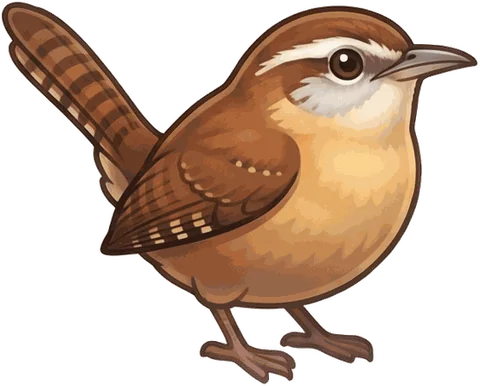
A Carolina Wren sounds far too loud for its size. The song is a ringing, whistled phrase of two or three syllables repeated three to five times in a row, most often written teakettle, teakettle, teakettle, delivered at full volume from a fence post, a woodpile or a porch railing. Only the male sings, but he does it in every month of the year and at any hour of the day, which is why this is often the first song people hear on a January morning in the Southeast. The female answers with a dry, buzzing chatter.
The birder's mnemonic
“teakettle, teakettle, teakettle” Each male has a couple of dozen versions, so you will also hear it rendered as tweedle-tweedle-tweedle, sweetheart, sweetheart or come-to-me, come-to-me. The rhythm stays the same.
What the song sounds like
The song is a short, loud, whistled phrase repeated several times without variation: teakettle, teakettle, teakettle, tea. Each phrase has three syllables, though it often sounds like two, and the whole thing rolls along with a bouncing, rhythmic swing that a cardinal's slurred whistles never have. The volume is the giveaway: few birds this small carry this far.
Only the male sings. He carries a repertoire of at least twenty phrase patterns, on average about thirty two, and he learns them all in the first three months of his life. He sings one pattern many times, then switches, so a bird that sounded like teakettle a minute ago may now be shouting sweetheart, sweetheart. Pairs also duet, the male's song overlapping the female's chatter.
Carolina Wrens sing in all seasons and at any point in the day, stopping only for the worst weather. Learn it once and you will hear it on a summer dawn and a cold February morning alike.
The calls: chatter, rattles and a falling cheer
Away from the song, the pair keeps up a running commentary of harsh, raspy notes. The female's contribution is a paired dit-dit or a rapid buzzing chatter, given especially during squabbles over territory. Both birds scold with a dry rattle when a cat or a person gets close to the nest, and there is a loud, descending cheeer that carries almost as far as the song.
When and where you hear it
This is a bird of the eastern United States, common from Texas and Florida north through the Ohio Valley and the Mid-Atlantic, and it does not migrate. Pairs hold a territory all year and stay together on it. The northern edge of the range moves with the weather: after a run of mild winters wrens push north into New England and the upper Midwest, and a hard winter with deep snow knocks them back. Over the long run they have been winning, with numbers rising more than 1.5 percent a year across most of the northern range from 1966 to 2015.
Habitat is tangles: brushy woodland edges, streamside thickets, swamps, overgrown farmland, exposed tree roots along riverbanks, and any suburban yard with a brush pile, dense shrubs or a slightly neglected corner. The nest goes into almost any cavity below about ten feet, and the list of places people have found one is long: mailboxes, tin cans, porch planters, the pockets of jackets hanging in sheds, clothes on a line, the end of a rolled carpet, and a tractor in daily use.
They eat mostly insects and spiders, with small lizards and tree frogs now and then, and turn to berries and seeds in winter, including poison ivy berries. It is the state bird of South Carolina, adopted in 1948 after the state briefly chose the mockingbird in 1939 and changed its mind.
What it looks like
A plump wren about 5.5 inches long, the second largest in the country after the Cactus Wren. It is rich reddish brown above and warm butterscotch buff below, with a whitish throat and a bold white eyebrow stripe that runs well back past the eye. The tail is often cocked straight up. Unlike a Bewick's Wren it has no white corners on the tail, and it is warmer and rounder than the smaller, plainer House Wren, which lacks the white eyebrow.
Birds that sound similar
 Northern Cardinal
A cardinal's whistles slur up or down and often speed into a trill. The wren's phrase is a bouncing three-beat rhythm repeated identically, and it is louder for its size.
 Tufted Titmouse
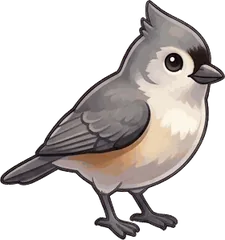
The titmouse's peter, peter, peter is a clear two-note whistle, thinner and more plaintive. Teakettle has a third syllable and a ringing, rollicking energy.
 House Wren
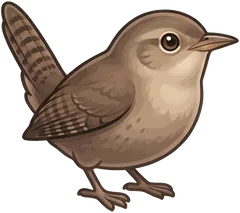
The House Wren bubbles and tumbles through a long, gurgling song with no repeated phrase. The Carolina Wren shouts one short phrase over and over.
Where the Carolina Wren card lives
In Warble the same bird can be an easy card in one state and a prized one in another, because each album ranks its birds by how often people really report them there. The Carolina Wren appears in 33 state albums:
 Heard one? Open Warble, tap the green button while it sings, and the Carolina Wren card flips into your album. Get the app free.
Questions people ask
Do Carolina Wrens sing in winter?
Yes. They sing year-round and at any time of day, pausing only in the harshest weather. In much of the Southeast the teakettle song is the loudest bird sound of a winter morning.
Do female Carolina Wrens sing?
No, only the male sings. The female contributes a buzzy chatter and paired dit-dit notes, especially during territorial disputes, and pairs often duet with his song laid over her chatter.
Why is there a Carolina Wren nest in my mailbox?
Because they nest in almost any sheltered cavity below ten feet, and they have a documented taste for untidy corners of human spaces: planters, cans, hanging jackets, rolled carpet and, yes, mailboxes.
Why did Carolina Wrens disappear after a hard winter?
They do not migrate, and a winter with deep snow or long ice can wipe out the northern edge of the population. Numbers rebuild over a few mild years, and the long-term trend across the northern range has been upward.
Sources
- National Audubon Society, Guide to North American Birds: Carolina Wren. www.audubon.org/field-guide/bird/carolina-wren
- Wikipedia: Carolina wren (song repertoire, range expansion, nesting and state bird status). en.wikipedia.org/wiki/Carolina_wren
- Missouri Department of Conservation field guide: Carolina Wren. mdc.mo.gov/discover-nature/field-guide/carolina-wren