 Warble
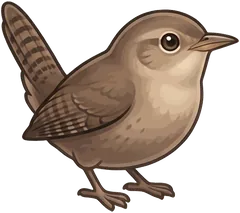
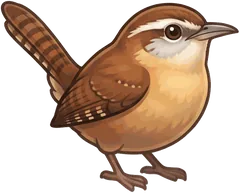
Listen for a repeated phrase. A Carolina Wren sings one loud, whistled phrase several times in a row, tea-kettle, tea-kettle, tea-kettle, and it sings in every season. A House Wren never settles on a phrase: its song is a bubbling jumble of twitters and gurgles that rises and then tumbles down, and in places like Missouri you hear it only from spring into fall. By eye, the Carolina Wren is the bigger, warmer bird, chestnut above and buff below with a bold white eyebrow. The House Wren is small, plain gray-brown, with only a faint eyebrow.
Side by side
| House Wren | Carolina Wren | |
|---|---|---|
| Song | A bubbling, gurgling jumble that rises, then falls; no repeated phrase | A loud, whistled tea-kettle, tea-kettle, tea-kettle: one phrase, several times |
| Calls | Stuttering notes, buzzy rattles, a sharp tchur | Harsh, raspy notes and a loud, falling cheeer; the female chatters |
| When it sings | Spring and summer; in Missouri it rarely lingers late into fall | All day, in every season |
| Size | 4.3 to 5.1 inches | About 5.5 inches, large for a wren |
| Looks | Plain gray-brown, faint eyebrow, thin eye ring, barred wings and tail | Chestnut above, butterscotch below, whitish throat, bold white eyebrow |
| Where | Open woods, yards, orchards, nest boxes; across most of the US in summer | Tangles, thickets and shrubby yards; the East, all year |
By ear: a jumble or a refrain
The Carolina Wren is the easy one. Its song is a single loud, whistled phrase repeated several times without a pause to think: Audubon writes it tea-kettle, tea-kettle, tea-kettle tea or tweedle-tweedle-tweedle. The Missouri Department of Conservation points out that each phrase has three syllables but often sounds like two, and that males sing varied versions, so not every bird says teakettle. What stays the same is the shape: one clear unit, said over and over, and loud.
The House Wren has no refrain. Audubon calls its song gurgling, bubbling and exuberant, rising and then falling, and Missouri describes a rising jumble of twittering, gurgling and chattering notes that slides down at the end. You cannot write it as a word, because it is a whole tumbling sentence rather than one word repeated. Missouri's Carolina Wren account makes the same point, calling the House Wren's song long, cascading and complex, nothing like the Carolina's.
The calls point the same way. House Wrens scold with stuttering notes, buzzy rattles and a sharp tchur. Carolina Wrens give harsh, raspy notes and a loud, descending cheeer, and pairs duet in any season, the female chattering under the male's song.
The calendar is the final clue. Audubon says the Carolina Wren sings all day long in all seasons, while in Missouri the House Wren is a summer resident that rarely lingers late into fall, with only a few known to stay the winter. So in a state like Missouri, a wren singing loudly in January is a Carolina Wren.
By sight: the eyebrow and the color
The Carolina Wren is one of the more colorful wrens: rich chestnut above, warm butterscotch buff below, with a whitish throat and a bold white eyebrow. At about 5.5 inches it is large for a wren. Missouri describes the House Wren, by comparison, as smaller and darker, lacking the white eyebrow and chest.
The House Wren is plainer than most wrens: gray-brown above and lighter below, with fine dark barring on the wings and tail, a faint, buffy eyebrow and a thin eye ring. It measures 4.3 to 5.1 inches and weighs a third of an ounce or so, with a thin bill. Both birds cock their tails up, so that posture tells you wren but not which one. Look at the face: a strong white stripe over the eye means Carolina; a plain face with just a hint of an eyebrow means House.
Their manners differ a little too. A House Wren is hyperactive, bouncing through low growth with its short tail held high. Carolina Wrens are often seen in pairs, poking busily through brush piles and low tangles and darting around tree trunks.
Where you will meet each one
The Carolina Wren is a bird of the East, common in open woods and backyards in the Southeast and found north into the Great Lakes, the Mid-Atlantic and New England. It wants tangles: dense undergrowth, thickets, vines, forest edges and riverbanks with exposed roots, plus suburbs and gardens where some low growth is left alone. Pairs stay together on a territory all year. The northern edge of the range moves over time, creeping north through runs of mild years and getting knocked back south by severe winters.
The House Wren, which newer lists call the Northern House Wren after a 2024 split, is found from southern Canada through the United States to Mexico. It breeds in semi-open country: open woods, woodlots, orchards, streamside groves, suburbs and gardens, and it takes to nest boxes readily. Males stuff sticks into several cavities as dummy nests and let the female choose one. Adults often puncture the eggs of other birds nesting nearby, and Missouri notes that they compete with bluebirds for nest boxes.
Both birds nest in odd places near houses, and the lists overlap almost comically: Missouri's field guides list both in mailboxes, porch planters and rolled-up carpet. So the nest site will not settle it. The song, the season and that white eyebrow will.
 Still not sure which one is outside? Warble listens while it sings and tells you, then adds the card to your album. Get the app free.
Questions people ask
How do you tell a House Wren from a Carolina Wren by sound?
Listen for repetition. A Carolina Wren repeats one loud, whistled phrase, tea-kettle, tea-kettle, tea-kettle. A House Wren pours out a bubbling, gurgling jumble that rises and then falls, with no phrase repeated. In winter in a state like Missouri, a singing wren is almost always a Carolina.
Do Carolina Wrens sing in winter?
Yes. Audubon notes that the Carolina Wren sings all day long in every season, and pairs stay on their territory year-round. In Missouri, by contrast, House Wrens rarely stay late into fall, and only a few are known to spend the winter.
Which wren has a white eyebrow?
The Carolina Wren, with a bold white stripe over each eye on a chestnut and butterscotch bird. The House Wren has only a faint, buffy eyebrow on plain gray-brown plumage.
Sources
- National Audubon Society, Guide to North American Birds: Northern House Wren. www.audubon.org/field-guide/bird/northern-house-wren
- National Audubon Society, Guide to North American Birds: Carolina Wren. www.audubon.org/field-guide/bird/carolina-wren
- Missouri Department of Conservation, Field Guide: Northern House Wren. mdc.mo.gov/discover-nature/field-guide/house-wren
- Missouri Department of Conservation, Field Guide: Carolina Wren. mdc.mo.gov/discover-nature/field-guide/carolina-wren