 Warble
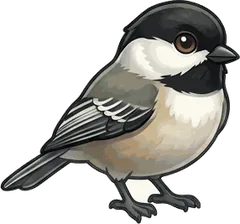
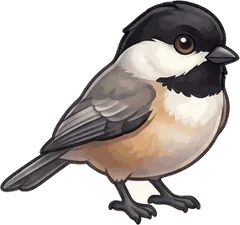
Count the whistled notes. A Black-capped Chickadee sings two, fee-bee, the second lower and sometimes doubled. A Carolina Chickadee sings four, see-bee-see-bay, with the first and third notes very high. The chick-a-dee-dee-dee call helps too: the Carolina's is faster and higher. That works almost everywhere, because the two species barely overlap. The exception is a narrow strip from New Jersey to Kansas where their ranges meet. There they interbreed and learn each other's songs, many birds sing both, and some chickadees cannot be named at all.
Side by side
| Black-capped Chickadee | Carolina Chickadee | |
|---|---|---|
| Song | Two whistled notes, fee-bee, the second lower and often doubled | Four whistled notes, see-bee-see-bay, the first and third very high |
| Call | Chick-a-dee-dee-dee, slower and lower | Chick-a-dee-dee-dee, faster and higher |
| Wings | Bold white edges on the wing feathers, lots of contrast | Plainer and grayer, much less white edging |
| Bib | Lower edge ragged and uneven | Lower edge neat and fairly straight |
| Sides and back | More buff on the flanks, olive tinge on the back | Grayer overall |
| Size | 5 to 6 inches, longer-tailed on average | About 4 to 4.7 inches, a little smaller |
| Where | Northern US and much of Canada; Appalachian high ground | Southeast, south of a line from New Jersey to Kansas; Appalachian lowlands |
By ear: two notes or four
The whistled song is the clearest difference between the two. A Black-capped Chickadee sings a simple two-part whistle, fee-bee: the first note higher, the second lower, and the second part often split into two syllables, so it can come out as fee-bee-ee. A Carolina Chickadee packs four notes into the same space, see-bee-see-bay, with the first and third notes pitched very high and the whole phrase sloping down. If you count two, think Black-capped; if you count four, think Carolina.
The famous chick-a-dee-dee-dee call is the second clue. Both birds give it, but the Carolina's version is faster and higher-pitched. Kenn Kaufman, writing for Audubon, says the difference can be heard with practice. Their other chips, buzzes and trills are no use for telling them apart, so stick to the song and the full chick-a-dee.
The overlap zone: where songs stop working
The ranges of the two chickadees meet along a narrow line from New Jersey west to Kansas, usually only about 20 miles wide. In the Appalachians the line runs up and down the mountains instead: Black-capped Chickadees on the high ground, Carolinas in the valleys, and probable hybrids in between. Inside that strip the two species often interbreed, and both Audubon field guide accounts warn that each can learn the other's song. Many birds near the hybrid zone sing both types, so a fee-bee there proves nothing, and many birds are intermediate in looks as well.
The strip is also on the move. A 2014 study by the Cornell Lab of Ornithology and Villanova University, published in Current Biology, tracked the zone in Pennsylvania, where it averages about 21 miles across. Over the previous decade it had shifted north by about 0.7 mile a year, in step with warming winters: the two species overlapped only where the average winter low fell between 14 and 20 degrees Fahrenheit. A site at the center of the zone when the work began was almost pure Carolina by the end, and the next site north, picked as a Black-capped stronghold, had filled with hybrids. Hybrids breed and survive less well than either parent, which keeps the zone narrow even as it slides north.
By sight: wings, bib and cheeks
Both are tiny birds with a black cap, black bib, white cheeks and a gray back, and range alone is the easiest way to sort most of them. When you do get a good look, start with the folded wing. A Black-capped shows bright white edges on the wing feathers, giving the wing real contrast; a Carolina has much less white, so its wing looks plainer and grayer. Be careful in strong sun, which can make gray edges look white.
Next, check the bottom of the bib. The Carolina's ends in a fairly neat, straight line; the Black-capped's is messy and uneven. On a Black-capped, the white cheek stays bright all the way back to the nape, while on a Carolina it fades to gray, a mark that needs excellent light. Black-cappeds also have buffier flanks and an olive tinge on the back. All of these marks are best in fresh fall and winter plumage; by late spring both species are worn and dull. Size is little help where it matters: Black-cappeds average larger and longer-tailed, but near the contact zone the difference is small.
Where you will meet each one
The Black-capped Chickadee is the bird of the northern United States and much of Canada, a permanent resident in mixed and deciduous woods, willow thickets and shade trees, most common in open woods and forest edges with birch or alder. It skips pure conifer forest and settles happily in suburbs. In some falls, mostly in the Northeast, large numbers push south in an invasion, and a few then turn up south of the usual line.
The Carolina Chickadee replaces it across the Southeast, from the New Jersey to Kansas line south to Florida and Texas. It also stays all year, in mixed and deciduous woods, river groves, shade trees and pine woods with leafy trees mixed in, and it nests in well-wooded suburbs. Carolinas seldom stray north of the line. Unless you live near the line, your map will name your chickadee before your ears do.
 Still not sure which one is outside? Warble listens while it sings and tells you, then adds the card to your album. Get the app free.
Questions people ask
Can chickadees learn another species' song?
Yes. Where Black-capped and Carolina Chickadees meet, each species can learn the other's song, and many birds near the hybrid zone sing both. That is why the song, reliable almost everywhere else, cannot settle a chickadee there.
Where do Black-capped and Carolina Chickadees overlap?
In a narrow band, usually about 20 miles wide, running from New Jersey west to Kansas, plus the slopes of the Appalachians, where Black-cappeds hold the high ground. A 2014 study found the Pennsylvania stretch moving north about 0.7 mile a year.
Which chickadee sings fee-bee?
The Black-capped Chickadee: two clear notes, the second lower. The Carolina Chickadee sings four, see-bee-see-bay. Near the zone where the two meet, either species may sing either song.
Sources
- Audubon, Kenn Kaufman: Identifying Black-capped and Carolina Chickadees. www.audubon.org/news/identifying-black-capped-and-carolina-chickadees
- ScienceDaily: Warming temperatures are pushing two chickadee species and their hybrids northward (Cornell Lab of Ornithology, Villanova University). www.sciencedaily.com/releases/2014/03/140306130056.htm
- National Audubon Society, Guide to North American Birds: Black-capped Chickadee. www.audubon.org/field-guide/bird/black-capped-chickadee
- National Audubon Society, Guide to North American Birds: Carolina Chickadee. www.audubon.org/field-guide/bird/carolina-chickadee