 Warble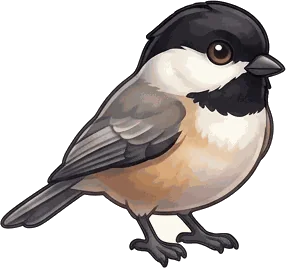
A Carolina Chickadee sounds like a smaller, faster version of the chickadee everyone knows. Its call is a buzzy chick-a-dee-dee-dee, higher pitched and quicker than the Black-capped Chickadee's, given all year from flocks in the branches. The song is a clear four-note whistle, see-dee, see-dee, high then low, high then low, sloping downward, instead of the Black-capped's two slow notes. It is the chickadee of the Southeast, from New Jersey and Kansas south to Florida and Texas.
The birder's mnemonic
“see-dee, see-dee (the song) and chick-a-dee-dee-dee (the call)” Count the whistled notes: four fast ones is Carolina, two slow ones is Black-capped.
What the song sounds like
The song is a thin, clear, whistled phrase of four notes that alternate high and low, see-dee, see-dee, with the whole thing sloping downward. It is quick and neat, with none of the lingering quality of the Black-capped Chickadee's two-note fee-bee.
Along the line where the two species meet, from New Jersey and Pennsylvania west to Kansas, and up the slopes of the Appalachians, things get messy. The two chickadees interbreed there, and birds in the contact zone can learn each other's songs, so a chickadee singing fee-bee in central Pennsylvania might be either one, or a hybrid. In the Appalachians the Carolina holds the lower elevations and the Black-capped the ridgetops. Away from that narrow band, the song is reliable.
The name itself is an imitation of the call.
The call: a quick chick-a-dee-dee-dee
The call is the buzzy chick-a-dee-dee-dee, but delivered faster and on a higher pitch than the Black-capped's, so that it sounds a little more hurried and less hoarse. You hear it in every month, in every weather, from pairs and small flocks working through twigs and hanging upside down from the undersides of branches. Chickadees also give buzzes, chips and thin trills as they forage.
When something disturbs a female on the nest, she answers with a loud, explosive hiss like a snake. And in winter, when titmice, nuthatches and other small birds travel with the chickadees, the chick-a-dee is usually the first sound that tells you a mixed flock is coming.
When and where you hear it
The Carolina Chickadee lives in the southeastern quarter of the country, from New Jersey and Pennsylvania west to southern Kansas and south to Florida and Texas, with a gap at the high elevations of the Appalachians. It is a permanent resident that does not move south even in hard winters, and it only occasionally drifts outside its range. The population is estimated at around 13 million birds.
It likes deciduous woods, river groves and shade trees, and pine woods as long as there are oaks or other leafy trees mixed in, and it nests happily in well-wooded suburbs. What it cannot do without is dead wood: a snag or a living tree with a cavity to nest in. The nest is a hole in a tree, usually an enlarged natural cavity five to fifteen feet up, and pairs, which may mate for life, form in fall and spend the winter together in the flock.
Winter is when most people notice chickadees, at feeders full of sunflower seed and suet. A Carolina Chickadee takes one seed at a time and carries it off to open it or hide it for later. On the coldest nights it can drop into a controlled state of hypothermia for up to fifteen hours to save energy. In Texas, Georgia and the rest of the Southeast it is one of the first Warble cards new players catch, and the call is what gives it away.
What it looks like
A tiny, plump, round-headed bird, under five inches long and weighing about a third of an ounce, with a black cap, a black bib and bright white cheeks. The back, wings and tail are a soft, even gray, the underparts white with a pale buff or gray wash on the flanks, and the bill is short and thick. It is almost identical to the Black-capped Chickadee; next to one it is slightly smaller, with a cleaner, more sharply edged bib and much less white edging on the wing feathers. In practice, range and voice do most of the work.
The female lays three to ten white eggs with fine reddish-brown dots, the young leave the nest at about two weeks, and both parents feed them.
Birds that sound similar
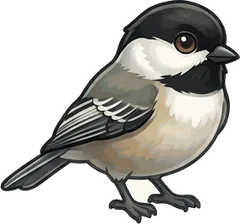 Black-capped Chickadee
The Black-capped Chickadee's chick-a-dee-dee-dee is slower, lower and hoarser, and its whistled song is two notes, fee-bee, instead of four. Where the ranges overlap, both can sing the other's song, so check the range map before deciding.
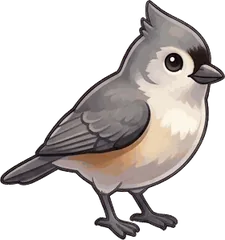 Tufted Titmouse
The Tufted Titmouse travels in the same flocks and makes harsh scolding notes and thin tseet calls that blend in, but its song is a strong, repeated two-note peter-peter-peter, louder and fuller than any chickadee whistle.
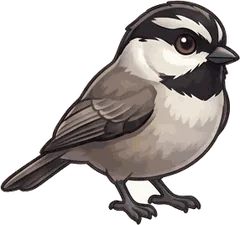 Mountain Chickadee
The Mountain Chickadee's call is a hoarse chick-a-zee-zee, zee and its song is three notes, but it lives in western conifer forest, far from any Carolina Chickadee. If you are in the Rockies, it is not a Carolina.
Where the Carolina Chickadee card lives
In Warble the same bird can be an easy card in one state and a prized one in another, because each album ranks its birds by how often people really report them there. The Carolina Chickadee appears in 23 state albums:
 Heard one? Open Warble, tap the green button while it sings, and the Carolina Chickadee card flips into your album. Get the app free.
Questions people ask
How do you tell a Carolina Chickadee from a Black-capped Chickadee by sound?
Speed and note count. The Carolina's chick-a-dee-dee-dee is faster and higher, and its song is four quick whistled notes, see-dee, see-dee. The Black-capped's call is slower and hoarser, and its song is two slow notes, fee-bee. Where the ranges meet, birds can learn the wrong song, so use the map too.
Do Carolina Chickadees migrate?
No. They are permanent residents across the Southeast and stay on their home range even through severe winters, only rarely drifting beyond it. Pairs form in fall and stay together in a winter flock until nesting starts.
Why is it called a chickadee?
The name imitates the call, chick-a-dee-dee-dee, which is the sound you hear from this bird far more often than its whistled song. The Carolina part is the region it was first described from, and the Southeast is still the heart of its range.
Do chickadees hiss?
Yes. A female Carolina Chickadee disturbed on her eggs gives a loud, explosive hiss like a snake, probably to scare off whatever is peering into the nest hole. The Black-capped Chickadee does the same.
Sources
- National Audubon Society, Guide to North American Birds: Carolina Chickadee. www.audubon.org/field-guide/bird/carolina-chickadee
- Wikipedia: Carolina chickadee (voice, range, torpor, name). en.wikipedia.org/wiki/Carolina_chickadee
- National Audubon Society, Guide to North American Birds: Black-capped Chickadee. www.audubon.org/field-guide/bird/black-capped-chickadee
- Wikipedia: Black-capped chickadee (nest hiss, hybrid zone). en.wikipedia.org/wiki/Black-capped_chickadee