 Warble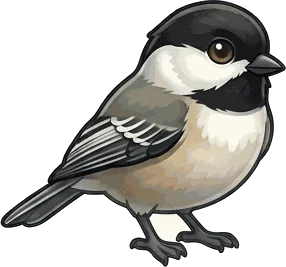
A Black-capped Chickadee makes two sounds almost everyone knows. The song is a clear, whistled fee-bee: two pure notes, the second one lower, sung mostly by males and often with the second note doubled. The call is the buzzy chick-a-dee-dee-dee that gave the bird its name, heard in every season from small flocks in the branches. The more dee notes on the end, the more alarmed the bird is.
The birder's mnemonic
“fee-bee (the song) and chick-a-dee-dee-dee (the call)” Whistle the fee-bee slowly with the second note a step lower and a chickadee will often answer or come in to look.
What the song sounds like
The song is about as simple as bird songs get: two clean whistled notes, the first higher than the second, fee-bee. Some people hear it as swee-tie, and close up you can catch a faint extra note in front, so the whole thing comes out as here, swee-tie. The second note is often doubled into fee-bee-ee. The tone is pure and unhurried, a little wistful, with none of the buzz of the call.
This is the spring song, and it comes mostly from males. Chickadees have a much bigger vocabulary than the two famous sounds suggest: a thin high zee, a soft tseet, an explosive snake-like hiss from the female inside the nest hole, and a gargle of up to nine notes crammed into half a second, which a male aims at a rival he is about to chase off, usually over food.
The call: chick-a-dee-dee-dee
The call is the buzzy, nasal chick-a-dee-dee-dee you hear all year, in every kind of weather. Researchers break it into up to four kinds of notes, and the number of dee notes on the end carries meaning: the more of them, the bigger the threat. A small, agile hawk or owl, the kind that can actually catch a chickadee, earns extra dees, often four instead of the usual two, and the gap between the chick and the first dee shrinks.
Through the winter, nuthatches, titmice and Downy Woodpeckers travel with chickadee flocks, so the chickadee call is usually the first sign that a mixed flock is coming through. When a hedge erupts in long strings of dees, stand still and look for the owl.
When and where you hear it
Black-capped Chickadees do not migrate. Their range runs from western Alaska across Canada and down through the northern half of the United States, reaching northern California in the West. In the East they stop roughly where the Carolina Chickadee begins, along a line from New Jersey and Pennsylvania west to Kansas. Along that line the two species interbreed and can learn each other's songs, so there the song alone will not settle the question.
They like open mixed and deciduous woods and forest edges, especially where birches or alders grow, plus willow thickets and shade trees. They avoid pure conifer forest but settle happily in suburbs with enough dead wood for nest holes. In some autumns, mostly in the Northeast and southeastern Canada, large numbers push south in a fall invasion.
Winter is chickadee season at the feeder. They take one sunflower seed at a time and fly off to open it or hide it, and they can remember a hiding place for up to 28 days. On bitter nights they drop their body temperature by as much as 12 degrees Celsius to save energy. The Black-capped Chickadee is the state bird of Maine and Massachusetts, and across the northern states it is one of the first cards Warble players catch, usually from the call.
What it looks like
A tiny, round-headed bird, five to six inches long and a third to half an ounce, with a black cap, a black bib and bright white cheeks. The back is gray, the underparts white with a buffy wash on the flanks, and the wing feathers have pale edges. Next to a Carolina Chickadee it is slightly larger, with whiter wing edging and a ragged rather than neat lower edge to the bib. In the West, a white eyebrow through the black cap means a Mountain Chickadee instead.
It nests in a tree hole, usually five to twenty feet up, and lays six to eight eggs that the female incubates alone for twelve to thirteen days.
Birds that sound similar
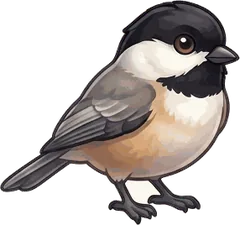 Carolina Chickadee
The Carolina's chick-a-dee-dee is faster and higher, and its song has four notes, see-dee, see-dee, instead of two. The Black-capped is slower, hoarser and two-noted. Where the ranges meet, both species can learn the wrong song.
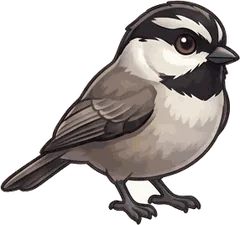 Mountain Chickadee
A Mountain Chickadee's spring song is three notes, fee-bee-bee, with the last two lower, and its call is a hoarse chick-a-zee-zee-zee. It lives in western conifer forest, which the Black-capped avoids.
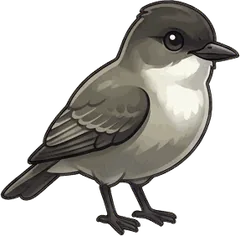 Eastern Phoebe
An Eastern Phoebe also says phoe-be, but as a quick, emphatic phrase repeated many times, with the second syllable alternately higher and lower. The chickadee's version is slower, purer and always drops on the second note.
Where the Black-capped Chickadee card lives
In Warble the same bird can be an easy card in one state and a prized one in another, because each album ranks its birds by how often people really report them there. The Black-capped Chickadee appears in 31 state albums:
 Heard one? Open Warble, tap the green button while it sings, and the Black-capped Chickadee card flips into your album. Get the app free.
Questions people ask
How do you tell a Black-capped Chickadee from a Carolina Chickadee?
By location first, then by ear. The Black-capped sings a slower, hoarser two-note fee-bee; the Carolina sings four faster, higher notes, and its chick-a-dee call is faster and higher too. By eye, the Black-capped shows whiter wing edges and a messier lower edge to the bib.
What does chick-a-dee-dee-dee mean?
It is a contact call and an alarm call at once. The number of dee notes tracks the level of danger: a small hawk or owl, the most dangerous predator for a chickadee, gets more dees, often four instead of two.
Do chickadees sing in winter?
The chick-a-dee call goes on all year, in any weather. The whistled fee-bee is the spring song, given mostly by males.
Which states have the Black-capped Chickadee as state bird?
Maine and Massachusetts. It is also the provincial bird of New Brunswick in Canada.
Sources
- National Audubon Society, Guide to North American Birds: Black-capped Chickadee. www.audubon.org/field-guide/bird/black-capped-chickadee
- Wikipedia: Black-capped chickadee (vocalizations, range, caching, state bird status). en.wikipedia.org/wiki/Black-capped_chickadee
- Mass Audubon: Black-capped Chickadees. www.massaudubon.org/nature-wildlife/birds/black-capped-chickadees
- National Audubon Society, Guide to North American Birds: Mountain Chickadee. www.audubon.org/field-guide/bird/mountain-chickadee