 Warble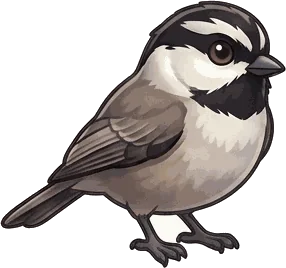
A Mountain Chickadee sounds like a Black-capped Chickadee with a sore throat. Its call is a hoarse, throaty chick-a-zee-zee, zee, rougher and buzzier than the clean chick-a-dee-dee-dee of its lowland cousin. The song is a clear whistle of three or four descending notes, fee-bee-bee, with the first note highest and the rest on a lower pitch, which some people hear as cheese-bur-ger. You hear both all year in pine, fir and spruce forest across the western mountains, usually from the high branches.
The birder's mnemonic
“cheese-bur-ger” Three whistled notes, the first higher and the last two lower and level, unlike the two-note fee-bee of the Black-capped Chickadee.
What the song sounds like
The song is a short set of pure whistles, usually three notes and sometimes four, stepping down in pitch: fee-bee-bee, with the opening note clearly higher and the bee notes lower and about equal. It is a simple, sweet sound, easy to whistle back, and it carries well through open conifer forest. Birders often write it as cheeseburger, a reminder that there are three syllables, not two.
That extra note is the key difference from the Black-capped Chickadee, whose song is a two-note fee-bee with the second note lower and often doubled. The Black-capped avoids pure conifer forest and prefers mixed and deciduous woods, willows and shade trees, so where the two meet you may hear the plain two-note whistle from the streamside trees and the three-note version from the pines above. The two do occasionally interbreed where their ranges overlap.
Singing is mostly a spring sound, strongest as pairs set up territories and look for nest holes. Even then it is less constant than the calls, so a quiet morning will usually give you a few songs and then a long stretch of chatter.
The call: a hoarse chick-a-dee
The everyday sound is the chickadee call with the polish taken off: a hoarse, throaty chick-a-zee-zee, zee. The dee notes of a Black-capped Chickadee are relatively clear; here they come out as a dry buzz, closer to zee. The harsh quality is usually the first clue that you have climbed high enough for Mountain Chickadees.
Pairs and small groups keep in touch with this call constantly as they work through the canopy, and after the breeding season they join mixed feeding flocks with other species. In those flocks the Black-capped Chickadee tends to be dominant, so where both occur the Mountain Chickadee is often the one giving way at the feeder.
When and where you hear it
This is a year-round resident of the mountain West, from far northwestern Canada down through the Rocky Mountains, the Southwest and the mountains of California. It breeds in forests of pine, spruce, fir and Douglas-fir, also in aspen groves within the conifer zone, in pinyon-juniper woodland and occasionally in cottonwood lowlands. In Montana it is common and widespread in suitable mountain habitat, and the same holds across Colorado, Utah and Idaho.
It does not migrate, but young birds and some adults drift downslope in winter, turning up in valley towns and even on the plains, often in planted conifers. That is when people in foothill suburbs wonder why their feeder chickadee has an eyebrow. They also cache food, remembering where each seed went with a spatial memory that researchers have studied closely.
Foraging birds work the high canopy, gleaning insects from twigs and often hanging upside down, and they probe bark crevices; they have even been seen using a wood splinter as a tool. Roughly 70 percent of the diet is animal matter, mostly caterpillars, beetles, insect eggs and pupae, and spiders, with conifer seeds taking over in the cold months. Nests go in tree cavities 5 to 25 feet up, natural or enlarged woodpecker holes, lined by the female with bark fibers, moss, hair and feathers. Clutches are large, usually seven to nine eggs, incubated about 14 days; in Montana most nesting runs from mid-June into late July. For Warble players, the hoarse call is a reliable catch at any mountain campground, though the app can hesitate when several chickadee species are chattering at once.
What it looks like
A standard chickadee, 4.7 to 5.5 inches long, with a black cap and bib, gray back and wings, and whitish underparts, plus the one feature no other North American chickadee has: a white stripe above the eye that cuts across the black cap. The width of that eyebrow varies, but it is almost always visible, and the Black-capped Chickadee has a solid black cap. Survey data show regional declines, but overall the species remains common across its range.
Birds that sound similar
 Black-capped Chickadee
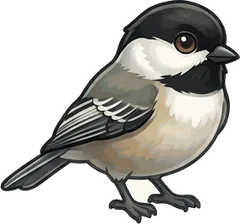
The Black-capped Chickadee's call is a clearer, buzzier chick-a-dee-dee-dee and its song is two notes, fee-bee. The Mountain Chickadee sounds hoarse and sings three or four descending notes, fee-bee-bee.
- ?Chestnut-backed Chickadee
The Chestnut-backed Chickadee of moist coastal conifer forest gives a squeaky, shrill, fast chick-a-dee and thin tsee-deee notes, and it has no whistled song at all. If you hear a clear whistle, it is not this bird.
Where the Mountain Chickadee card lives
In Warble the same bird can be an easy card in one state and a prized one in another, because each album ranks its birds by how often people really report them there. The Mountain Chickadee appears in 8 state albums:
 Heard one? Open Warble, tap the green button while it sings, and the Mountain Chickadee card flips into your album. Get the app free.
Questions people ask
What is the difference between a Mountain Chickadee and a Black-capped Chickadee call?
The Mountain Chickadee sounds hoarse. Its call is a throaty chick-a-zee-zee, zee, while the Black-capped Chickadee gives a cleaner chick-a-dee-dee-dee. The songs differ too: three or four descending whistles versus two.
Why does the Mountain Chickadee song sound like cheeseburger?
Because it has three syllables, the first higher than the other two: fee-bee-bee. The word is just a memory aid birders use for the rhythm and the drop in pitch. The Black-capped Chickadee's two-note fee-bee does not fit it.
Do Mountain Chickadees come to feeders?
Yes, readily, especially in winter when some birds move down into valleys and towns. They often carry seeds off to hide them, returning later to the exact spots they cached.
Do Mountain Chickadees migrate?
No. They are permanent residents of western mountain forests. Young birds and a few adults do move to lower elevations in winter, sometimes reaching the plains, and then return upslope to breed.
Sources
- National Audubon Society, Guide to North American Birds: Mountain Chickadee. www.audubon.org/field-guide/bird/mountain-chickadee
- Wikipedia: Mountain chickadee (song, call, diet, caching, flocks). en.wikipedia.org/wiki/Mountain_chickadee
- Montana Field Guide: Mountain Chickadee. fieldguide.mt.gov/speciesDetail.aspx?elcode=ABPAW01040
- National Audubon Society, Guide to North American Birds: Black-capped Chickadee. www.audubon.org/field-guide/bird/black-capped-chickadee