 Warble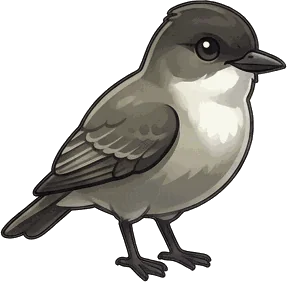
An Eastern Phoebe says its own name: a short, raspy, emphatic fee-bee, the first syllable stressed, longer and higher, repeated over and over from a low perch near a bridge, barn or porch. The bird alternates two versions, one with the second syllable higher and one with it lower or broken into a stutter, fee-b'dee. It is burry, not whistled, which is how you separate it from a chickadee. The call is a sharp, clear chip.
The birder's mnemonic
“fee-bee” A phoebe's fee-bee is rough and quick, like it is clearing its throat; a chickadee's fee-bee is a pure, slow whistle.
What the song sounds like
The song is two syllables, FEE-bee, with the accent hard on the first. The tone is harsh and buzzy rather than musical, and the bird gives it many times in a row, switching between two forms: one where the second note is higher than the first and one where it drops, sometimes breaking into a quick stutter, FEE-b'dee. Heard from a distance, the alternation gives the song a back-and-forth, seesaw quality.
Phoebes do not have to learn this. Young birds raised without ever hearing another phoebe still sing a normal song, which is unusual among songbirds and one reason the phoebe's voice is so consistent from Georgia to Ontario. Males sing hardest in the hours before dawn during the breeding season, and they start earlier and sing longer on the days when their mate is most fertile. Singing continues, at a lower rate, through the summer.
The classic confusion is with a chickadee, which also whistles a two-note fee-bee. The difference is texture: the Black-capped Chickadee gives a clean, pure whistle, the second note lower and often doubled, and it takes its time. The phoebe's version is quick, rough and insistent, and it comes from a bird wagging its tail on a fence post rather than from a flock in the treetops.
The call: a sharp chip
The everyday call is a short, sharp, clear chip, given between mates, by birds on the move in migration and by a phoebe disturbed near its nest. It is the sound you are most likely to hear in September and October, once the song has faded, and in the southern states through the winter.
When and where you hear it
The phoebe is the first flycatcher of spring and the last of fall. It arrives in the middle and late part of March, long before the pewees and other flycatchers, and lingers into October; in Missouri it is the only flycatcher that sometimes stays the winter. Records going back a century show its arrival and departure dates have hardly changed. Males come back about two weeks before females, and females tend to return to the same nest site they used the year before. It breeds across eastern North America, from the Northwest Territories and northeastern British Columbia south to Texas and New Mexico, but skips the southeastern coastal plain, and it winters from Virginia south through Florida and the Gulf states into Texas and Mexico.
The habitat is water plus a ledge. Phoebes work woodland edges, streamsides and farmyards, and they nest on a sheltered horizontal surface with a roof over it: under bridges, in culverts, on barn beams, on the light fixture over a porch, and on the rock ledges and cave mouths they used before there were buildings. The nest is an open cup on a base of mud, built up with green moss, leaves and grass and lined with fine grass and hair, and it is often reused, which lets a pair start early. Four or five white eggs are incubated for about 16 days, the young fly at about 16 days, and most pairs raise two broods. Brown-headed Cowbirds lay in phoebe nests. Because bridges and buildings created so many new sites, the population has probably grown over the years, and it stands around 35 million today.
Phoebes stay close to home once nesting starts, rarely foraging more than a hundred yards from the nest, so if you have one on your porch you will hear the same bird all summer.
What it looks like
A plain, big-headed flycatcher about six to seven inches long: gray-brown above, off-white below, with a sooty, slightly darker head that contrasts with the whitish throat. There are no wing bars and no eye ring, the bill is entirely black, and the bird can raise a small peaked crest. Fresh fall birds show a yellowish wash below and faint wing bars, which can make them look like pewees for a moment. The giveaway is the tail: a perched phoebe pumps it down and up, over and over, a habit thought to tell predators they have been spotted. It hunts by watching from a low perch and darting out to take insects in the air, wasps, bees, beetles, flies and grasshoppers, plus spiders, ticks and millipedes, and it eats small fruits and berries in the cold months. Both the common name and the Greek goddess it echoes came after the song.
Birds that sound similar
 Black-capped Chickadee
The chickadee's fee-bee is a slow, pure, whistled two-note tune, the second note lower and often doubled. The phoebe's is fast, raspy and repeated relentlessly from a low open perch.
 Eastern Wood-Pewee
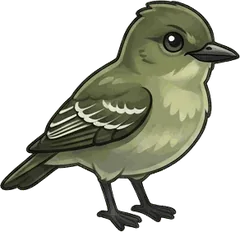
The wood-pewee's pee-a-wee is a slow, sweet, plaintive whistle that slides, usually three syllables, from the middle of a tree. It arrives in May, has wing bars, and does not wag its tail.
- ?Least Flycatcher
A dry, snapped che-bec with the accent on the second syllable, given incessantly from open woods. The phoebe accents the first syllable and its voice is lower and burrier.
Where the Eastern Phoebe card lives
In Warble the same bird can be an easy card in one state and a prized one in another, because each album ranks its birds by how often people really report them there. The Eastern Phoebe appears in 36 state albums:
 Heard one? Open Warble, tap the green button while it sings, and the Eastern Phoebe card flips into your album. Get the app free.
Questions people ask
Is it a phoebe or a chickadee saying fee-bee?
Listen to the texture. A Black-capped Chickadee whistles a slow, pure fee-bee with the second note lower and often doubled. An Eastern Phoebe rasps a quick, rough FEE-bee with the first syllable stressed and alternates a higher and a lower ending. If the singer is on a fence post or a porch light pumping its tail, it is the phoebe.
Why is there a phoebe nest on my porch light?
Because it is exactly what the bird is looking for: a sheltered horizontal ledge under a roof, near open ground and water. Before buildings, phoebes used rock ledges and cave mouths. The mud-and-moss nest is often reused and repaired year after year, sometimes by the same female, and a pair usually raises two broods a summer.
When do Eastern Phoebes come back in spring?
In the second half of March across most of the East, weeks ahead of any other flycatcher, and birds in the southern states may be around all winter. Males arrive about two weeks before females. Fall departure runs through September and October.
Do phoebes learn their song?
No. The Eastern Phoebe is one of the songbirds whose song is innate: young birds raised without hearing an adult still sing a normal alternating fee-bee. That is why the song sounds the same across the entire range.
Sources
- National Audubon Society, Guide to North American Birds: Eastern Phoebe. www.audubon.org/field-guide/bird/eastern-phoebe
- Wikipedia: Eastern phoebe (measurements, range, migration timing and nesting). en.wikipedia.org/wiki/Eastern_phoebe
- Missouri Department of Conservation, Field Guide: Eastern Phoebe. mdc.mo.gov/discover-nature/field-guide/eastern-phoebe
- Animal Diversity Web (University of Michigan): Sayornis phoebe. animaldiversity.org/accounts/Sayornis_phoebe/