 Warble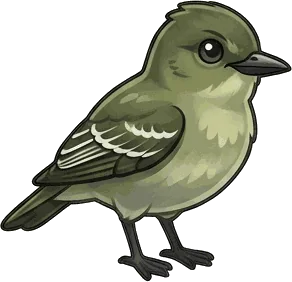
An Eastern Wood-Pewee sounds like a sigh with a tune in it: a slow, sweet, plaintive whistle, pee-a-weee, that rises in the middle and slides down at the end, followed after a pause by a shorter pee-oh or pee-yer that only falls. The notes are pure and unhurried, nothing like the raspy snap of a phoebe, and they come from the leafy middle of a tree where the plain gray bird sits still. It sings at dawn and dusk especially, and often through the heat of the day.
The birder's mnemonic
“pee-a-wee” Drag the syllables out and let the last one droop; a pewee never hurries.
What the song sounds like
The full song has two parts. The main phrase is pee-a-weee, three slurred syllables that climb on the second and fall away on the third; some transcribe a version with the rising note at the end, pee-weee. After a pause comes the second phrase, a shorter downslurred pee-oh, pee-yer or wee-ooo. Strung together, with a few seconds of silence between each phrase, the pattern runs pee-a-weee, pee-a-weee, pee-oh and repeats for minutes. The tone is thin, clear and melancholy, more like someone whistling absently than like a bird.
Timing sets it apart. A male starts as much as 45 minutes before sunrise and sings on into dusk, often continuing later in the evening than most other songbirds, and unlike many birds he keeps going through the middle of hot summer days. The steadiness is the clue: every few seconds, all summer, from the same stretch of woods. Females are mostly silent but give a two-note call when a predator is near.
The call
The downslurred pee-yer or wee-ur doubles as the everyday call, given singly by a bird that is not in full song. Compared with the phoebe's crisp chip, everything a pewee says is soft, whistled and a little sad.
When and where you hear it
The pewee is a late migrant. Where the Eastern Phoebe is back in March, the wood-pewee does not appear until the very end of April or May, and in southern Ontario it arrives between the middle of May and early June. In Missouri birds arrive in late April and early May and leave in September; very few remain anywhere after the first days of October. Like the phoebe, its arrival dates have held steady for a century. It breeds across eastern North America, from Saskatchewan to Newfoundland and south through the eastern United States, and winters in Central America, the Caribbean and the northern Andes, as far as Peru and Brazil. It travels at night.
It lives in deciduous and mixed woods, seldom in pure conifers, and favors the margins of clearings: roadsides, pond edges, pastures with scattered trees, small openings in the forest. It perches higher than most flycatchers, in the middle story, on an exposed twig with a clear view, and darts out to snatch flies, wasps, bees, winged ants, beetles and moths from the air before returning to the same perch. It sometimes picks insects from bark and takes a few berries.
The nest is almost impossible to find: a small, compact cup of grass, plant fibers and spider silk, its outside covered in lichens so it looks like a knot on a horizontal branch, usually 15 to 60 feet up in an oak, maple, pine or birch. Three eggs are incubated for 12 to 13 days and the young fledge two weeks or so later, with one brood a year. Some males keep two mates at once and feed both nests. Brown-headed Cowbirds parasitize pewee nests regularly. The species is still common, but Breeding Bird Survey counts have fallen about 44 percent since the mid-1960s, roughly one percent a year; the causes are not settled, and loss of winter forest and overbrowsing of the understory by white-tailed deer are both suspected. In Warble it is a card you will almost always catch by the song, since the bird is a gray dot in the shade.
What it looks like
A slim, plain flycatcher about six inches long: grayish olive above, whitish below with a gray-olive wash across the breast and sides, two pale wing bars, no eye ring, and often a slight peak at the back of the crown. The wingtips are very long, reaching far down the tail when the bird is perched, and the bill is dark above and dull orange or yellowish below, though young birds can have an all-dark bill. It sits upright and still. That stillness, the wing bars and the lack of tail-wagging separate it from a phoebe, and nothing separates it by sight from the Western Wood-Pewee, which lives west of the Plains and has an entirely different voice.
Birds that sound similar
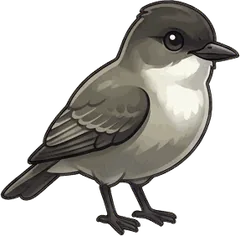 Eastern Phoebe
The phoebe's fee-bee is quick, raspy and two syllables, accented on the first. The pewee's pee-a-wee is slow, sweet and whistled, and the pewee arrives six weeks later, has wing bars and never wags its tail.
- ?Western Wood-Pewee
Identical to look at but sings a harsh, nasal, descending pee-eeer with none of the eastern bird's sweet upward slide. The ranges meet on the Great Plains, so in the middle of the country trust the voice.
Where the Eastern Wood-Pewee card lives
In Warble the same bird can be an easy card in one state and a prized one in another, because each album ranks its birds by how often people really report them there. The Eastern Wood-Pewee appears in 32 state albums:
 Heard one? Open Warble, tap the green button while it sings, and the Eastern Wood-Pewee card flips into your album. Get the app free.
Questions people ask
How do you tell an Eastern Wood-Pewee from an Eastern Phoebe?
By voice first: the pewee gives a slow, sweet, whistled pee-a-wee, the phoebe a quick raspy fee-bee. Then by habits: the phoebe pumps its tail, has no clear wing bars and arrives in March; the pewee sits still, shows two pale wing bars and long wingtips, and does not arrive until late April or May.
When does the Eastern Wood-Pewee sing?
From before dawn to after dusk. Males begin up to 45 minutes before sunrise, sing every few seconds through much of the day including hot afternoons, and continue later into the evening than most songbirds. The singing runs from arrival in May through the summer.
Why are Eastern Wood-Pewee numbers declining?
Nobody is certain. Surveys show a drop of about 44 percent since the mid-1960s, about one percent a year. Loss of forest on the wintering grounds in Central and South America is one suspect; another is overbrowsing by white-tailed deer, which strips the lower forest layers and the insects that live in them.
Is the Western Wood-Pewee the same bird?
No, though you cannot tell them apart by eye. The two species replace each other roughly at the Great Plains and sing completely different songs: the eastern bird's sweet, rising pee-a-wee against the western bird's harsh, nasal, descending pee-eeer.
Sources
- National Audubon Society, Guide to North American Birds: Eastern Wood-Pewee. www.audubon.org/field-guide/bird/eastern-wood-pewee
- Wikipedia: Eastern wood pewee (song, plumage, phoebe and western pewee comparison, migration, nesting). en.wikipedia.org/wiki/Eastern_wood_pewee
- Missouri Department of Conservation, Field Guide: Eastern Wood-Pewee. mdc.mo.gov/discover-nature/field-guide/eastern-wood-pewee
- Animal Diversity Web (University of Michigan): Contopus virens. animaldiversity.org/accounts/Contopus_virens/