 Warble
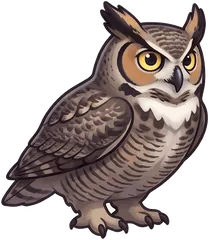
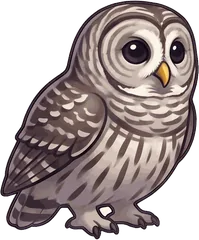
Listen to the rhythm. A Barred Owl hoots loudly in a barking phrase of about eight notes that fits who cooks for you, who cooks for you-all, with the last note sliding down into a drawn-out hooo-aw. A Great Horned Owl gives a low, smooth run of four or five hoots, hoo, hoo-hoo, hoo, hoo, with a quick pair in the middle and no falling finish. In view, a Great Horned Owl has ear tufts and yellow eyes; a Barred Owl has a round head with no tufts and dark eyes.
Side by side
| Great Horned Owl | Barred Owl | |
|---|---|---|
| Main call | Four or five low, far-carrying hoots, hoo, hoo-hoo, hoo, hoo, the middle two shorter | About eight loud, barking hoots, who cooks for you, who cooks for you-all, ending in a falling hooo-aw |
| Other sounds | Growls, laughs and cat-like notes; the young hiss and screech | Cackles, gurgles and cat-like screams; hisses and bill clicks |
| Pairs | The female joins in, higher-pitched and rising at the end | Mates often call back and forth in duet |
| Peak calling | After midnight; builds before egg-laying in late winter, again in autumn | 6 p.m. to 6 a.m.; late winter to early spring, again after the young disperse |
| Looks | Ear tufts, yellow eyes, white throat, barred belly | Round head, no tufts, dark eyes, barred chest and streaked belly |
| Where | Almost anywhere with trees or brush for cover | Dense, often wet woods: river bottoms and swamps |
By ear: count the hoots, listen for the slide
The Barred Owl is the talker. Its classic call is a run of about eight accented hoots, which birders remember as who cooks for you, who cooks for you-all and which earned it the nickname old eight-hooter. The voice is a rich baritone but the delivery is loud and barking, and the last note slides down into a drawn-out hooo-aw. That falling finish is the giveaway. The call probably carries well over half a mile.
Barred Owls can also raise a wild racket. Mates call back and forth in duets, and the hoots can break down into cackles, caws, gurgles and cat-like screams that have been compared to sudden demonic laughter. A shorter phrase ending in hoo-aah is common too; in north Florida the lone hoo-aah was the song heard most often.
The Great Horned Owl is calmer. Its song is a series of low, sonorous hoots that carry a long way, usually four or five of them, hoo, hoo-hoo, hoo, hoo, with the second and third notes shorter than the rest. It has neither the Barred Owl's barking accent nor its long, falling finish. Females often join their mates' hooting, and the female's voice is higher and rises at the end. The young are the noisy ones, with loud hisses and piercing screeches.
A quick test on a dark night: if you can fit the words who cooks for you to it and it ends in a long, falling aw, it is a Barred Owl. If it is a short, deep, even set of hoots with a stutter in the middle, it is a Great Horned Owl.
By sight: tufts and eyes
Size will not help much, since Audubon calls the Barred Owl only a little smaller than the Great Horned. Look at the head. A Great Horned Owl has conspicuous ear tufts, which are feathers rather than ears, plus a white throat patch and yellow eyes. A Barred Owl has a large, rounded head with no tufts at all and dark brown eyes that can look black in the field.
The body pattern differs too. The Great Horned Owl has horizontal bars across its belly. The Barred Owl is barred only across the throat and upper chest, then streaked with bold vertical stripes down the belly, and it is grayish brown overall with a pale yellow bill.
Where you will meet each one
The Great Horned Owl lives in nearly every North American habitat, from swamps and deserts to northern conifer forest near tree line, and it likes best the places where open hunting ground meets woods for roosting and nesting, including some towns. It has no regular migration. It is one of the earliest nesting birds on the continent, often laying eggs weeks or months ahead of other raptors, so its territorial hooting builds before egg-laying, which can start in late winter, and drops off in February or March. Calling seems to peak after midnight.
The Barred Owl wants dense woods with few clearings, especially low, swampy ground: wooded river bottoms and swamps, deciduous and mixed woods in the Southeast, mature conifers in the North and the Pacific Northwest. It stays all year. It has spread west, reaching Washington by 1965, Oregon by 1972 and northern California by 1976, and it now competes with the Spotted Owl. Calling peaks between 6 p.m. and 6 a.m., and the loudest season runs from late January in Florida to early April in Canada. It also calls in daylight, especially when answering an imitation.
The two often live near each other, though not comfortably. Audubon notes that the Barred Owl is much less aggressive and that competition with the Great Horned Owl may keep it out of more open woods. In New Jersey, Barred Owls rarely breed successfully near towns, partly because Great Horned Owls crowd them out and prey on them. Deep, wet woods favor the Barred Owl; patchy, open country favors the Great Horned.
 Still not sure which one is outside? Warble listens while it sings and tells you, then adds the card to your album. Get the app free.
Questions people ask
What owl says who cooks for you?
The Barred Owl. Its main call is about eight loud, barking hoots that fit who cooks for you, who cooks for you-all, ending in a falling hooo-aw. A Great Horned Owl's hoots are fewer and smoother, with no spoken rhythm.
Which owl hoots five times?
Usually the Great Horned Owl. Its song is four or five low hoots, hoo, hoo-hoo, hoo, hoo, with the second and third notes shorter than the others. A Barred Owl's phrase runs to about eight notes and ends with a drawn-out slide.
Do Great Horned Owls eat Barred Owls?
Sometimes. In New Jersey, Barred Owls rarely nest successfully near towns, partly because Great Horned Owls displace them through competition and predation. Audubon adds that the Barred Owl is much less aggressive.
Sources
- National Audubon Society, Guide to North American Birds: Great Horned Owl. www.audubon.org/field-guide/bird/great-horned-owl
- National Audubon Society, Guide to North American Birds: Barred Owl. www.audubon.org/field-guide/bird/barred-owl
- Wikipedia: Great horned owl (song, female voice, calling times, nesting). en.wikipedia.org/wiki/Great_horned_owl
- Wikipedia: Barred owl (calls, mnemonic, calling hours and seasons, westward spread). en.wikipedia.org/wiki/Barred_owl