 Warble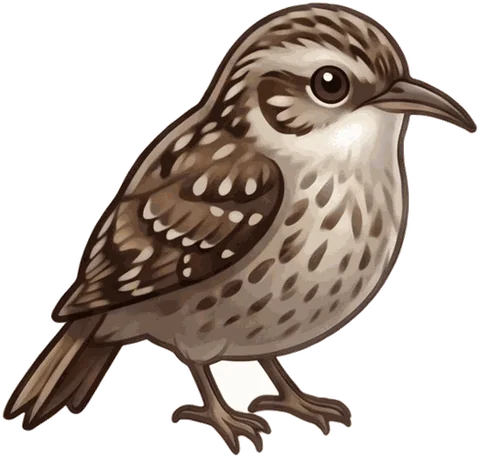
A Brown Creeper sounds like a whisper from high in the trees. Its call is a single, very high, thin see, so high-pitched that many people never notice it. The song is a short, tinkling warble of high notes that tumbles downward, about two seconds long, often written see tidle swee. Listen for it in spring in mature woods with big trees, while a small brown bird spirals up a trunk, drops to the base of the next tree and starts again.
What the song sounds like
The song is a brief, tinkling run of very high notes, thin and lisping, that slides downward as it goes. Field guides write it as a descending warble; birders write it out as see tidle swee or pee pee willow wee, and the notes have the same wiry quality as the call. Most songs fit inside about two seconds. In California most birds use four to nine syllables, while creepers in the San Bernardino Mountains pack nine to thirteen into the same span.
Only the male sings, and he uses it to hold a territory once breeding starts in April. The pitch is the problem for the listener: the song sits near the top of what human ears pick up, and combined with bark-colored plumage it makes the species one of the hardest common forest birds to detect. Survey biologists consistently undercount it for that reason. The trick is to stop walking, stand still among big trunks in a quiet stretch of woods, and let the sound come to you. Almost nothing else in the forest is that high and that sweet at the same time.
The call: a single high see
The everyday call is one short, piercing, insistent see or swee, given over and over as the bird works up a trunk. It is very easy to confuse with a Golden-crowned Kinglet, which often travels in the same winter flocks. In fall and winter that call is usually all you get, and it is often the only clue that a creeper is on the tree in front of you. If you use Warble, hold the phone still and get close: a sound this quiet and this high is the first thing wind and traffic noise swallow.
When and where you hear it
Brown Creepers breed in mature forest with large trees, conifer or hardwood, from mountain pine woods to lowland swamps, across Alaska, Canada, the northern and western United States and down the Appalachians. Big trees with deep bark furrows are the requirement, since that is where the food lives and where the nest goes. Northern birds move south for the winter and many southern birds stay put all year, so across much of the country the creeper is a migrant and winter visitor rather than a nester. Migration peaks in April and again from late September into early October. On migration and in winter any patch with decent-sized trees will do, including suburban parks and shady yards. In Missouri, for example, it is a common migrant and an uncommon winter bird of river-valley woods, more often found in the southern part of the state.
The bird itself is easy to recognize once you know the routine. It lands near the base of a rough-barked trunk, creeps upward in a spiral, bracing on its stiff tail like a woodpecker and probing crevices with its thin curved bill for insect eggs, beetles, spiders and pseudoscorpions. When it gets within a few yards of the top it flies down to the bottom of the next tree and begins again. It rarely visits the ground. The nest is one of the oddest in North America: a shallow half-cup of twigs, bark strips and moss tucked like a hammock between the trunk and a slab of loose bark on a dead or dying tree. The female builds it and lays five or six eggs, and the young leave roughly two weeks after hatching.
What it looks like
A slim bird about 5 inches long with a wingspan of 7 to 8 inches, roughly sparrow-sized but much thinner. The back is streaked brown, gray and white and blends into bark so well that a motionless creeper simply disappears. The underparts are white, there is a whitish stripe over the eye, the base of the tail is rusty, and the bill is long, thin and curved downward. The tail is long and stiff, with pointed feathers that prop the bird against the trunk. Males and females look alike. Numbers have been rising by about 1.5 percent a year since 1966 in the Northeast and Northwest, and the species is listed as Least Concern.
Birds that sound similar
 Golden-crowned Kinglet
The kinglet's call is a thin, wiry ti-ti-ti that rises, usually in threes, and its song ends in a tumbling chatter. The creeper gives one see at a time and its song slides downward, not up.
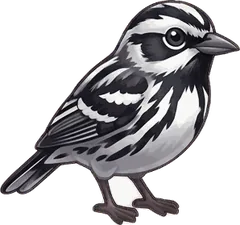 Black-and-white Warbler
The Black-and-white Warbler also creeps along trunks, but its song is a steady, squeaky weesy-weesy-weesy on an even rhythm, like a wheelbarrow, not a quick tumbling run that drops in pitch.
Where the Brown Creeper card lives
In Warble the same bird can be an easy card in one state and a prized one in another, because each album ranks its birds by how often people really report them there. The Brown Creeper appears in 20 state albums:
 Heard one? Open Warble, tap the green button while it sings, and the Brown Creeper card flips into your album. Get the app free.
Questions people ask
Why can't I hear the Brown Creeper?
Its voice is extremely high and thin, right at the edge of what people notice, and the bird is quiet and camouflaged besides. Even trained survey crews undercount it. Stand still among large trunks and listen for a single tiny see repeated as a small brown shape moves up the bark.
Is a Brown Creeper a kind of woodpecker?
No. It braces on a stiff tail like a woodpecker, but it is a tiny songbird with a thin downcurved bill that probes bark crevices instead of drilling. It spirals up one tree, then flies down to the base of the next.
Do Brown Creepers come to feeders?
Sometimes, in winter. They will take suet or peanut butter, especially if it is smeared on rough bark, and they may work the trunks of yard trees during migration and cold months.
Sources
- National Audubon Society, Guide to North American Birds: Brown Creeper. www.audubon.org/field-guide/bird/brown-creeper
- Wikipedia: Brown creeper (calls, song variation, detection, range and population). en.wikipedia.org/wiki/Brown_creeper
- Missouri Department of Conservation field guide: Brown Creeper. mdc.mo.gov/discover-nature/field-guide/brown-creeper
- Animal Diversity Web: Certhia americana. animaldiversity.org/accounts/Certhia_americana/