 Warble


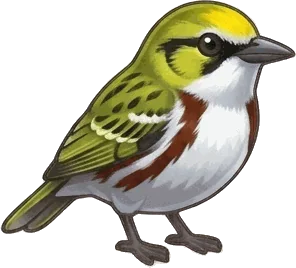
A Chestnut-sided Warbler sounds like a small bird politely introducing itself with a lot of enthusiasm. The song is a quick run of rich, high, whistled notes that ends with a strongly accented flourish, written pleased, pleased, pleased to MEETCHA. Males sing it from brushy clearings, overgrown fields and regrowing woods across the Great Lakes region and the eastern states from May into summer. Later in the season they switch to versions without the accented ending, which are much harder to tell from a Yellow Warbler.
The birder's mnemonic
“pleased, pleased, pleased to MEETCHA” Audubon's field guide writes it very very pleased to meet cha! The number of pleaseds changes; the stressed MEET-cha at the end is the part to listen for.
What the song sounds like: pleased to meet you
The song most people learn is the courtship version: a string of similar bright, whistled notes followed by a two-part ending with the weight on the first syllable. Audubon calls it rich and musical with an emphatic finish, and Wikipedia renders it pleased, pleased, pleased to MEECHA. That accented last word is the whole trick. Once you hear it as a sentence, you will not be able to hear it any other way. It is the classic answer to the question what bird says pleased to meet you.
This accented song does a specific job. Males use it mainly to attract females, and they sing it less once nesting is well under way. In Audubon Magazine, Tom Stephenson notes that the mate-attraction song sounds much the same everywhere the species breeds, which makes it a reliable thing to learn.
For defending territory and confronting other males, they switch to unaccented songs that drop the MEETCHA, and some of these versions are saved for escalating a fight with an intruder. Unlike the courtship song, these aggressive songs are highly local, varying from one area to the next. Males that sing only unaccented songs have a harder time finding mates than males that sing both. For listeners, the practical result is that a Chestnut-sided later in the summer may sing a run of sweet notes that never gets around to the introduction.
The call: a harsh chip
Away from the song, Chestnut-sided Warblers give a harsh chip, along with high, whistled notes. Away from the breeding grounds, these notes are often the best clue to a bird working through a shrub, gleaning insects from the undersides of leaves.
When and where you hear it
Chestnut-sided Warblers breed in eastern North America, from Saskatchewan to the Maritimes and through the Great Lakes region and the eastern states, south to northwest Georgia. Migration happens mostly at night and peaks in May and September. Males arrive a few days to a week ahead of females and start claiming territories, so the first weeks after arrival are the best time to hear the full pleased to meetcha.
This is a specialist of young, scrubby growth: forest regrowing after a clearcut or fire, overgrown fields, forest edges and thickets of briers and brambles. After a clearcut, numbers start to rise about a year later and peak seven to eight years after the cutting. That habitat preference has shaped the bird's history. Audubon notes that it is apparently far more common today than in the early nineteenth century, because clearing the eastern forests created so much brushy second growth. Numbers have declined slightly in recent decades, falling in New England but rising in Pennsylvania.
In winter the birds head to the tropics, from southern Mexico and Central America to northern Colombia, with the largest numbers in Costa Rica. There they live mostly in the middle and upper levels of mature rainforest, along with forest edges and coffee plantations.
What it looks like
A small warbler weighing about a third of an ounce, often seen hopping through saplings with its tail cocked. The breeding male has a yellow cap, a black line through the eye that curves around a white cheek, white underparts and a ragged chestnut stripe down each side. Females are paler, with less chestnut. In fall the look changes completely: lime green above, clean white below, a white eye-ring on a gray face and two yellowish wing bars. During courtship the male fluffs his feathers, raises his yellow crown and spreads and quivers his wings and tail.
Birds that sound similar
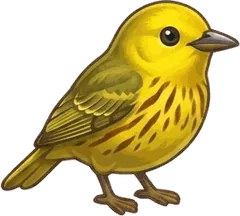 Yellow Warbler
The Yellow Warbler has a version of its song that comes very close, and its territorial songs can be very similar too. Its lookalike song is a bit higher and brighter, less emphatic at the end, and usually has fewer notes before the finish.
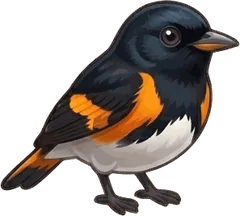 American Redstart
A redstart in the same second growth sings five or six high notes or two-note phrases that end with an upward or downward slur. It lacks the Chestnut-sided's stressed two-part MEET-cha finish.
Where the Chestnut-sided Warbler card lives
In Warble the same bird can be an easy card in one state and a prized one in another, because each album ranks its birds by how often people really report them there. The Chestnut-sided Warbler appears in 9 state albums:
 Heard one? Open Warble, tap the green button while it sings, and the Chestnut-sided Warbler card flips into your album. Get the app free.
More about the Chestnut-sided Warbler on this site
Questions people ask
What bird says pleased, pleased, pleased to meet you?
The Chestnut-sided Warbler. Its courtship song is a run of high, clear whistles that ends with an accented MEET-cha. You hear it in late spring in brushy clearings and young woods across the Great Lakes region and the eastern states.
Why doesn't the Chestnut-sided Warbler always say meetcha?
Because it has two kinds of song. The accented meetcha version is mainly for attracting a mate and becomes less frequent once nesting is under way. For territorial disputes males use unaccented songs that leave the ending off.
Was the Chestnut-sided Warbler always this common?
No. It is apparently far more common now than in the early 1800s, because clearing the eastern forests created the brushy second growth it needs. Numbers rose in the late nineteenth century and have dipped slightly in recent decades.
Where do Chestnut-sided Warblers go in winter?
To the tropics, from southern Mexico and Central America to northern Colombia, with the biggest numbers in Costa Rica. They leave the breeding grounds between late August and late September.
Sources
- National Audubon Society, Guide to North American Birds: Chestnut-sided Warbler. www.audubon.org/field-guide/bird/chestnut-sided-warbler
- Wikipedia: Chestnut-sided warbler (accented and unaccented songs, habitat, range, population). en.wikipedia.org/wiki/Chestnut-sided_warbler
- Audubon Magazine (Tom Stephenson): How to tell apart sound-alike warblers. www.audubon.org/magazine/how-tell-apart-sound-alike-warblers
- National Audubon Society, Guide to North American Birds: American Redstart. www.audubon.org/field-guide/bird/american-redstart