 Warble


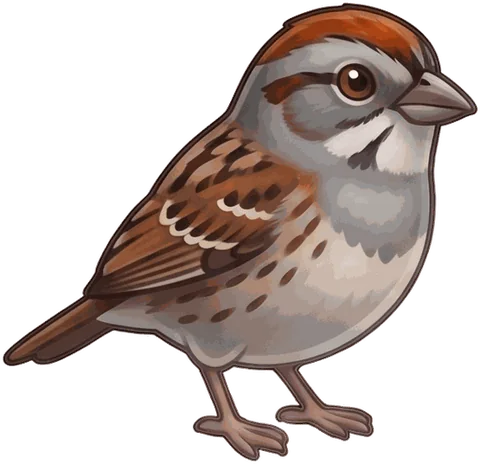
A Swamp Sparrow sounds like a slow, sweet trill held on a single pitch: a steady run of rapid, repeated notes, musical and fairly low for a sparrow, sung by a male from the top of a cattail or a marsh shrub. It is noticeably slower than a Chipping Sparrow's trill. The call is a sharp, metallic tchip, and in winter that chip from a weedy ditch or marsh edge is usually all you get, since the bird stays hidden.
What the song sounds like: a slow, sweet trill
The song is a trill all on one note: the same short syllable repeated quickly and evenly, with no change in pitch from start to finish. What sets it apart from other trills is its pace and tone. The notes come slowly enough that you can almost hear each one, and they are sweet and musical rather than dry or buzzy. The Missouri Department of Conservation calls it a low, sweet trill, and that is a fair summary.
A male does not have just one version. Each bird carries several different trills in his repertoire, so the same male may not sound exactly alike from one song to the next. Swamp Sparrows in the tidal marshes between northern Virginia and the Hudson River belong to a distinct, grayer and darker local form that sings different songs from inland birds.
During the nesting season, the male sings from a raised perch such as the top of a cattail or a shrub at the marsh edge, and he sings at night as well as by day, so the trill can come out of a marsh long after dark.
The call: a sharp, metallic chip
The everyday call is a loud, sharp, metallic tchip, and it is often the way people find a Swamp Sparrow at all, because the bird is a skulker that spends its time low in dense cover. There is also a thin zeee note that resembles the call of a Lincoln's Sparrow. Swamp Sparrows will sometimes come up to investigate when a birder makes loud squeaking sounds at the edge of a marsh.
When and where you hear it
In summer, Swamp Sparrows breed across the northern United States and much of Canada, and they are common in the Northeast and Midwest. They nest mostly in freshwater marshes with cattails, sedges or grasses, often mixed with alder or willow thickets, and in swampy thickets around ponds and rivers. On the Middle Atlantic Coast a few nest in salt marshes.
Most birds migrate, chiefly to the southeastern states, and a few stay year-round at the southern edge of the breeding range. Birds from western Canada travel east in fall to winter in the Southeast, while small numbers winter scattered across the West. In migration and winter they spread into streamside thickets, wet meadows, hay fields and weedy fields, sometimes away from water. In Missouri they are a common migrant and uncommon winter resident, present from September to mid-May; the state has had no nesting record for about a century.
Outside the nesting season, expect the chip rather than the song. In Warble it is an uncommon card in New York, Minnesota, Wisconsin and Louisiana, and rare across most of the East.
What it looks like
A dark, medium-sized sparrow about 5 to 6 inches long, with bright chestnut on the wings and back and no wing bars. In breeding season it shows a gray face, a white throat and a rusty cap; in winter the crown turns duller, brown with a pale central stripe. The breast is gray and unstreaked. The rusty cap can suggest a Chipping Sparrow, but the Swamp Sparrow is bigger and bulkier and lives mostly in marshes.
It feeds on wet mud at the water's edge and wades into very shallow water, and its long legs let it reach small aquatic invertebrates, sometimes by dunking its head under the surface. Insects such as beetles, caterpillars, grasshoppers, crickets and ants fill the summer diet; seeds of grasses, weeds and sedges carry it through fall and winter. The nest is a bulky grass cup tucked into cattails, sedge tussocks or bushes, often over water, with dead leaves arching over it so the birds enter from the side. The female builds it and lays four or five heavily marked, greenish eggs, and pairs often raise two broods a year.
Birds that sound similar
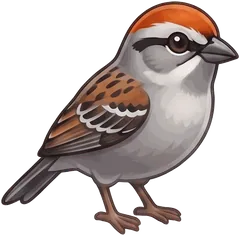 Chipping Sparrow
The Chipping Sparrow also sings a trill on one note, but a faster one. The Swamp Sparrow's trill is noticeably slower and sweeter, and it usually comes from a marsh.
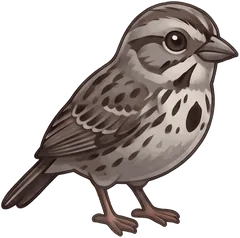 Song Sparrow
The Song Sparrow shares the marsh edge, but its song opens with three short notes and then breaks into a varied trill. The Swamp Sparrow holds one note from start to finish.
Where the Swamp Sparrow card lives
In Warble the same bird can be an easy card in one state and a prized one in another, because each album ranks its birds by how often people really report them there. The Swamp Sparrow appears in 31 state albums:
 Heard one? Open Warble, tap the green button while it sings, and the Swamp Sparrow card flips into your album. Get the app free.
Questions people ask
What bird sings a slow trill in a marsh?
Very often a Swamp Sparrow. Its song is a sweet, musical trill all on one pitch, slower than a Chipping Sparrow's, sung from a cattail top or shrub in freshwater marshes across the northern states and Canada. Males sing at night too.
How do you tell a Swamp Sparrow from a Chipping Sparrow by song?
Speed and setting. Both sing a trill on one note, but the Swamp Sparrow's is much slower, with notes you can nearly count, and sweeter in tone. It usually comes from cattails, sedges and marsh shrubs.
Do Swamp Sparrows sing at night?
Yes. In the nesting season males sing from raised perches by day and by night, so a slow trill coming from a dark marsh is often a Swamp Sparrow.
Do Swamp Sparrows come to feeders?
Rarely. They are unlikely feeder visitors and stay in marshes, wet meadows and weedy fields, foraging on the ground and in shallow water. Listen for the sharp tchip from dense cover instead.
Sources
- National Audubon Society, Guide to North American Birds: Swamp Sparrow. www.audubon.org/field-guide/bird/swamp-sparrow
- Wikipedia: Swamp sparrow (song, repertoire, range, coastal plain form). en.wikipedia.org/wiki/Swamp_sparrow
- Missouri Department of Conservation, Field Guide: Swamp Sparrow. mdc.mo.gov/discover-nature/field-guide/swamp-sparrow
- National Audubon Society, Guide to North American Birds: Song Sparrow. www.audubon.org/field-guide/bird/song-sparrow