 Warble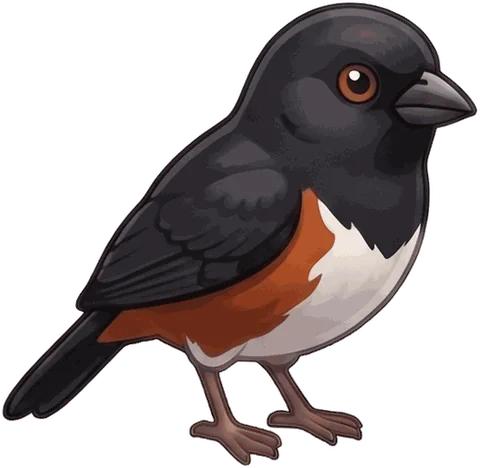
An Eastern Towhee sounds like a bird ordering a drink: a short, bright drink your teeeea, about a second long, with a sharp opening note, a second whistle and a fast trill at the end. The everyday call is a rising, two-part chewink or tow-hee, which is where the name comes from. Both come from low in a thicket, often with the sound of dead leaves being kicked about.
The birder's mnemonic
“drink your teeeea” The song varies by region and some birds render it closer to to-wheeeee, so listen for the sharp start and the trilled ending rather than counting syllables.
What the song sounds like
The full song has three pieces. It opens with a sharp, emphatic note (the drink), follows with one or two clear whistles on a different pitch (the your), and finishes with a trill that is higher and looser than the notes before it (the teeeea). The whole thing takes about one second, and the bird repeats it every few seconds from a low perch inside a shrub or from the top of a small tree.
The song varies by region. Some birds stretch the ending into a long to-wheeeee, and the number of introductory notes changes from place to place. The shape stays the same: a couple of clean, separate notes, then a rush of fast ones.
The call: a rising chewink
Most of the year you will hear the call more than the song. It is a short two-part note that rises in pitch, written chewink or tow-hee, and it is loud enough to carry out of a thicket you cannot see into. Often it comes out slurred and indistinct, closer to a questioning meeww?, and that nasal version is cat-like enough that beginners log a towhee as a Gray Catbird.
The other giveaway is not a voice at all. Towhees feed on the ground by hopping forward and then kicking both feet backward at the same time, throwing leaf litter behind them. In a quiet woodland the rustling sounds like something much bigger than a sparrow-sized bird.
When and where you hear it
Eastern Towhees live across the eastern United States and southeastern Canada. In the South many birds stay all year, so the chewink is a winter sound in Florida and across the Deep South. North of southern New England, and west through northern Indiana and Illinois to southern Iowa, they are mostly summer birds that move to the southern states for the cold months. In Missouri, for example, they are common statewide in summer but scarce in winter.
The habitat is always brushy: overgrown fields, woodland edges, young regrowth where trees have been cut, streamside thickets, the shrubs behind a suburban fence. The song belongs to spring and early summer; the call and the leaf-kicking go on in any month the bird is present. Because towhees need young, shrubby growth, their numbers have dropped seriously in the Northeast as that habitat has shrunk.
The Eastern Towhee is in the Warble album of nearly every eastern state, and it is one of the birds players usually catch by ear first: the song is loud and the bird is not.
What it looks like
A large, long-tailed sparrow, roughly seven to nine inches from bill to tail tip. The male is black on the head, back and tail, with rusty orange sides and a white belly, and the female wears the same pattern in warm chocolate brown. Both show white corners on the tail and a white patch at the base of the wing when they flush. Across most of the range the eye is a deep red, but in Florida and nearby parts of the Southeast birds have pale, whitish-yellow eyes, the so-called white-eyed form.
For years this bird and the western Spotted Towhee were treated as one species, the Rufous-sided Towhee. The two meet on the Great Plains, where they occasionally hybridize.
Birds that sound similar
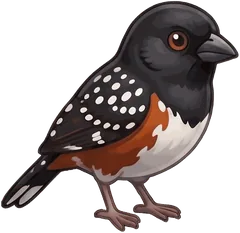 Spotted Towhee
The western twin sings a long, buzzy cheweeeee with no clean introductory whistles, and its calls are harsher and more variable. The Eastern Towhee's song has separate notes before the trill.
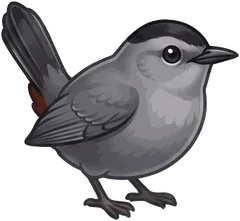 Gray Catbird
The catbird's meeoow is a drawn-out, nasal whine; the towhee's chewink is short, two-parted and rises. The catbird's song is a long jumble with little repetition and no towhee-style trill.
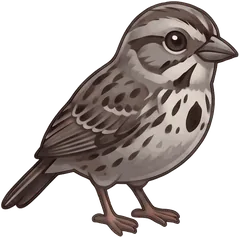 Song Sparrow
A Song Sparrow also opens with short notes and ends in a trill, but it gives three quick notes and a longer, more varied trill. The towhee's version is shorter and simpler: one sharp note, a whistle, a trill.
Where the Eastern Towhee card lives
In Warble the same bird can be an easy card in one state and a prized one in another, because each album ranks its birds by how often people really report them there. The Eastern Towhee appears in 30 state albums:
 Heard one? Open Warble, tap the green button while it sings, and the Eastern Towhee card flips into your album. Get the app free.
Questions people ask
What bird says drink your tea?
The Eastern Towhee. Its song is usually written drink your teeeea: a sharp first note, a whistle, then a trill on the last word. It sings from thickets across the eastern United States in spring and summer.
Why is it called a towhee?
The name imitates its call. The most common call is a two-part note that rises in pitch, and people heard it as tow-hee or chewink. Both words have been used as names for the bird.
What is the scratching noise in the leaves under my bushes?
Very often a towhee. It feeds by hopping forward and kicking both feet backward at once, flinging leaves aside to uncover insects, spiders and seeds. The noise is surprisingly loud for a bird of its size, and you will usually hear a chewink nearby.
Do Eastern Towhees have red eyes or white eyes?
Both, depending on where you are. Most Eastern Towhees have red eyes. Birds in Florida and neighboring parts of the Southeast have pale whitish-yellow eyes and are known as the white-eyed form.
Sources
- National Audubon Society, Guide to North American Birds: Eastern Towhee. www.audubon.org/field-guide/bird/eastern-towhee
- Wikipedia: Eastern towhee (song, calls, range and taxonomy). en.wikipedia.org/wiki/Eastern_towhee
- Missouri Department of Conservation, Field Guide: Eastern Towhee. mdc.mo.gov/discover-nature/field-guide/eastern-towhee
- National Audubon Society, Guide to North American Birds: Spotted Towhee (for the comparison). www.audubon.org/field-guide/bird/spotted-towhee