 Warble
A Mountain Bluebird sounds quiet for such a bright bird. The song is a soft, low warble of short burry notes, sometimes written chur chur, given by the male mostly at dawn from a bare branch or fence post. The everyday call is a thin, soft few, and the alarm near a nest is a harsher chup. You will usually see one first, a sky-blue bird hovering over a meadow or sagebrush flat, before you notice the small sounds it makes. It is the state bird of Idaho and Nevada.
What the song sounds like
The song is a series of soft warbling notes, low and a little burry, without the carrying power of a robin even though the bird is a thrush. Each phrase is short, and the whole performance is easy to miss unless you are close. The best time to hear it is first light, when males sing from a bare branch, a post or a wire before they start hunting.
Males sing most while the female is incubating and in the first days after the eggs hatch, later in the season than many songbirds. There is an advertising song to attract a mate, and a quieter signal that seems to tell the female no predator is near the nest.
The call: a thin few and a harsh chup
The contact call is a thin, soft few, often the first sign that a loose flock is working a field in winter. When a cat, a raccoon or a person comes too close to the nest, the pair switches to a harsh chup, repeated as they fly at the intruder, and they snap their bills while diving. Even so, Mountain Bluebirds tolerate people near the nest better than most birds and rarely abandon a box over it.
Compared with its relatives, the Mountain Bluebird is the softest-voiced. The Eastern Bluebird has a liquid, musical turee or queedle call; the Western Bluebird gives a phew and a chuck and a short cheer, cheer-lee, churr song. Where ranges overlap, look as well as listen.
When and where you hear it
This is the bluebird of big open spaces: prairies, sagebrush flats, mountain meadows, burns and clear-cuts, and alpine basins up to the tree line, anywhere there is open ground with a few trees or posts to perch on. It avoids dense forest. The breeding range covers the western United States and Canada from Manitoba to British Columbia and north into Alaska, with nests found as high as about 4,270 meters. Many birds stay year-round from Oregon and California east to Colorado and south to Arizona; northern birds winter in the Southwest, Texas, Oklahoma and central Mexico.
Migration is late in fall and early in spring, and the winter range shifts from year to year with the food supply, across pinyon-juniper woodland, grassland, desert, farmland and plowed fields. They also wander more than the other bluebirds: flocks drift east onto the Great Plains, and stragglers have reached the Atlantic Coast.
Watch how it hunts. The bird hovers over open ground, then drops onto a beetle, grasshopper, cricket, caterpillar or spider; it hovers far more than other bluebirds and also darts from a perch after flying insects. In winter it switches largely to berries of juniper, mistletoe and elderberry. Nests go in woodpecker holes, cliff crevices, dirt banks and, very often, nest boxes, which have raised local numbers across the West and the Canadian prairies. The female builds a nest of grass, twigs and pine needles and lays four to six pale blue eggs; she incubates for about two weeks while the male brings her food, and the young fledge at around three weeks. Pairs can raise two broods. For Warble players in Idaho and Nevada, this is the state bird card, best caught at dawn near a nest box in May.
What it looks like
Sparrow-sized but longer-winged and longer-tailed than other bluebirds, 6.3 to 7.9 inches long, with a thinner bill. The male is sky blue to turquoise above, paler blue below, fading to a white lower belly, with no orange or rust anywhere, which is why it is called the bluest of the bluebirds. The female is gray to gray-brown with blue in the wings, tail and rump and a white belly; in fresh fall plumage she can show a faint orange wash on the breast that invites confusion with a female Western Bluebird. The population, around 5.6 million, is stable.
Birds that sound similar
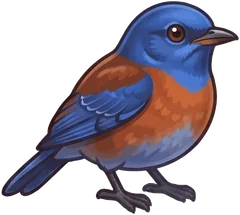 Western Bluebird
The Western Bluebird's song is a short cheer, cheer-lee, churr and its calls are a soft phew and chuck. The Mountain Bluebird's warble is lower and burrier and its call a thinner few; the male also lacks any rusty breast.
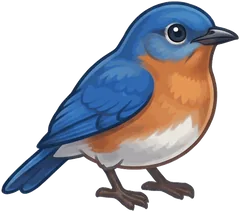 Eastern Bluebird
The Eastern Bluebird's turee or queedle call is liquid and musical, and its warble is sweeter. The two meet only where Mountain Bluebirds wander east onto the plains; a rusty throat and chest means Eastern.
Where the Mountain Bluebird card lives
In Warble the same bird can be an easy card in one state and a prized one in another, because each album ranks its birds by how often people really report them there. The Mountain Bluebird appears in 7 state albums:
 Heard one? Open Warble, tap the green button while it sings, and the Mountain Bluebird card flips into your album. Get the app free.
Questions people ask
What is the difference between a Mountain Bluebird and a Western Bluebird?
Color first: the male Mountain Bluebird is entirely sky blue with a white lower belly and no orange, while the male Western has a blue throat and a rusty chest. The Mountain is longer-winged with a thinner bill, prefers wide open country, hovers while hunting, and has a softer warble.
Which states have the Mountain Bluebird as state bird?
Two: Idaho, which adopted it in 1931, and Nevada, in 1967. Both are states where sagebrush flats and high meadows make it a familiar bird.
Why do Mountain Bluebirds hover?
It is how they hunt in open ground with few perches. The bird hangs over a field, spots an insect, and drops on it. Among the three bluebirds this one hovers by far the most, probably because its long wings carry its light body easily.
Will Mountain Bluebirds use a nest box?
Readily, and they become attached to a box where they have raised young, often returning to it. Nest box trails have increased local populations, for example in southwestern Manitoba.
Sources
- National Audubon Society, Guide to North American Birds: Mountain Bluebird. www.audubon.org/field-guide/bird/mountain-bluebird
- Wikipedia: Mountain bluebird (song and call, plumage, nest boxes, state bird). en.wikipedia.org/wiki/Mountain_bluebird
- Animal Diversity Web: Sialia currucoides. animaldiversity.org/accounts/Sialia_currucoides/
- Wikipedia: List of U.S. state birds (Idaho 1931, Nevada 1967). en.wikipedia.org/wiki/List_of_U.S._state_birds