 Warble
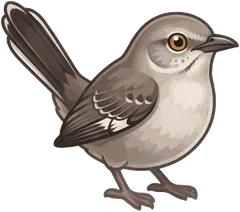
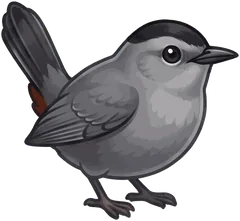
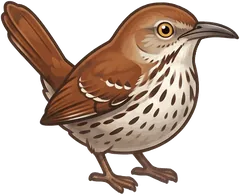
Count the repeats. A Northern Mockingbird sings each phrase three or more times before moving on. A Brown Thrasher sings each phrase twice, sometimes three times. A Gray Catbird sings most phrases only once, in a raspy jumble with no steady rhythm. The calls back it up: a harsh chack from the mockingbird, a loud, kissing smack from the thrasher, a cat-like mew from the catbird. In view, the mockingbird is pale gray with white wing flashes, the catbird lead gray, the thrasher foxy brown.
Side by side
| Northern Mockingbird | Gray Catbird | Brown Thrasher | |
|---|---|---|---|
| Repeats | Each phrase three or more times | Most phrases once | Each phrase twice, sometimes three times |
| Song | Long series of musical and grating phrases, many copied | Raspy, rambling jumble, less musical than a mockingbird's | Loud, complex chain of short phrases; over 1,000 song types |
| Call | Harsh chack | Cat-like mew | Loud smack, like a quick kiss |
| Habit | Sings all day in nesting season, often all night | Sings from inside a bush or small tree | Sings from an open perch, often a high treetop |
| Looks | Pale gray, white wing patches and outer tail feathers | Lead gray, darker crown, rusty under the tail | Reddish brown, streaked breast, yellow eyes |
| Size | 8 to 10 inches | About 8 to 9.5 inches | About 9.3 to 12 inches |
| Where and when | Towns, lawns, hedges and farms; many stay all winter | Dense thickets east of the Rockies; most leave in fall | Shrubby edges in the East and center; northern birds migrate |
By ear: count the repeats
All three are mimids, the family of mockingbirds and thrashers, and all three mix borrowed material into long, varied songs, so what a bird copies tells you less than how it repeats. Count how many times each phrase comes before the bird switches.
Three or more: mockingbird. The Northern Mockingbird sings a long series of musical and grating phrases, each repeated at least three times, so the song comes in insistent little bursts: this, this, this; that, that, that. It copies other birds freely, and in the nesting season it may sing all day and much of the night. A medley of tripled phrases at two in the morning is very likely a mockingbird.
Two, sometimes three: Brown Thrasher. The thrasher's song is a loud, complex chain of short phrases, one or a few notes each, and each phrase comes two or three times in a regular pattern. A male may have the largest repertoire of any bird in North America, more than 1,000 song types, and he works through them for minutes at a time, often from the top of a tall tree.
Once: catbird. The Gray Catbird sings most phrases a single time and moves on, so its song never settles into a pattern you could tap your foot to. It is raspier and less musical than a mockingbird's, often with a loud mewing note dropped in. Catbirds copy other birds, tree frogs and mechanical noises, usually from inside a bush where you cannot see them.
Between songs the calls are the easy part. The mockingbird gives a harsh chack. The thrasher gives a loud smack, very like a quick kiss. The catbird gives the cat-like mew that named it.
By sight: gray, darker gray or brown
A mockingbird is slim and long-tailed, 8 to 10 inches long, pale gray with white wing patches and white outer tail feathers that flash when it flies. On a lawn it often runs a few feet, stops and half opens its wings to show the patches. Young mockingbirds have dark streaks on the chest and can look a bit like a thrasher.
A catbird is about the same length or a little shorter, plain lead gray all over, with a darker crown and a patch of rusty chestnut under the tail. No white wing patches, no streaks.
A Brown Thrasher is the biggest of the three, up to a foot long, and the only brown one: bright reddish brown above with gray cheeks, pale below with heavy dark streaks, a long rufous tail, a long downcurved bill and brilliant yellow eyes. It stays on or near the ground, sweeping leaf litter aside with its bill. The usual mix-up is the Wood Thrush, which is chunkier, with round spots instead of streaks, dark eyes and a much shorter tail.
Where you will meet each one
The mockingbird is the town bird of the three: houses, farms, roadsides, brushy edges, suburban lawns and hedges. It is very common in towns and cities, especially in the South, and has spread north in recent decades. Some move south in fall, but others stay all winter even at the northern edge of the range, so its chack is a cold-weather sound too.
The catbird lives across most of temperate North America east of the Rocky Mountains, but in most of that range only from spring to fall. Most birds leave in September or October for the southeastern United States, Mexico, Central America and the Caribbean, though a few now stay into midwinter as far north as Ohio. It wants dense, preferably thorny growth such as scrub, woodland edges and overgrown farmland, not deep forest or pine woods.
The Brown Thrasher is common across the eastern and central United States and southern Canada, the only thrasher that lives mainly east of the Rockies and central Texas. Southern birds stay all year; northern ones migrate short distances at night. Look for it in thickets, brush and shrubby edges, including yards with thick shrubs. It is the state bird of Georgia.
Across much of the East all three can share the same brushy edge in summer. Then the count decides.
 Still not sure which one is outside? Warble listens while it sings and tells you, then adds the card to your album. Get the app free.
Questions people ask
How do you tell a mockingbird from a brown thrasher by song?
Count the repeats. A mockingbird says each phrase three or more times; a Brown Thrasher says each phrase twice, sometimes three times. The calls differ too: a harsh chack from the mockingbird, a loud, kissing smack from the thrasher.
Which mimic sings all night?
The Northern Mockingbird. In the nesting season it can be heard all day and often all night as well. A medley of phrases in the dark, each repeated three or more times, is very likely a mockingbird.
Sources
- Missouri Department of Conservation field guide: Brown Thrasher (repeat counts of all three mimics, calls, habitat). mdc.mo.gov/discover-nature/field-guide/brown-thrasher
- National Audubon Society, Guide to North American Birds: Northern Mockingbird. www.audubon.org/field-guide/bird/northern-mockingbird
- Wikipedia: Gray catbird (song compared with mockingbird and thrasher, range, migration, habitat, name). en.wikipedia.org/wiki/Gray_catbird
- Wikipedia: Brown thrasher (repertoire, calls, plumage, range). en.wikipedia.org/wiki/Brown_thrasher