 Warble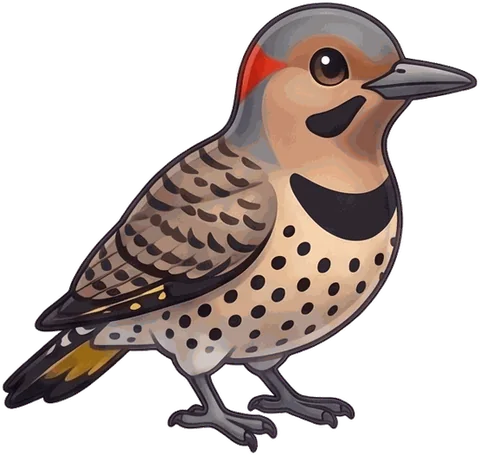
A Northern Flicker sounds like a long, loud, even laugh, wick-wick-wick-wick-wick or ki-ki-ki-ki, that can run on for many seconds from a treetop or a pole in spring. Its single call is a loud kleeer or klee-yer, a sharp whistle that drops in pitch. Up close, two flickers facing off or courting trade a squeaky wicka-wicka-wicka or flicka-flicka, the sound that gave the bird its name. Flickers also drum, often on metal, and you will hear all of this from open woods, parks and lawns across the whole country.
The birder's mnemonic
“wicka-wicka-wicka (or flicka-flicka-flicka)” That squeaky phrase is the close-range courtship and rivalry call, not the long laugh; when you hear it, look for two birds bobbing their heads at each other.
What the song sounds like: the long laugh
The flicker's spring announcement is a series of identical notes, wick wick wick wick wick, delivered fast and steadily for several seconds at a time. It is loud enough to carry across a park and has a laughing quality, which is why it is often confused with the Pileated Woodpecker. The flicker's version is thinner and flatter: it lacks the Pileated's ringing resonance and volume, and it holds one pitch rather than rising and falling.
The other named sound is the one people write as wicka-wicka-wicka, flicka-flicka or woika-woika. It is softer and squeakier, given by two birds close together, and it comes with a show: the birds swing their heads back and forth, point and bob their bills, flick their wings open and fan their tails so the yellow or red undersides flash. Rivals and courting pairs do the same dance, so the call means either a fight or a wedding.
The call: a loud kleeer
The everyday call is a single loud kleeer or klee-yer, a sharp whistle that slides downward. You hear it from a bird flushed off a lawn, from one landing on a snag, and at random through the day in every season. Flickers also call in flight. Once learned, the kleeer is one of the easiest bird sounds in North America to pick out, and it is often the first clue that the brown bird that just bounded away from the sidewalk was a woodpecker.
When and where you hear it
Flickers live from Alaska and Canada south through the entire United States to Nicaragua. There are two forms: the Yellow-shafted Flicker of the East and North, and the Red-shafted Flicker of the West, which meet and interbreed on the Great Plains. Northern Yellow-shafted birds are strong migrants, streaming east and then south each fall with big flights along the Atlantic coast, while Red-shafted birds mostly just drop from the mountains to the lowlands. Across most of the country a flicker is a year-round bird, but the long laugh belongs to spring and early summer.
This is the woodpecker you see on the ground. Flickers hop across lawns, pastures and forest floors hunting ants, and they probably eat more ants than any other North American bird; ants can be almost half the diet, licked up with a tongue that reaches two inches past the bill. They also take beetles, termites and caterpillars, and in fall and winter more than half the food is fruit and seeds: poison ivy, dogwood, sumac, cherry, hackberry and elderberry. They need open ground plus some trees, so open forests, woodlots, groves, farmland, towns and suburbs suit them, and dense unbroken forest does not.
The nest is a cavity in dead wood, often pine, cottonwood or willow, sometimes a utility pole, with an entrance about three inches across and a chamber more than a foot deep. Both sexes dig it and both incubate the five to eight white eggs for a little under two weeks; the young leave after about four weeks. European Starlings compete hard for freshly dug flicker holes. In Warble the flicker is the state-bird card of the Alabama album.
The drum
Flickers drum in short bursts in spring to mark territory, and they are famous for choosing metal. A chimney cap, a stovepipe, a gutter or a transformer box amplifies the roll far beyond what a dead limb can, and a flicker will return to the same loud spot morning after morning. The drumming is a fast, even burst, and the bird pairs it with the long wick-wick-wick series, which does the rest of the advertising.
What it looks like
A big, brown woodpecker, 11 to 12 inches long with a wingspan of 17 to 20 inches, that does not look like a woodpecker at first. The back is brown barred with black, the belly beige with round black spots, and there is a black crescent across the chest. In flight the white rump flashes and the underwings and tail light up yellow (Yellow-shafted) or salmon pink (Red-shafted). Eastern birds have a tan face, gray crown and a red crescent on the nape, and the male wears a black mustache; western birds have a gray face, brown crown and no red nape, and the male's mustache is red. Females of both forms have no mustache.
Alabama calls it the yellowhammer and adopted it as the state bird in 1927. The nickname goes back to the Civil War, when it was applied to Confederate soldiers from Alabama, and it is only one of more than a hundred folk names the bird has collected, among them clape, harry-wicket, heigh-ho, wake-up, yarrup and gawker bird.
Birds that sound similar
 Pileated Woodpecker
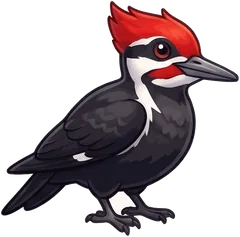
The Pileated Woodpecker's cuk-cuk-cuk-cuk is the flicker's closest match, but it is louder, deeper and more resonant, and it rises and then falls in pitch while the flicker's laugh stays level.
 Red-bellied Woodpecker
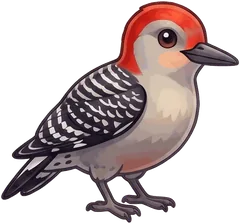
The Red-bellied Woodpecker's churrrr is a rolling trill, and its chuck-chuck-chuck is short and descending. Neither runs on as long or as evenly as a flicker's wick-wick-wick.
 Red-headed Woodpecker
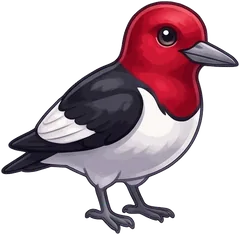
The Red-headed Woodpecker's kweeer is a single hoarse descending call much like the flicker's kleeer, but rougher. The flicker's is a cleaner whistle.
Where the Northern Flicker card lives
In Warble the same bird can be an easy card in one state and a prized one in another, because each album ranks its birds by how often people really report them there. The Northern Flicker appears in 48 state albums:
 Heard one? Open Warble, tap the green button while it sings, and the Northern Flicker card flips into your album. Get the app free.
Questions people ask
What is Alabama's state bird?
The Northern Flicker, known in Alabama as the yellowhammer, adopted in 1927. The nickname dates to the Civil War, when it was used for Confederate soldiers from Alabama, and the state itself is called the Yellowhammer State.
Why is a flicker called a flicker?
For its call. The squeaky flicka-flicka or wicka-wicka that two birds trade during courtship and rivalry gave the bird its name. Other folk names such as wake-up, wick-up and yarrup come from the same sound.
Why is a woodpecker on the ground in my yard?
It is almost certainly a flicker eating ants. Flickers feed on the ground more than any other North American woodpecker, hopping across lawns and probing anthills with a tongue that reaches two inches past the bill. The white rump when it flies confirms it.
Why is a flicker drumming on my chimney?
Because it is loud. Flickers drum in spring to claim territory and pick the most resonant surface available, and metal chimney caps, stovepipes and gutters carry the sound much farther than wood. It stops once nesting is under way.
Sources
- National Audubon Society, Guide to North American Birds: Northern Flicker. www.audubon.org/field-guide/bird/northern-flicker
- Wikipedia: Northern flicker (calls, plumage, diet, folk names, Alabama) and List of U.S. state birds (Alabama, 1927). en.wikipedia.org/wiki/Northern_flicker
- Animal Diversity Web: Colaptes auratus (calls, nesting, behavior). animaldiversity.org/accounts/Colaptes_auratus/
- Missouri Department of Conservation, Field Guide: Northern Flicker. mdc.mo.gov/discover-nature/field-guide/northern-flicker