 Warble
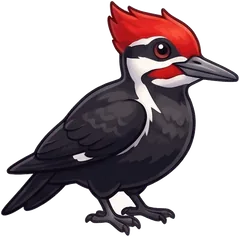
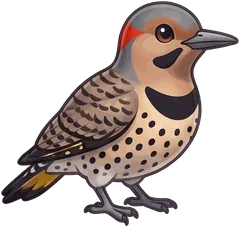
Both give a long, laughing series of notes, so listen to its shape. A Pileated Woodpecker's cuk-cuk-cuk-cuk-cuk is loud and rises, then falls in pitch and volume. A Northern Flicker's ki-ki-ki-ki holds steady, and the flicker adds a loud, single kleeer. The drums differ too: the Pileated's territorial drum is a slow, deep roll of about three seconds on a hollow tree, while flickers drum in short bursts and often pick metal for the extra noise. By sight it is easy: a crow-sized black bird with a red crest, or a brown, spotted one with a white rump.
Side by side
| Pileated Woodpecker | Northern Flicker | |
|---|---|---|
| Main call | Loud cuk-cuk-cuk-cuk-cuk, rising and then falling in pitch and volume | A sustained laugh, ki-ki-ki-ki, flat or rising |
| Other calls | A cuk alarm; woick in courtship | A loud kleeer; a repeated wicka-wicka-wicka |
| Drum | Slow, deep roll of about 3 seconds, on hollow trees | Short bursts, on trees or on metal when available |
| Size | 16 to 19 inches, about as big as a crow | Roughly a foot long |
| Color | Black, with a red crest and a white stripe down the neck | Brown, barred back, black chest patch, spotted belly |
| In flight | Big white patches under the wings | White rump; yellow or salmon-pink under the wings and tail |
| Where it feeds | Chisels big rectangular holes in dead wood for carpenter ants | Often on the ground, probing for ants |
| Where and when | Mature forest and big-tree woodlots; stays all year | Open woods, yards, parks and towns; northern birds migrate |
By ear: the shape of the laugh
Both of these woodpeckers have a loud, laughing call, which is why they get mixed up. Audubon even describes the Pileated's call as flicker-like. The difference is in the shape. A Pileated runs off a fast cuk-cuk-cuk-cuk-cuk that climbs in pitch and volume, then falls away at the end, like a laugh that builds and fades. A flicker's version, written ki-ki-ki-ki, is a sustained, even series that holds its pitch or rises a little and simply keeps going. Wikipedia's account of the flicker goes further and calls its laugh quite different from the Pileated's.
The other calls are just as useful. A flicker also gives a single loud kleeer and a loud, repeated wicka-wicka-wicka, and in territorial and courtship displays it swings its head, flicks its wings and fans its tail to flash the bright color underneath. The Pileated's alarm is a cuk note, given when a hawk shows up, and courting pairs exchange woick calls. So a single loud kleeer from a lawn or a pole points to a flicker.
The drum: a slow roll or a short burst
Both birds drum to claim territory, and the drums are the second way to separate them by ear. The Pileated's territorial drum is a fairly slow, deep roll that lasts about three seconds. It picks hollow trees because they ring the loudest. During courtship it also gives a shorter display drum of around ten taps.
Flickers drum in short bursts, in spring, and they want volume above everything else, so they drum on metal whenever they can find it. Drumming on metal is a flicker trademark: if the noise is coming off your roof or a gutter, think flicker first. If it is a long, deep roll out of mature forest, think Pileated.
By sight: black and red, or brown and spotted
Seen well, these two look nothing alike. The Pileated Woodpecker is the largest woodpecker in North America, 16 to 19 inches long and about the size of a crow, mostly black with a red crest and a white stripe running down the neck. In flight, big white patches flash under the wings. Males have a red forehead and a red mustache stripe; on females both are black. The flicker is much smaller, roughly a foot long, brown with black bars on the back, a black patch across the chest and black spots on a beige belly.
The flicker's best mark is the white rump that flashes as it flies away, with a burst of color underneath: yellow under the wings and tail in the East and North, where it is called the Yellow-shafted Flicker, and salmon-pink in the West, the Red-shafted. Males of both forms wear a mustache, black in the East and red in the West.
Flickers are the only woodpeckers that frequently feed on the ground, hopping across lawns and probing for ants with a tongue that reaches about two inches past the bill. A Pileated chisels large, roughly rectangular holes into dead wood to get at carpenter ants, which can make up 60 percent of its diet, and it tears into stumps and fallen logs.
Where you will meet each one
The Pileated Woodpecker is a permanent resident, and pairs keep their territories all year. It breeds across Canada, the eastern United States and parts of the Pacific Coast, in mature forest with big trees, from southern swamps to old Douglas-fir stands, and in smaller woodlots and wooded parks as long as some large trees remain. Forest clearing cut its numbers in the East in the 1700s and 1800s, and it has been recovering since about 1900.
The Northern Flicker ranges from Alaska to Nicaragua and wants open ground near trees: open woods, forest edges, groves, yards, parks and towns. It avoids dense, unbroken forest, the very place the Pileated likes best. Yellow-shafted birds from Alaska and Canada are strong migrants, with big daytime flights down the Atlantic Coast in fall, while Red-shafted birds mostly move shorter distances. So the setting is a fair hint: open lawns and yards suit the flicker, big timber suits the Pileated.
 Still not sure which one is outside? Warble listens while it sings and tells you, then adds the card to your album. Get the app free.
Questions people ask
Which woodpecker laughs, the Pileated or the flicker?
Both do. The flicker gives a long, even ki-ki-ki-ki; the Pileated a loud cuk-cuk-cuk-cuk that rises and then falls in pitch and volume.
Why is a woodpecker drumming on my metal chimney?
Most likely a Northern Flicker claiming territory. Flickers drum for maximum loudness, and metal is louder than wood, so they choose metal objects when they can. The drumming comes in short bursts, mostly in spring.
Is a Pileated Woodpecker bigger than a flicker?
Much bigger. The Pileated is 16 to 19 inches long, about the size of a crow, and is the largest woodpecker in North America. A flicker is roughly a foot long.
Sources
- National Audubon Society, Guide to North American Birds: Pileated Woodpecker. www.audubon.org/field-guide/bird/pileated-woodpecker
- National Audubon Society, Guide to North American Birds: Northern Flicker. www.audubon.org/field-guide/bird/northern-flicker
- Wikipedia: Pileated woodpecker (calls, drumming, feeding holes, range). en.wikipedia.org/wiki/Pileated_woodpecker
- Wikipedia: Northern flicker (laugh call, drumming on metal, ground feeding, plumage). en.wikipedia.org/wiki/Northern_flicker