 Warble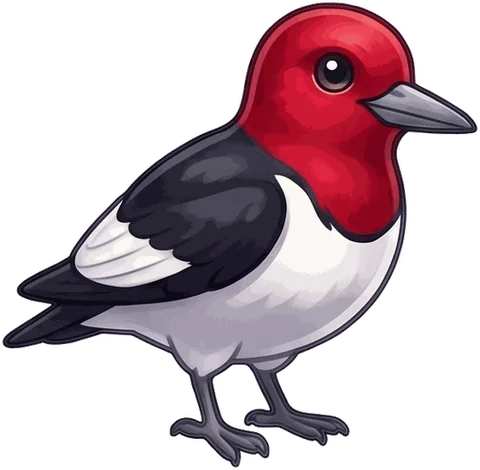
A Red-headed Woodpecker sounds like a loud, hoarse kweeer or queer that drops in pitch, a call that carries across an open field and sounds more like a shout than a woodpecker note. It also gives a rougher churr-churr and a repeated yarrow-yarrow-yarrow, and adults churr when a hawk or a snake is near. There is no song; the male drums to claim territory, and courting pairs tap back and forth at the nest hole. Listen in open country with dead trees across the eastern and central United States, spring through fall.
What the song sounds like: kweeer
The signature sound is a single loud kweeer, also written queer or tchur, that starts high and slides down. It is harsher and more abrupt than the rolling churr of a Red-bellied Woodpecker, and because Red-headed Woodpeckers live in open places, groves, savannas and roadside fence lines, it travels a long way. A bird often calls from the top of a dead tree or a utility pole, so once you hear it, finding the caller is easy.
Two other calls are common. A rough churr-churr serves as the everyday contact note and turns into a steady churring alarm when a predator shows up. The yarrow-yarrow-yarrow is a longer, repeated phrase you hear most in the breeding season. Red-headed Woodpeckers are noisy, quarrelsome birds that chase rivals and even destroy the nests of other birds nearby, and much of that action comes with sound effects.
The call at the nest: tapping duets
Courtship here is percussive. When a male has picked a cavity site, the female signals that she accepts it by tapping on it, and pairs go on with mutual tapping, the male inside the hole and the female outside, drumming softly back and forth. Young in the nest and after fledging beg loudly, and a pair with a second brood started while still feeding the first can make a grove sound crowded in July.
When and where you hear it
The range runs from the Rocky Mountains east to the Atlantic and from southern Canada south to Texas, the Gulf Coast and Florida. Unlike most woodpeckers, this one migrates: northern birds leave by late October, travel by day in short hops, never go farther than the southeastern states, and return by late April. Southern birds stay put. Where a bird winters depends on the acorn and beechnut crop that year, so a woods that was full of them one winter may be empty the next.
Look for open country with scattered big trees and plenty of dead ones: oak groves, farm country, orchards, open pine woods, river bottoms, burned areas and town shade trees. This is the most omnivorous of North American woodpeckers and, for a woodpecker, an unusual hunter: it sits on a branch or a pole, watches for a flying insect and darts out to catch it in the air, and it also drops to the ground for beetles, grasshoppers and earthworms. Nuts, seeds and fruit make up roughly two thirds of the diet, and in fall the birds stash acorns and other nuts in crevices and cavities, breaking them to fit and sometimes sealing the cache with wood chips. Only a few other woodpeckers store food this way. They will take eggs and nestlings from bluebird and chickadee nests too.
The male does most of the digging on the nest cavity, in a dead tree, a pole or a fence post, anywhere from near the ground to more than 60 feet up. The female lays four or five white eggs; both parents incubate, the male at night, and the young fledge after about four weeks. Roadside flycatching costs this bird dearly, since swooping birds are often hit by cars. In Warble it is a scarcer card than the Red-bellied in most eastern albums, which matches what has happened in the wild.
The drum
The male drums to advertise a territory, and both sexes use drumming and calls in territorial fights, courtship and contact between mates. Dead trees and utility poles are the usual instruments, and the bird favors open sites where the sound carries. Along with the soft tapping duets at the cavity, drumming stands in for the song this species never developed.
What it looks like
There is nothing subtle about an adult: the whole head, neck, throat and upper breast are deep red, the back and tail are black with a blue gloss, and the belly, rump and a broad patch on the rear of each wing are pure white. In flight the white patches flash like signal flags. Males and females look the same. The bird is about nine to ten inches long, robin-sized, and weighs two to three and a half ounces.
Young birds are the ones that confuse people. A juvenile has a brownish gray head and a dark bar across each white wing patch, and the red comes in gradually over the first winter, so a fall bird may be blotchy. If the head is red only on top and the back is barred, you are looking at a Red-bellied Woodpecker, not a Red-headed.
Once one of the commonest birds of the East, the Red-headed Woodpecker lost roughly two thirds of its population between the 1960s and the 2000s. The causes are the removal of dead trees, competition for nest holes from European Starlings, introduced in the 1890s, and cars. Numbers have steadied enough that the species was moved from near threatened to least concern in 2018, with about 1.8 million birds. Landowners who leave dead trees standing help more than anything else.
Birds that sound similar
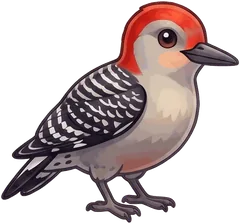 Red-bellied Woodpecker
The Red-bellied Woodpecker's churrrr is a rolling, even trill given over and over. The Red-headed's kweeer is a single hoarse shout that falls in pitch.
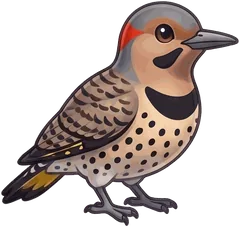 Northern Flicker
A Northern Flicker's kleeer is also a loud single descending call, but it is a cleaner whistle. The Red-headed's version is rougher, and flickers add a laughing wicka-wicka-wicka that Red-headeds never give.
Where the Red-headed Woodpecker card lives
In Warble the same bird can be an easy card in one state and a prized one in another, because each album ranks its birds by how often people really report them there. The Red-headed Woodpecker appears in 19 state albums:
 Heard one? Open Warble, tap the green button while it sings, and the Red-headed Woodpecker card flips into your album. Get the app free.
Questions people ask
What does a red-headed woodpecker sound like?
A loud, hoarse kweeer that drops in pitch, plus a rough churr-churr and a repeated yarrow-yarrow-yarrow. It has no song. Males drum on dead trees and poles, and courting pairs tap softly back and forth at the nest hole.
Why are red-headed woodpeckers so rare now?
The population fell by roughly two thirds from the 1960s to the 2000s. Dead trees that held nest holes were cut down, European Starlings took over many of the cavities that remained, and birds swooping after insects along roads are often hit by cars. Numbers have since stabilized somewhat.
Do red-headed woodpeckers migrate?
Partly. Birds in the north leave by late October and spend the winter in the southeastern states, flying by day and never leaving the country, then return by late April. Southern birds stay all year. Winter numbers in a given place track the acorn and beechnut crop.
Is a red-headed woodpecker the same as a red-bellied woodpecker?
No. The Red-headed has a completely red head, a solid black back and a white belly. The Red-bellied has red only on the crown and nape, a black-and-white barred back and a gray front. The Red-bellied is far more common in most yards.
Sources
- National Audubon Society, Guide to North American Birds: Red-headed Woodpecker. www.audubon.org/field-guide/bird/red-headed-woodpecker
- Wikipedia: Red-headed woodpecker (measurements, migration, caching, decline). en.wikipedia.org/wiki/Red-headed_woodpecker
- Missouri Department of Conservation, Field Guide: Red-headed Woodpecker. mdc.mo.gov/discover-nature/field-guide/red-headed-woodpecker
- Animal Diversity Web: Melanerpes erythrocephalus (communication, foraging, nesting, threats). animaldiversity.org/accounts/Melanerpes_erythrocephalus/