 Warble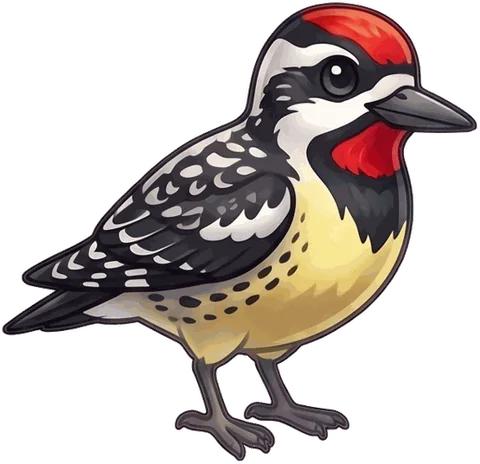
A Yellow-bellied Sapsucker sounds like a cat somewhere in the trees: a nasal, whining mew or neaaah that drops in pitch, usually not loud. In spring on the breeding grounds it adds a squealing kwee-urk and a run of wee-wee-wee-wee notes, and family members greet each other with week week or wurp wurp. The drum is the giveaway: instead of an even roll, a sapsucker taps in a stuttering, irregular rhythm, tap-tap, tap-tap-tap, tap, tap-tap-tap, like Morse code. For most Americans it is a quiet fall and winter visitor found by its rows of holes.
What the song sounds like: mews and squeals
This is not a loud bird. Its calls are a set of squealing, whining notes that most people hear only once they know to listen: a descending, cat-like mew or neaaah, a two-part owee-owee, a series of wee-wee-wee-wee, and a scratchy kwee-urk that serves as the territorial call on the breeding grounds. Audubon sums it up as mewing and whining. In April and May a nesting pair in a northern aspen grove is noisy, with cat calls and bursts of drumming through the morning.
Pairs meeting at the nest give soft quirk quirk notes with head bobbing, and a family group keeps in touch with week week and wurp wurp. A soft mew means mild alarm; a shrill quarr means two birds are fighting.
The call in winter: mostly silence
On the wintering grounds, which is where most of the United States meets this bird, a sapsucker is close to mute. It works its sap wells quietly and slips around the far side of the trunk when watched. The occasional mew and the evidence on the bark are what you have to go on, and the Gray Catbird in the same hedge is a more likely source of a loud meow.
When and where you hear it
The Yellow-bellied Sapsucker is the most migratory woodpecker in eastern North America, and its summer and winter ranges hardly overlap at all. It breeds across Canada, eastern Alaska, the Great Lakes states and New England in mixed woods, especially around aspen, and winters from the southeastern United States south through Mexico and Central America to the West Indies. Birds from the northwest of the range fly east and then south. In Missouri it is present from mid-September to the end of April, with peaks in October and March, and that pattern holds for much of the middle of the country: a migrant and a winter bird, gone all summer.
It earns its name. A sapsucker drills small holes through the bark in neat horizontal rows to find sap, then adds vertical columns of feeding holes above the best ones, and returns through the day to lick up the sap and eat the insects it attracts, plus bits of the inner bark. In summer it favors paper birch, red maple, serviceberry and bigtooth aspen; in winter and early spring it turns to pines, spruces and firs; hickory, willow and poplar get tapped too. Insects are about half the diet during nesting, sap dominates in late summer and fall, and fruit fills in from October to February. Hummingbirds, squirrels and other birds drink at the wells, and in early spring hummingbirds often get their first meals of the year from sapsucker holes before any flowers open.
The nest is a cavity in a live deciduous tree with a rotten heart, very often a quaking aspen infected with tinder fungus, 6 to 60 feet up; the same tree may be reused. The female lays four to seven white eggs, both birds incubate for 10 to 13 days, the male taking the nights, and the young fledge after 25 to 29 days. Heavy drilling can girdle a small tree, though mature trees usually shrug it off. In Warble the sapsucker is a fall and winter card for most of the East and South.
The drum: Morse code
Most woodpeckers drum in an even roll. The sapsucker does not. Its drum starts as a quick burst and then slows into scattered, uneven taps, tap-tap, tap-tap-tap, tap, tap-tap-tap, which is why every field guide reaches for Morse code. A bout lasts from about one and a half to five seconds. The bird picks dead trees and other surfaces that ring, and the drum works as long-distance signaling between birds rather than marking a nest site. Hear that broken rhythm in a northern woods in spring and you can name the drummer without seeing it.
What it looks like
A medium-small woodpecker, seven to almost nine inches long, with a wingspan around fourteen inches and a weight under two ounces. The face is boldly striped black and white with a bright red forehead; the back is mottled black and white; a long white stripe runs down the folded wing, the mark that separates it from a Downy or Hairy at a glance; the rump is white; and the belly carries the pale yellow wash of the name. The male has a red throat, the female a white one. Juveniles are brownish and dusky all over with a striped head and a barred tail, and that is the plumage most people see in fall.
The mottled back blends into sap-darkened bark surprisingly well. Look instead for the rows of holes, then check the tree above them.
Birds that sound similar
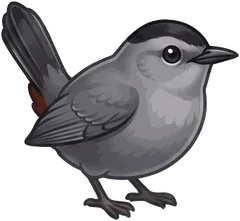 Gray Catbird
The Gray Catbird's call is also a cat-like mew, but it is louder and comes from low in a thicket, and the catbird sings a long jumbled song. A sapsucker's mew is softer, comes from a trunk and never turns into song.
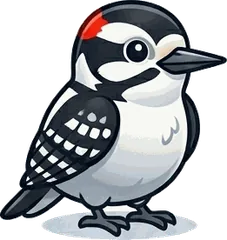 Downy Woodpecker
The Downy's drum is a short, even roll and its rattle tumbles down in pitch. The sapsucker's drum is stuttering and irregular, and its calls are nasal mews and squeals rather than a pik.
Where the Yellow-bellied Sapsucker card lives
In Warble the same bird can be an easy card in one state and a prized one in another, because each album ranks its birds by how often people really report them there. The Yellow-bellied Sapsucker appears in 23 state albums:
 Heard one? Open Warble, tap the green button while it sings, and the Yellow-bellied Sapsucker card flips into your album. Get the app free.
Questions people ask
What does a yellow-bellied sapsucker sound like?
Mostly a nasal, cat-like mew that drops in pitch, plus squealing notes such as kwee-urk and wee-wee-wee-wee in spring. Its drum is unmistakable: an uneven, stuttering series of taps that sounds like Morse code rather than a steady roll.
Will a sapsucker kill my tree?
Usually not. Heavy drilling can girdle a small tree by cutting off sap flow, but mature trees normally tolerate the holes. Wells drilled in neat rows are the sign, and hummingbirds, squirrels and other birds often feed at them too.
Where do yellow-bellied sapsuckers go in summer?
North. They breed in Canada, eastern Alaska, the Great Lakes states and New England, favoring aspen groves in mixed woods. Across most of the United States they are present only from about September to April, which is why so few people ever hear them call.
How do you tell a sapsucker from a downy woodpecker?
Look for the long white stripe down the folded wing and the red forehead; a Downy has a white back stripe and white wing spots instead. By ear, a sapsucker mews and drums in broken Morse-code bursts, while a Downy says pik and drums in an even roll.
Sources
- National Audubon Society, Guide to North American Birds: Yellow-bellied Sapsucker. www.audubon.org/field-guide/bird/yellow-bellied-sapsucker
- Wikipedia: Yellow-bellied sapsucker (calls, drumming, sap wells, nesting). en.wikipedia.org/wiki/Yellow-bellied_sapsucker
- Missouri Department of Conservation, Field Guide: Yellow-bellied Sapsucker. mdc.mo.gov/discover-nature/field-guide/yellow-bellied-sapsucker
- Animal Diversity Web: Sphyrapicus varius (communication, diet, breeding). animaldiversity.org/accounts/Sphyrapicus_varius/