 Warble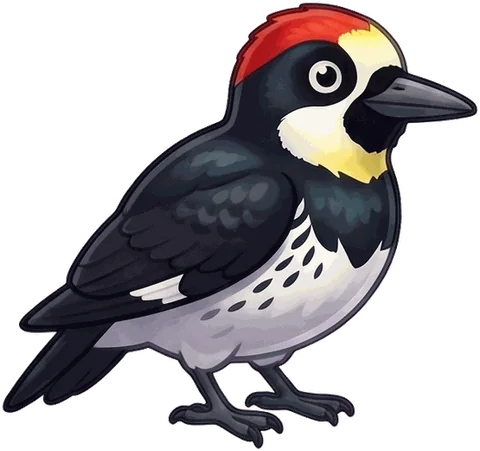
An Acorn Woodpecker sounds like a small crowd laughing at the same joke. The main call is a loud, rising ja-cob, ja-cob or wake-up, wake-up, often written waka-waka, and because these birds live in family groups of a dozen or more, you usually hear several at once, trading the call back and forth from the top of an oak. The laughing quality is famous: Woody Woodpecker's laugh is believed to be modeled on it. Listen in oak woodlands from Oregon and California through the Southwest and into Texas, all year round.
The birder's mnemonic
“ja-cob, ja-cob (or wake-up, wake-up)” Say it fast and nasal with the second syllable higher, then repeat it three or four times, and you have the call that gives the bird its laughing reputation.
What the song sounds like: the laugh
There is no song, but there is a lot of talk. The signature call is a loud two-note phrase repeated in a series, ja-cob, ja-cob, ja-cob or wake-up, wake-up, with the pitch rising through each phrase. It is nasal, emphatic and cheerful, and it sounds like laughter, which is why Walter Lantz is thought to have borrowed it for Woody Woodpecker (Woody's look, by contrast, is usually credited to the Pileated Woodpecker).
The call is social. Acorn Woodpeckers live in groups that can number up to 15 birds, and members greet each other, scold intruders and argue over granary holes with the same phrase, so a grove of oaks in California can sound like a party all afternoon. Add rattles, chatters and screams for fights and alarms, and this is one of the noisiest woodpeckers in the country.
The call: a group that never stops
Because the whole family defends one territory and one store of acorns all year, the calling never really has an off-season. A jay or a squirrel approaching the granary tree triggers a chorus. A returning group member is greeted. A neighboring group at the boundary is shouted at. If you hear one Acorn Woodpecker, wait a moment; the rest will announce themselves.
When and where you hear it
Acorn Woodpeckers live in the coastal areas and foothills of Oregon, California and the Southwest, in oak-pine country of Arizona, New Mexico and west Texas, and south through Mexico and Central America to Colombia. Washington holds a tiny population at the northern edge of the range along the Klickitat River. They are permanent residents. Individuals wander, and if the acorn crop fails a whole group may move down into lowland valleys for the fall and winter, but most groups stay on the same territory for years.
The habitat is oaks: oak woodland, oak groves in mixed forest, oak-pine canyons and foothills, plus parks and suburbs with big oaks. The birds do best where several oak species grow together, because different oaks have good and bad years at different times. Acorns are about half the diet, and more in a California winter; the rest is insects, especially flying ants caught on the wing from a high perch, plus sap, catkins, fruit, nectar and an occasional lizard or bird egg. Unlike most woodpeckers they rarely chisel into wood for food.
Breeding is a group affair. A typical nest has one breeding female and one to three cobreeding males, often brothers, helped by up to ten of their grown offspring; some groups run to seven breeding males and three females. When two or more females lay in the same cavity, each destroys the eggs already there until all of them are laying, and a joint clutch can hold as many as 17 eggs. Incubation takes about 11 days, every group member feeds the young, and they fledge after 30 to 32 days. The cavity is dug in a dead tree or limb, usually 12 to 30 feet up, and reused for years. In Warble the Acorn Woodpecker is a signature card of the California and Southwest albums.
The drum, and the granary
Acorn Woodpeckers drum like other woodpeckers to mark territory, but the tapping you are most likely to hear from them is work, not display. Each group maintains a granary: a dead snag, a thick-barked pine, a utility pole, a fence post or the wooden trim of a house, drilled with hundreds to thousands of small holes, each one sized to hold a single acorn wedged in tight so a jay or squirrel cannot pull it out. The holes are drilled mostly in winter, in dead limbs and thick bark that will not leak sap, and the same granary grows year after year: an old one can hold up to 50,000 holes and serve a family for generations.
In fall the group harvests acorns and hammers them into the holes; through the winter they check the store and move shrinking acorns into smaller holes so they stay snug. That steady tapping and the constant traffic around one tree are the surest way to find a group.
What it looks like
A medium-sized woodpecker, seven and a half to nine inches long, with a wingspan of 14 to 17 inches, and a face like a clown: white forehead, black around the bill, a pale yellowish-white throat, glossy black back and chest, a white belly with black streaks, and staring white eyes. The male has a solid red cap running back from the white forehead; on the female a black band separates the white forehead from the red. Young birds start with dark eyes that turn white within a few months. In flight the white rump and a round white patch in each wing flash against the black.
Birds that sound similar
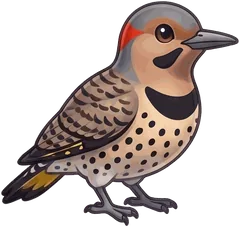 Northern Flicker
The Northern Flicker's wick-wick-wick is a long run of single notes on one pitch. The Acorn Woodpecker's ja-cob is a two-syllable phrase that rises, and it usually comes from several birds at once.
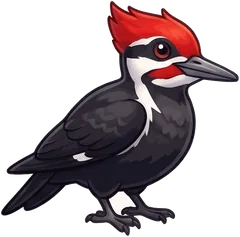 Pileated Woodpecker
The Pileated's cuk-cuk-cuk is a deeper, ringing single-note series from one bird in big timber. The Acorn Woodpecker's laugh is higher, nasal, two-parted and chorused from an oak grove.
Where the Acorn Woodpecker card lives
In Warble the same bird can be an easy card in one state and a prized one in another, because each album ranks its birds by how often people really report them there. The Acorn Woodpecker appears in 3 state albums:
 Heard one? Open Warble, tap the green button while it sings, and the Acorn Woodpecker card flips into your album. Get the app free.
Questions people ask
What does an acorn woodpecker sound like?
A loud, nasal, laughing ja-cob, ja-cob or wake-up, wake-up, repeated in a rising series and usually given by several birds together. It is the call Woody Woodpecker's laugh is believed to be based on.
Why do acorn woodpeckers put acorns in holes?
To get through the winter. Each family group drills a granary tree with hundreds to thousands of holes, harvests acorns in fall and wedges one into each hole so tightly that jays and squirrels cannot steal it. The group moves acorns to smaller holes as they dry. Old granaries can hold up to 50,000 holes.
Do acorn woodpeckers damage houses?
Sometimes. A group may adopt the wooden trim or siding of a building, or a utility pole, as a granary and drill it full of acorn holes, and they defend it. Leaving dead limbs and snags standing nearby gives them a better option.
Do acorn woodpeckers live in groups?
Yes, in family groups of up to 15. Most nests have one breeding female, one to three breeding males who are often brothers, and up to ten nonbreeding helpers, all sharing one cavity and one granary. When several females lay together the clutch can reach 17 eggs.
Sources
- National Audubon Society, Guide to North American Birds: Acorn Woodpecker. www.audubon.org/field-guide/bird/acorn-woodpecker
- Wikipedia: Acorn woodpecker (calls, granaries, cooperative breeding, Woody Woodpecker). en.wikipedia.org/wiki/Acorn_woodpecker
- Animal Diversity Web: Melanerpes formicivorus (diet, granaries, breeding). animaldiversity.org/accounts/Melanerpes_formicivorus/
- BirdWeb (Seattle Audubon): Acorn Woodpecker. www.birdweb.org/birdweb/bird/acorn_woodpecker