 Warble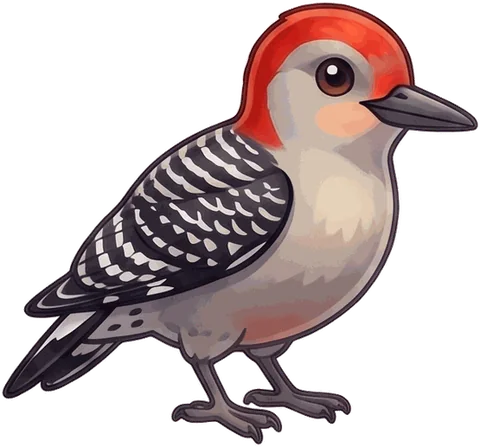
A Red-bellied Woodpecker sounds like a loud, rolling churrrr, harsh and a little musical, repeated over and over from the trees. Its other common call is a chuck-chuck-chuck that drops in pitch, and up close you may hear a dry, flat chif-chif. There is no song; in spring both sexes drum on hollow trees, utility poles and sometimes metal roofs and gutters instead. It is a year-round voice of eastern and central woodlands, parks and suburbs, and one of the most common woodpecker sounds east of the Great Plains.
What the song sounds like: the churr
If you learn one woodpecker sound in the East, make it this one. The churrrr is loud, rolling and slightly harsh, sometimes written churr-churr-churr or thrraa-thrraa-thrraa, and a bird will repeat it for minutes at a time, often with a shorter br-r-r-t mixed in. It has a bit of a trill to it, so it can sound almost musical from a distance and quite rough up close. Both sexes give it, all year, and it is the sound that most often gives away a Red-bellied working high in an oak.
Because the churr is so loud and so frequent, people who have never seen the bird usually know the noise. It is also the call most often mistaken for something exotic in a suburban yard, since it sounds too big and too tropical for a nine-inch bird with a mostly gray front.
The call: chuck-chuck-chuck and chif-chif
The second call is a series of chuck notes that steps down in pitch, chuck-chuck-chuck, often given between two birds. A drier, non-musical chif-chif serves as a short-range contact note. Begging young give a thin pree-pree-pree from the nest hole and, for weeks after fledging, from wherever the parents are working. Biologists count about six distinct calls in all.
When and where you hear it
Red-bellied Woodpeckers live year-round across the eastern and central United States, from the Great Plains to the Atlantic and from the Gulf Coast north to southern Ontario, Minnesota, Wisconsin, Michigan and New York. The range has been pushing north for decades. Birds do not migrate, though the northernmost ones may slip south in a hard winter, and each pair holds a territory all year, so the churr is as much a January sound as a May one.
The habitat is any woodland with big deciduous trees: forest near rivers and swamps, mixed woods, edges, farm groves, orchards, town parks and suburban shade trees. Feeders with suet and sunflower seed pull them in. They forage on trunks and limbs for insects, chiseling into bark and then reaching in with a long, barbed, sticky tongue, and they spend a good part of their time on dead or dying wood; a Red-bellied can strip most of the emerald ash borer larvae out of an infested ash. But more than half the diet in some seasons is plant food, acorns, nuts, fruit and seeds, and they climb out among the branches to pick it. Whatever they do not eat they wedge deep into cracks in bark or fence posts for later.
Nesting starts in April or May. Both birds dig the cavity, usually in dead wood but sometimes in a live elm, maple or willow, and lay two to six white eggs that hatch in about twelve days; the young leave after three and a half weeks and are fed for up to ten more. Population estimates run around 16 million and the trend is stable or rising slightly. In Warble the Red-bellied is a common card across every eastern album.
The drum
Like other woodpeckers, the Red-bellied drums instead of singing. Both sexes do it, males more often, to announce a territory and to keep a pair together. The sound is a steady, even roll, and the bird chooses the surface for volume: a hollow tree, a dead snag, a utility pole, and in the suburbs an aluminum roof, a metal gutter or a transformer box. A drum from a metal surface carries far and starts early in the morning, which is how most people first meet the bird.
What it looks like
About nine and a half inches long and two to three ounces, a medium-sized woodpecker with a back and wings finely barred in black and white and a pale gray face and underparts. The male wears a red band from the bill over the crown to the nape; the female has red only on the nape and a small patch above the bill. The red belly of the name is a faint blush low on the underparts that is hard to see in the field, which is why so many people call this bird a red-headed woodpecker by mistake. In its deeply undulating flight, a white patch shows near the tip of each wing.
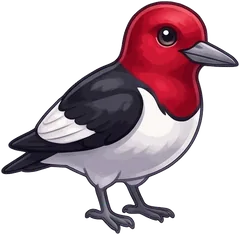
The real Red-headed Woodpecker has an entirely crimson head and neck, a solid black back and a clean white belly. If the head is only partly red and the back looks like a barcode, it is a Red-bellied.
Birds that sound similar
 Red-headed Woodpecker
The Red-headed Woodpecker also churrs, but its signature call is a loud kweeer or queer that drops in pitch, sharper and more like a shout than the Red-bellied's rolling trill.
 Northern Flicker
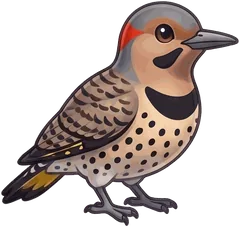
A Northern Flicker's kleeer is a single loud, descending whistle, and its wicka-wicka-wicka series is faster and laughing. Neither rolls the way a Red-bellied churr does.
 Downy Woodpecker
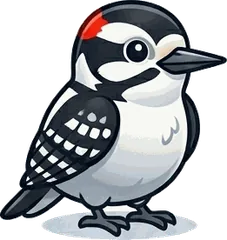
The Downy's whinny is a quiet, quick rattle that tumbles down in pitch. The Red-bellied churr is louder, lower and holds steady.
Where the Red-bellied Woodpecker card lives
In Warble the same bird can be an easy card in one state and a prized one in another, because each album ranks its birds by how often people really report them there. The Red-bellied Woodpecker appears in 37 state albums:
 Heard one? Open Warble, tap the green button while it sings, and the Red-bellied Woodpecker card flips into your album. Get the app free.
Questions people ask
Why is it called a red-bellied woodpecker when its head is red?
Because the name was given by someone holding the bird. There is a reddish wash on the lower belly, but it is faint and rarely visible in the field. The true Red-headed Woodpecker has a completely red head, a black back and a white belly.
Do red-bellied woodpeckers make noise all year?
Yes. They do not migrate and defend a territory year-round, so the churr and the chuck calls are heard in every month. Drumming is most obvious in spring, when pairs form and nesting begins in April or May.
What is the red-bellied woodpecker's churr?
A loud, rolling, slightly harsh trill, written churrrr or churr-churr-churr, repeated many times. It is the bird's most frequent call and carries well through the trees. Both males and females give it.
Do red-bellied woodpeckers store food?
Yes. They cache nuts, acorns, corn, fruit, seeds and even insects deep in cracks in bark and fence posts to eat later, especially in fall and winter. Plant food makes up more than half the diet in some seasons.
Sources
- National Audubon Society, Guide to North American Birds: Red-bellied Woodpecker. www.audubon.org/field-guide/bird/red-bellied-woodpecker
- Wikipedia: Red-bellied woodpecker (calls, drumming, plumage, feeding). en.wikipedia.org/wiki/Red-bellied_woodpecker
- Missouri Department of Conservation, Field Guide: Red-bellied Woodpecker. mdc.mo.gov/discover-nature/field-guide/red-bellied-woodpecker
- Animal Diversity Web: Melanerpes carolinus (range, caching, breeding, lifespan). animaldiversity.org/accounts/Melanerpes_carolinus/