 Warble
A Downy Woodpecker sounds like a quiet pik, a single short note that is easy to miss, and a descending rattle or whinny that speeds up and drops in pitch at the end, a bit like a ball bouncing to a stop. It has no true song. When pairs form in late winter, both the male and the female drum on dead limbs instead, a short, even roll that is slower than most other North American woodpeckers. You hear all three sounds in woodlots, parks and backyards across nearly all of the United States and Canada, all year long.
What the song sounds like: a whinny, not a tune
Woodpeckers do not sing, and the Downy is no exception. The closest thing it has to a song is the rattle, sometimes called a whinny: a run of pik notes strung together that gets faster and falls in pitch toward the end. The effect is a little like a small ball dropped on a hard floor, each bounce closer and lower than the last. It carries farther than the single call and is often the sound that tells you a Downy is in the neighbor's maple before you have found it.
The same rattle from the Downy's big look-alike, the Hairy Woodpecker, is louder and stays on one pitch instead of sliding downward. That difference is the most reliable way to separate the two by ear, and it is worth learning, because the birds look almost identical.
The call: a soft pik
The everyday note is a short, flat pik, quieter and less emphatic than the sharp peek of a Hairy Woodpecker. You hear it from a bird working a trunk, from one arriving at the suet, and in a run of scolding notes when a cat or a hawk is close.
When and where you hear it
The Downy is the most widespread woodpecker on the continent. It lives year-round from Alaska across Canada and south through almost all of the lower 48, missing only the dry Southwest deserts and the far northern tundra. Most birds never migrate; a few from the far north drift south in winter, and mountain birds in the West drop down to the valleys. So the pik and the whinny are winter sounds as much as spring ones.
Any place with deciduous trees will do: forests, woodlots, river groves, orchards, city parks and suburban shade trees. In conifer country the Downy sticks to aspen and willow stands. It forages on trunks, limbs, small branches and even weed stalks, hanging upside down from twigs too thin for any other woodpecker, and it comes readily to suet and sunflower seed. The diet is mostly insects, beetles, ants, gall wasps and caterpillars among them, plus seeds, berries and sap. In winter each bird sleeps in its own tree cavity.
Pairs dig a new cavity in a dead limb or snag, usually 12 to 30 feet up, and the female lays four or five white eggs that hatch after about twelve days. Old Downy holes are prized real estate afterward for chickadees, wrens and other birds that cannot dig their own. In Warble it is usually the first woodpecker card a new player catches in an eastern or midwestern album.
The drum
Drumming is the Downy's territorial announcement, the job a song does for a thrush or a wren. Both sexes do it. During pair formation a male and a female take turns drumming loudly on dead limbs on their separate territories while the male gradually works his way closer. The roll is short and even, and by woodpecker standards it is slow: Downies strike more slowly than most other North American species, so with practice you can pick the drum out by tempo alone.
They pick whatever resonates. Dead limbs are the natural choice, but woodpeckers of all kinds discover that a house works as an amplifier, and downspouts, chimney caps, antennas and siding all get used. Drumming happens where there are no insects at all; a woodpecker feeding on infested wood drills instead of rolling, and the two sound nothing alike.
What it looks like
The smallest woodpecker in North America, about six to seven inches long with a wingspan under a foot and a weight of around an ounce, roughly a sparrow with a chisel. The pattern is black and white: black wings with rows of white spots, a broad white stripe down the back, white underparts and a face striped black and white. The male has a small red patch on the back of the head; the female has none. Young birds show red on the crown instead.
To separate it from the Hairy Woodpecker, look at the bill first: the Downy's is stubby, much shorter than the head, while the Hairy's is nearly as long as its head. Then check size (a Hairy is robin-sized) and the outer tail feathers, which carry black spots or bars on a Downy and are plain white on a Hairy. The resemblance is a case of convergent evolution: the two are not close relatives, and in 2015 the Downy was moved to the genus Dryobates.
Birds that sound similar
- ?Hairy Woodpecker
The Hairy's peek is sharper and louder than the Downy's soft pik, and its rattle stays on one pitch instead of falling away at the end. If the call makes you flinch, think Hairy.
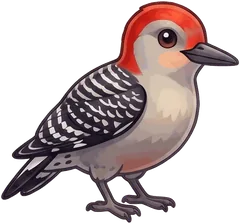 Red-bellied Woodpecker
A Red-bellied Woodpecker's loud, rolling churrrr is bigger and harsher than a Downy's whinny and holds its pitch instead of bouncing downward. Its chuck-chuck-chuck series does descend, but each note is fuller than a pik.
Where the Downy Woodpecker card lives
In Warble the same bird can be an easy card in one state and a prized one in another, because each album ranks its birds by how often people really report them there. The Downy Woodpecker appears in 48 state albums:
 Heard one? Open Warble, tap the green button while it sings, and the Downy Woodpecker card flips into your album. Get the app free.
Questions people ask
How do you tell a Downy Woodpecker from a Hairy Woodpecker by sound?
Listen to the rattle. The Downy's whinny gets faster and drops in pitch at the end; the Hairy's rattle is louder and holds one pitch. The single call notes differ the same way: a soft pik from a Downy, a sharp, loud peek from a Hairy.
Do Downy Woodpeckers sing?
No. Like other woodpeckers they have calls but no song. The descending rattle is the closest thing, and drumming on dead wood does the work of a song: claiming territory and attracting a mate. Both males and females drum.
Why is a woodpecker drumming on my house?
It has found something that resonates. Houses amplify a drum, and downspouts, chimney caps, antennas and siding carry the sound farther than a dead branch, which is the point when the bird wants to be heard. Drumming happens where there are no insects; feeding damage is a different, quieter kind of drilling.
Are Downy Woodpeckers around in winter?
Yes. Downies are permanent residents nearly everywhere they occur, and only the northernmost and highest-mountain birds shift a short distance in winter. They roost alone in tree cavities on cold nights and are among the most dependable visitors to suet feeders.
Sources
- National Audubon Society, Guide to North American Birds: Downy Woodpecker. www.audubon.org/field-guide/bird/downy-woodpecker
- Wikipedia: Downy woodpecker (measurements, calls, drumming, taxonomy). en.wikipedia.org/wiki/Downy_woodpecker
- Missouri Department of Conservation, Field Guide: Downy Woodpecker. mdc.mo.gov/discover-nature/field-guide/downy-woodpecker
- Penn State Extension: Woodpeckers (drumming on houses). extension.psu.edu/woodpeckers